Feeds:
Posts
Comments

Archive for the ‘article’ Category

Some months ago, Overland published an essay in which (as a scholar of Buddhist non-violent resistance) I detailed the now 120 self-immolations of Tibetan monks, nuns and lay-people, a number not including the case of an Englishman, a young man whom I knew and who was also an ordained monk in the same Tibetan Buddhist tradition as the majority of his Tibetan cohorts. He’d carried a Tibetan flag, in solidarity with the others, and burned to death on the same day in November 2012 as the transition to Chinese leadership of Xi Jinping. To this day his act, as a political statement, is denied and ignored by his own monastic establishment and organisation, and hence by the world at large.

I have also since found it near to impossible to garner interest in a longer, more detailed version of the Overland article, that itself engendered not a bare comment, from anyone, anywhere, and only a handful of tweets, ‘likes’ and shares – if these last are presumably meaningful indices for social utility or relevance. A man had self-immolated in principled conscience and solidarity with far too many others, and few cared to pay any attention. His friends and loved ones, at least in public forums, understood his act as a tragic loss. His suicide was recently privately commemorated, and has been laid to rest. End of story.

But the ephemerality of his demise, of my own honouring of it in the pages of Overland, and indeed of the 120 Tibetans whose plea for freedom has similarly slipped into marginalisation, made me think a little more about the nature of such sacrifice and what it means for the social polity. Because conditions now, in Australia, beg similar questions, in perhaps less stark, yet strangely more compromised ways because of our distance from extremity.

We like to think, in liberal society, that a fundamental concern for the other, especially the more vulnerable, lies at the very heart of the democratic welfare state. Our social policies, research programs and civil bodies are often designed to attend especially to the needs of the weak and needy, those who are unable, for a multitude of reasons, to manage their own successful negotiation of the economic, professional, and interpersonal imperatives of life in late-industrial capitalist society. Those who can’t quite play that game, as it is required to be played in order to meet the standards of life, both subjective and objective, that the social system will consensually judge as being a worthwhile one.

In other words, we care insofar as it comes inbuilt into our implicit agreement to the rules of this particular socio-economic game, along with all its other more or less explicit instrumental rules (paying taxes, fines, fees; entrusting personal data to the discretion of the state; accepting the terms of democratic governance, etc.). Within this consensual game, those who play well and fairly, as well as those who don’t, claim a conscious recognition of the values of universal human dignity, of equality of opportunity, of responsibility to her neighbour. We will assume every life as having an equally inviolable value and significance, worthy of respect, its sovereignty enshrined in a secular law of universal humanity that goes beyond mere legalism.

Yet these values are also the ones that leave us ambivalent about issues such as voluntary euthanasia, suicide (principled or otherwise) or, less often, abortion. How is it, we think, that life, of such intrinsic value, can be taken away, by ourselves, with impunity? Most of the editors and scholars who turned down my longer study of the Tibetan self-immolations (and their sole Western counterpart), presumably did so on the basis of some obscure but powerful sense that I was endorsing political suicide, or could be interpreted as doing the same.

Yet it was not a question of indulging some personal opinion of mine; it was a matter of the advertisement of fact. Still, the editors didn’t want to risk any taint of culpability; they thought that to uphold liberal freedom means to uphold the normative claim of the inviolability of life, that life must not be threatened, diminished or disvalued in any way. Of course, they are right.

Yet their moral concern, which also seemed like a moral diffidence, a feebleness, given the gravity of the sacrifices by the Tibetan and English monks, appeared to say a lot more about their own preservation of a certain sense of self than about a genuine concern for the recognition of Tibetan human rights. A curious paradox: we will express our true moral concern for Tibetan sovereignty by quietly downplaying the ultimate, radical sacrifices they, and now a Westerner, have made on its behalf: that’s how much concern we hold – enough to appear to not hold any concern at all.

No-one enjoys the thought of suicide, even that of a total stranger. At the same time no-one lives someone else’s life for them. Every day each of us passes in the street a few hundred or more lives that go on without us having the barest minimum of direct or meaningful influence, agency or onus over them. Each other’s life is their own affair, just as mine is to me.

What gives me cause to hold any moral guardianship over another’s life? On what basis can I possibly pretend to step in and claim some authority over the inviolable integrity or decisions of that life? It has never been, and never will be, my own life, no matter how close to or enmeshed in it I may become, no matter how deeply and richly I may have come to value and love the person whose life they embody.

We like to imagine we hold moral concern for the destinies of others’ lives, but this is not true. It is, more truthfully, an illusion of the liberal-democratic ego, perpetuated by post-Enlightenment liberal rationalism, codified in law and global institutions of the super-ego such as the UN. More accurately, more closer to reality, we could say we are essentially indifferent to the lives of others: indifference not as a value-judgement, but as a phenomenological truth. We have an ethical concern but not an existential concern. No readers responded to my essay, and no editors would touch its more developed thesis, just because they didn’t have that kind of concern, simply because they weren’t that interested in 120 Tibetan people and a single Westerner, burning themselves to death. They thought they did, and at the level of thought they do, but in fact they don’t. There is a deep fissure between the two, of which we are largely unconscious.

Great amounts of government funding go into heritage conservation, with a thousand young students beginning degrees in art or cultural curation every year. Nonetheless, in the last few weeks Chinese authorities in Lhasa have been able to raze to the ground the oldest and most important of Tibetan Buddhist temples and religious pilgrimage sites, to make way for a massive underground carpark and above-ground shopping-malls and hotels catering to the millions of Han Chinese tourists rushing to the new themed tourist ‘Shangri-La’ into which they have turned old Lhasa. It is like pulling down St Peters to put up a few Pizza Huts.

Despite an international campaign submitted to UNESCO during recent weeks, nothing has been able to stop those bulldozers from permanently destroying the living symbols of an old, high culture –thousands of irreplaceable years old. You see, we care, in the ego’s mind, in the safety of liberal self-consciousness – just, not really, not in fact.

There is a very similar dynamic with regard to asylum seekers arriving in boats on Australian shores from Iran, Pakistan, Afghanistan, Myanmar, Sri Lanka and everywhere else where, we know, consciously, that intolerable conditions pertain. So, consciously, we know we should care, and indeed, at one level, we do. At the same time, the existential truth is that, just as we don’t care whether the person in front of me on the bus will suicide tomorrow, we also don’t care whether that person who chooses to get on the boat in Indonesia, lives or dies. It is their affair, not ours.

Some might even suggest it would be unhealthy to walk around feeling true care for someone we have never seen and will never know, so very far away.

Of course, we do care, when we think about it. But not in truth, not in fact. Which is why the Rudd ‘solution’ – to put these interlopers on some obscurely not-too-distant but not-too-close patch of ground, a bit like sweeping dirt under the rug, out of sight, but not quite out of mind, is the perfect and most honest real metaphor for how we actually feel, in this particular game of liberal democratic enlightened capitalist compassionate self-interest. Obviously, we care. It’s just that – we don’t really. And maybe it’s time we came a bit clean about that.


Published Overland Literary Journal August 7, 2013: http://overland.org.au/2013/08/on-self-immolation-asylum-seekers-and-the-manufacture-of-concern/

Read Full Post »

Does Buddhism really deny life, with all its vast plenitudes and richness of invention, in the way it is often presumed to? Or is the idea – and the reality – of abundance central to its vision of life? The literature of canonical Buddhism is replete with the imagery, tales and promises of life in the round, the full and the rich. But it also comes with a few qualifying caveats.

The Buddhist universe is often described in plethoras of many-worlded glory: the different pure realms to which virtuous Buddhist practitioners are bound as the natural result of this-worldly devotion are remarkable for their richly-described abundance of happiness, wealth and long-lived prosperity. There are Buddhas and their retinue in each, and if for example the Buddha of devotion is Amitabha ‘of infinite light’ (as it is for much of East Asia and its Western diaspora communities) the bliss of such devotion is promised to be eternal and unbounded.

Still more, Buddhist enlightenment is not limited to some future life outside this one, but is the very condition of this life and world itself, that we are only blind to: this world now is already the paradise, if we could only see it, taste and treasure it. And herein lies the caveat: such blindness, at its very worst, engenders the various painful ‘hell-realms,’ both hot and cold and many-pronged, as the obverse of the reward for virtuous practice. And they are as abundant in their pain and suffering, as their counterparts are in wealth, health and freedom from suffering.

The good news is that the pain and suffering aren’t intractable, and can be permanently sundered. The particularly Buddhist news is that having started on the path, one’s ideas about abundance – what it is, why we value it, why we seek it – may change, and may change radically, so that it is not some objective notion of abundance that proves the case, but a relative, subjective one. In one of the central canonical texts of the Mahāyāna tradition, the 2nd-century C.E. Vimalakirti Nirdesa Sutra, abundance is literally figured into the mise-en-scene and the ensuing narrative. Vimalakirti (‘Stainless Reputation’) is a lay Buddhist master, who while feigning an illness invites vast numbers of enlightened and divine beings, monk and nun faithful, so-called ordinary folk and even innumerable animals and sentient creatures into his tiny room which miraculuously is able to hold them all, and expounds to them the teaching of the prajnaparamita (perfection of wisdom) philosophy.

What is almost unique in this popular text (and subsequently highly important for the pragmatically-minded spirituality of China and East Asia), is that this Buddhist adept is an ordinary if wealthy man, yet also an enlightenend being who seeks to inspire all sentient beings to the knowledge and practice of the way (dharma) of the Buddha. With his infinitely diverse audience at his bedside, Vimalakirti teaches that all freedom, all abundance of object and thought, feeling and hope, is born and dies in the mind that understands the suffering nature, impermanence, and essencelessness of the phenomenal world (the Three Marks of Existence). That when we understand the way all things actually exist, rather than how we would wish them to, then the riches of all the ten directions and the three times, as vast as space, become ours; and anything else pales in comparison.

This is an inspiring, also perhaps a grandiose vision, that might seem remote from our more quotidian concerns. But what else does Buddhism really point to in these visions of both splendor and pathos? Are their hells and heavens really real, whatever that might mean, and what do they mean for us here, in this world we already know?

The Desire realm
We could probably start understanding what they mean by considering some basic existential facts. Buddhism characterizes life as we know it in this human realm as being dominated by desire: for all kinds of things, whether they be Tim Tams or new cars, fame or political power. Different people desire different kinds of things, as well as some in common. We all crave pleasure, security and freedom from discomfort, but we tend to have different ways of achieving them. Some of us derive comfort from the vantage of a couch, a TV, chocolate or ice-cream stores, and a steady diet of DVDs; others from minimizing their needs and living with very little – as monastics do in most of the world religions, deprived of most of the comforts the rest of us take for granted.

This is strange – shouldn’t we all derive the same sense of abundance from the same things? But clearly we don’t, and differ quite markedly in our preferences, and our literal psychological experience of them. What does this tell us? Perhaps, that what defines the value of things is not their apparent inherent nature, but how we perceive them by virtue of our own minds. Their value then is not purely a function of the external world (despite some consensus on ‘things of value’), but more concretely of how we constitute them psychologically.

And when we consider the quantity of abundance, the disjunction between differing needs is even wider. Some of us need only one or two Tim Tams to be satisfied, others need (or think they do!) the whole packet. What is the balance here, the natural scale or the objective marker? Clearly, in an existential if not a scientific sense—nutritionists can tell you how many calories you should ideally consume, but not precisely why you should safeguard your own health—there is none. It really is up to us. Which is where freedom and self-empowerment comes in. But more of that in a moment.

If the world, as it is for Buddhism, is characterized by desire, it is also characterized by what are called the Three Marks of Existence, mentioned earlier: dukkha (suffering, or unsatisfactoriness), anicca (impermance) and anattā (selflessness). As beings driven by desire (animals on the other hand are dominated by fear) we humans relate with these three marks, or facts, from our default-position of need or desire of various kinds. We 1) suffer because we have too little, or too much, of what we (think we) need, and also because 2) whatever we get hold of to satisfy our desire is only temporary and must be continually renewed to keep satisfaction constant over time, but still worse 3) can never be completely achieved because what , or more precisely who, we think we’re satisfying doesn’t actually exist in the way we assume it does. In other words, this me who desires, who needs, who continually must be satisfied, is only partly real, and partly an illusion. And desire feeds on that illusion, as a junkie does on his drug of choice. For Buddhism, where that illusion of ‘me’ is very strong and very fixed in the mind, it is certain that uncontrolled desire reigns supreme. And this is where abundance, critically, comes in.

Too little in too much?
In consumer-capitalist culture, we have mistaken abundance for the mere quantity of whatever temporarily satisfies us. But have we adequately questioned whether the causal link between quantity (material abundance) and satisfaction, works the way it is supposed to? If I have unlimited chocolate and DVDs to feast on over the weekend, I ought to experience that abundance as equally unlimited. But do I? In reality, I will feel over-indulged and even exhausted and ill. If I need more to crave my satisfaction, is there a point where it will be reached? It may, but as Buddhism sees it, it is also likely that encouraging more consumption only leads to a more fixed habit of need, which simply reinforces on a psychological and even physiological level the craving for a certain minimum-level threshold of satisfaction.

Of course there is genuine and important pleasure in good food, fine wines and erotic stimulation at the right time, in the right place and context of our lives, and hopefully for most of us, such ‘Epicurean delight’ stays fairly fine-tuned—even if finally the best-lived sensory life might not bring the ultimate happiness some of us, and certainly Buddhists, may seek. While for others it can tip the balance into serious addiction and its extremes in eating-disorders, self-harm and even life-threatening pathology.

What is critical here for Buddhism is how this balance is a function of the mind, rather than the object of craving itself. The problem doesn’t even lie in the drug itself (though of course some are dangerously addictive), but in the mind that engages with it. A mind, or psyche, that is dominated by the deep delusion that pleasure and the happiness that results from it lies in things themselves, will be more vulnerable to the abuse of things, whether it be chocolate, sex, heroin, or power. A mind that becomes more and more aware that satisfaction lies in the mind itself rather than in the object it craves, becomes more and more attuned to its own homeostasis and the happiness and well-being that result from it.

The mind understands that a few Tim Tams and just one or two DVDs, or even none at all, is intrinsically happier and more abundant in that happiness, than the mind that has a surfeit of both but never achieves satisfaction from them (or most likely anything else either). And this is because the problem of satisfaction is not one of having enough pleasureable things to enjoy, of their sheer abundance, but of how we enjoy, appreciate, and value them. Of course, the body is naturally satisfied by good wine, food, and sexual stimulation, but there is clearly a physical and mental limit to those joys also. Too much of them, and the body and mind feel worn and wasted, tired and burdened with their ‘abundance,’ even depressed: the petite triste of too much stimulation, release, and indeed, satisfaction. It seems we may well suffer in getting too much of a good thing—Mae West and her perennial wisdom notwithstanding!

The mind that enjoys and the thing enjoyed
The crux here, and this is the largest part of Buddhism, is about the kind of mind that knows this, and can distinguish between the illusory abundance (quantity) of having endless satisfaction through things, and that of knowing that actual fulfillment is a quality of the mind that experiences them. In this case abundance would be a capacity of the mind, a way of enjoying what we have, however modest it may be. In fact the Buddha recommends having comparatively little for precisely the reason that you don’t need more of something to appreciate its quality as such. But which of these is the focus for our society, or political and economic system?

No Super-Savers Mars Bars for guessing (not yet, anyway!). Why should we be surprised that the majority of internet content is pornography? And that much of the developed world is increasingly characterized by the diseases, both mental and physical, of over-consumption, addiction and surplus production? For Buddhism, these are all symptomatic of how our minds are, how we experience what we already have, not of what we actually need in real terms to be happy and appreciate our so-called, and perhaps misguided, ‘abundance.’ And on an environmental and political level, can the whole world really aspire to match the levels of purely material abundance of the USA, Australia or Western Europe, and is it even desirable it should?

This is where we can return to the freedom and self-empowerment I briefly mentioned earlier. If the Buddhist way of life is above all concerned about understanding why and how we experience the pain and suffering we do, rather than what we think we need to avoid them, then it will naturally try to get to the bottom of how that mind works. This is why Buddhist meditation, and the practice of retreat from our habitual modes of consumption, is so important. It wants to understand and try to map out why we are caught up (it seems for a whole lifetime!) in these modes, and whether they really serve our happiness and well-being or not. It wants to get to the root of this mind that is dominated by desire, that craves objects of satisfaction, that even where it gains these, still somehow remains unfulfilled. And it does that through the simple practice of self-observation.

Another caveat: I just said ‘simple,’ but maybe it’s not so simple. After all, if I’ve spent a decade or more smoking, and drinking a little more than I need to, or generally being led by my appetites rather than leading them, it might not be so easy to just stop or reverse them. The tide of habit built over long time becomes who we are, and how we are, in a literal sense. We need to start with the pause- rather than the stop-button. And the process of self-knowledge, in this sense, last a whole lifetime. The important thing is that we should give ourselves the opportunity to truly understand this ‘six-fathom length of body and mind’ in which, as the Buddha proclaimed, we may discover the joy of profound enlightenment—and, naturally, everything that keeps us from that knowledge.

That we even have this opportunity is a cause for gratitude, and the value of being born in this human form is so great and rare that even to have reached this literal point we are all in here and now is already proof of the abundance that awaits us on the Buddhist path. And this introduces the idea not merely of material and psychological abundance, but the ethical and affective abundance of the bodhisattva—that being who devotes all her own abundance to the moral and emotional well-being of everyone else.

The abundance of the Bodhisattva
Earlier I mentioned the Mahāyāna sutra in which the wealthy layman Vimalakirti teaches the buddhadharma (the Way of the Buddha) to innumerable beings, all gathered in his ‘ten-foot square room.’ The critical thing about this particular layman, however, is that he is also a bodhisattva, or a Buddhist practitioner who has achieved great existential realizations of truth, and has combined these with genuine compassion and concern for the suffering of others. And it is a metaphor for the superabundant nature of the bodhisattva’s wisdom and compassion, that Vimalakirti is able to hold these infinite numbers of beings within his own domain, and bring them, as a bodhisattva is pledged to do, to the realization of enlightenment themselves.

The abundance that is pointed to here, however, obviously has little to do with showering others with gifts and shopping-vouchers and Bonanza-style handouts. It’s not even about making donations to charities so that ‘starving children’ in the ‘Third World’ might have enough dried rations to get through the summer. (There is nothing wrong with such charity in itself, except that it needs to be seen in the larger global context of greed and dependency that keeps the dynamics of inequity in place). The charity of the bodhisattva goes deeper than that. And that is because she is concerned not merely to keep people materially satisfied, but to introduce them to the nature of the cycle of need, acquisition and temporary satisfaction that keeps them ultimately unfulfilled in the first place.

The bodhisattva wants to awaken people to their own minds and spirits before merely satisfying their bodies, so that they can empower themselves to their own awakening as well. Vimalakirti teaches his audience that true abundance lies in the confrontation with the finiteness of life, and the revaluation of values that implies: not so we rush out to merely ‘experience’ as much pleasure as we can in our span of years, as if the sheer biochemical soup of adrenalin-charged hedonism is actually all that human happiness amounts to.

Unlike that utilitarian ethic that dominates our own time, based on a naturalistic equation between wealth and happiness, the Buddhist ethic for human abundance is geared to recognizing all that we don’t, and can’t ever ultimately have, so that we truly value and savour what we do, and indisputably, can have. In Zen practice, a dedicated adept experiences the bliss of satori in seeing the cherry-trees blossom for the first time (even when he has seen them a hundred times), or savours the poignancy (the Japanese mono no aware) of the passing of physical beauty in an aging woman. (The Japanese aesthetic of wabi-sabi has made a virtual way of life from this realization.) For Buddhism, these are the highest abundance indeed. So that what makes abundance abundant in Buddhism is not how much of it you have, but how you have and relate to it—even and especially if it is very little by conventional standards. And this works two ways: the act of giving is a wealth that can’t be denied. It is all the greater when offered from a place of relative poverty: the psychological benefit is proportionately that much more.

That which is given might be very little, or merely seem so to some outsider’s view. I once spent a week in a very poor village in central Burma, and despite the scarcity of resources there was no doubt that the villagers there enjoyed a high degree of psychological, emotional and even, relatively, material abundance. Is it possible that it is our own post-industrial, economically-driven notion of abundance that has it wrong, and that the time has come for us to learn from those who, superficially, have ‘less’?

Buddhism leaves the question open for your own discovery. But in doing so, promises that no matter what you do, or don’t have, you have precisely what you need to live a truly abundant, and happy, life. Just as it is.

Published in WellBeing Abundance magazine, print issue, Australia, April 2013

Read Full Post »

On Technoscientism

Technoscientism is the privileging of a worldly transitivity: an ecstatic rather than enstatic pursuit of the humanly possible. That is, the things of the world, and the instrumentality of the world, come to determine the prioritizations of behavior and will. Technological objects in their utility are presumed to, and do, perform the functions of ontical significance for which they are devised, but which in their increasing indispensability can and do become ontologically more significant. Technological objects as such and their manipulation are invested with the kind of epistemic authority that disguises a fetishism of the object as a signifier for which the signified is necessarily unconscious. If the unconscious relation with biotechnological prosthesis were made explicit (as it potentially becomes in the symptomatology of obsessive compulsion or repetition), then the objects themselves would become ambiguous and the appearance of the repressed begin to subvert their overt, rather than covert, purposes.

Which means the human-prosthetic status of technological objects ideally remains regulated by a larger authority or even power than the merely individual one: the political and economic state, the free market, and the scientific-academic-medical institution. The dependency relation with the internet is perhaps in a transition phase, and it is not surprising that it accordingly begins to be controlled and censored by the regulating mechanism of the corporation and state which requires its polymorphous potentiality to be constrained within the boundaries of the pre-circumscribed system. Technoscience is in this case the value-neutral means to nevertheless authorize and faciltate the control of that system as it seeks to delimit the proliferation of the virtual world-mind threatening its own hegemony.

Trivially, it is not negotiable that larger digital home TVs or CD players should replace old quaint analog versions; yet this kind of imperative has an unspoken demandedness that goes beyond mere functionality and begins to disclose otherwise unseen ontological demands. When it comes to much less trivial cases such as biogenetic manipulation the same dynamic is less opaque. Yet the ontological emphasis is in principle the same: it is not the case that the market-state could ever potentially ‘choose’ to sanction old analog technology some nostalgic dignity beside the new, just as citizens could not optionally choose between the disclosure of biodata or remaining biologically obscure in the interests of state security. The mythos of technoscientism, by which late-industrial capitalism reifies its vested imaginaries, would disabuse the possibility. Biodata as a form of national security validation or incrimination is only an extreme, so visible, case.

Instead, ‘the maintenance of the state’ as a biotechnological complex performs an ecstatic (or external ‘world-centric’) function in the objectified manifestation of a collectively projective yet unconscious value. By so doing it absolutises technoscientific advance as the primary, if not exclusive site for the generation of such value. This value is increasingly only understood by virtue of its non-contingent artefacts, so that lacking these, value-as-such remains not only dis-placed but dis-agentic. Technoscientism begins to perform an ultimate validation and authorization of the sense of value that otherwise is left individually undetermined, ostensibly merely ‘subjective’ and even dubitable as such.

Such fetishisation of technoscientific authority is perhaps nowhere as distinct as in the near-universal concession to brain science and neurophysiology as the fundamental site and arbiter for all properly human value. Only insofar as ‘my brain’ allows my cognitive process differing degrees of agency, do I have sanctioned value as a sentient being. Further, it is only such self-empowering brain-states themselves that allow for the generation of those cognitive and creative products that mark me as an organism embodying value, and thus of value. My value is my brain-states; thus I must embark on the project of maintaining, and better, enhancing to greater and greater degrees of self-determination, ‘my brain’ in its privileged ontical status.

But I do this not for the sake of value as such, or as  ‘the place’ or prime site of value, as ‘representing’ or embodying it, but for the sake of the brain in its singular instantiation of value before all other objects. The complex symbolic relations I negotiate in ‘consuming’ technical, logical or aesthetic data have value not principally in themselves, but in their disclosure of the more significant functions and superior capacities of my cognitive or neurophysiological process. I am my brain, in the ontology of technoscientism, before I am ‘represented’ by whatever cognitions and symbolic systems that brain proposes as its ostensible, but necessarily diminished, sacred cows. Science alone escapes such delusive projection by ascertaining reality most truly even where the Higgs Boson  – or so-called ‘God’ – particle is an inference that ontologically speaking has possibly no less negligible existence than the antediluvian God once did.

Similarly, my society is primarily its efficient and enhanced capacity for technoscientific (ie. collective-objectified) advancement. Value is the advancement; not something advancement fails or doesn’t fail to instantiate. Value, subsumed by technoscientific production, is not pre-constitutive for the plethora of phone applications, mobile devices, virtual or digital resources I am able to access; they are value in their capacity purely as ontic signifiers of a transcendental signified: that which must necessarily represent an ultimate biotechnical fulfillment itself also deferred into an indefinitely postponed utopian future.

Technoscientific innovations do not exist neutrally, as optional addenda to the already-constituted habitus of value. Increasingly they monopolise the shared imaginary of value so that lacking them my lived-world lacks, not merely incidental, but ontologically decisive value. Such lack begins to be legalistically invoked in the minor but consequent requirements that attend many social and economic forms of enfranchisement. House leases, banking transactions and loans, training applications, minor medical or legal processes and so on increasingly require that the subject of the state be regulated and ‘connected’ in its specifically technoscientific constitution. In this way the state is a biotechnological organism that can only adequately function with the acquiescence of its similarly plugged-in human validators.

Thus my subjecthood increasingly finds metaphysical alibi in its embeddedness in, and submission to, state-sanctioned technoscience. My religious, political or ethnic identification carries almost nothing of the ontological weight it may once have. What counts now is my participation in and submission to those objectified forms of communal identity technoscience validates with primary epistemic authority. To demur is to be off the ontological grid, which is to be negligibly sub-existent in all the terms that now qualify full existence and membership in the species.

August, 2012

Copyright © 2012


Read Full Post »

27.VIII.2012 – A brief guest-blogpiece about consciousness and how it gets that way.

Consciousness is mysterious. It isn’t just casually mysterious, it is REALLY mysterious, and perhaps, ultimately, the most mysterious thing our species has going for it. It is also hard to pin down, though neuroscience would like to and the philosophy of mind has been trying to for aeons. It is perhaps the hardest thing to pin down by its very nature: it may be the one most unpindownable thing of all.

Why is this? Try an experiment: you are reading these words right now, so you must be conscious of them. But how do you know you are? Because you are conscious of it? How are you conscious of that? We are able to recognise what it is to be aware of being conscious, though this is deceptively obvious.

When you wake up in the morning and realise you are awake, this is not necessarily the same thing as to realise you are conscious. Yet being awake clearly implies you are conscious. They are the same thing.

Even in a dream you are in some sense awake because you are aware of your dream-experience (even if you are not aware you are dreaming, though this is possible too).

In fact, at no point are we ever anything but conscious in some way, and the two obvious exceptions to this—dreamless deep sleep and death—that we assume to lack consciousness, can only be inferences from consciousness, that we could by definition never verify because we would lack the consciousness of them to do so.

So that their lacking ‘being-conscious’ can necessarily only ever remain hypothetical. Yet many billions of the scientific-physicalist and atheistic faithful maintain this necessarily unverifiable hypothesis as a dogmatic fact. Mysterious!

If, whether out of scientific habit, or sheer curiosity, you make ‘being conscious’ the object of your consciousness (or ‘being-conscious’) then it involves a strange circularity. You are being conscious of being-conscious purely by virtue of being conscious. Consciousness tries to objectify consciousness by virtue of consciousness. Surely this is just a kind of vicious circle that can’t get anywhere.

Even if you can, for a moment, make of your currently-being-conscious an object-consciousness, is that object still properly consciousness, or only a second-order representation of it? Is it even an ‘object’ at all?

To try to turn consciousness into an object seems to be to misrepresent it, because looked at more closely ‘it’ seems to behave more like an action, a process, like Heraclitus’ river which he said you can’t step into twice.

In the case of consciousness (among other things, like the ‘self’, with which consciousness has an intimate relationship) it could be said you can’t ‘step into’ it once, let alone twice. As soon as you try, it is not ‘the same’ ‘consciousness’ (or being-conscious). It is necessarily something else. There is always a remainder left over: the precondition, a primordial one, for being able to think, perceive or be conscious of anything at all.

Being-conscious will always be a step behind any possible statement we can make about it.

This is a problem for science, which requires the object of analysis to be a relatively stable and ‘objectifiable’ one. I can perceive and investigate external phenomena, such as stars and planets and rainbows, as things that have some objective existence, even when they also appear to subsist both ‘objectively’ and by virtue of my being-conscious of them.

But when I try to investigate ‘being-conscious’ in the same way, my methodology runs into the problem of its own reflexivity, which seems to mire the project in a deep and swampy subjectivity, or else a hall of mirrors whose infinite regress seems to promise only ultimate uncertainty about what I’m trying to clarify: what it is to be conscious.

But this might not be a problem from another perspective. Some contemplative traditions, especially those of the Hindu Vedanta, or of Buddhism, take it as a challenge: for them it might even be of ultimate import in their desire to understand ourselves and our given conscious circumstances more richly and fully.

The objective open-endedness of consciousness is something they have explored quite rigorously for thousands of years, and some of the reports they bring back are interesting not just in themselves, or for the spiritual or transcendental ambitions they express, but also for the purely ‘scientific’ impulse of getting some more data on what, from the perspective of the contemporary philosophy of mind, has reached an intractable, and intriguing, impasse.

It is a compelling fact that modern evolutionary biology and neurophysiology cannot explain ‘where’ or how ‘consciousness’ originates. Whether the conundrum of consciousness remains an obscure yet glaringly present question mark, or begins to be seen scientifically and otherwise as the most fruitful portal into further knowledge of ourselves and our universe (and how by virtue of consciousness they are not entirely separable) is a major question for the 21st century.

My guess is that taking up the challenge of that mystery could begin to provide some sorely-needed responses to who we are and what reality means in all the scientific, psychological, social and religious forms that now appear to fall short of our questions.

We invest billions of dollars into sending a space-probe to Mars. The irony is that, for each one of us, no expense is needed to enquire into the furthest stellar reaches of consciousness beyond the curiosity and willingness to suspend the assumptions, beliefs and worldviews that keep us from taking the journey.

If not ultimate answers, at the very least we’ll gain some new, stimulating and very possibly liberating ways of being still more conscious than we are now.

Copyright © 2012

*

At the “Happiness and its Causes” conference blog: http://blogs.terrapinn.com/happiness/2012/08/27/consciousness-mysterious-guest-blogger-martin-kovan/

Read Full Post »

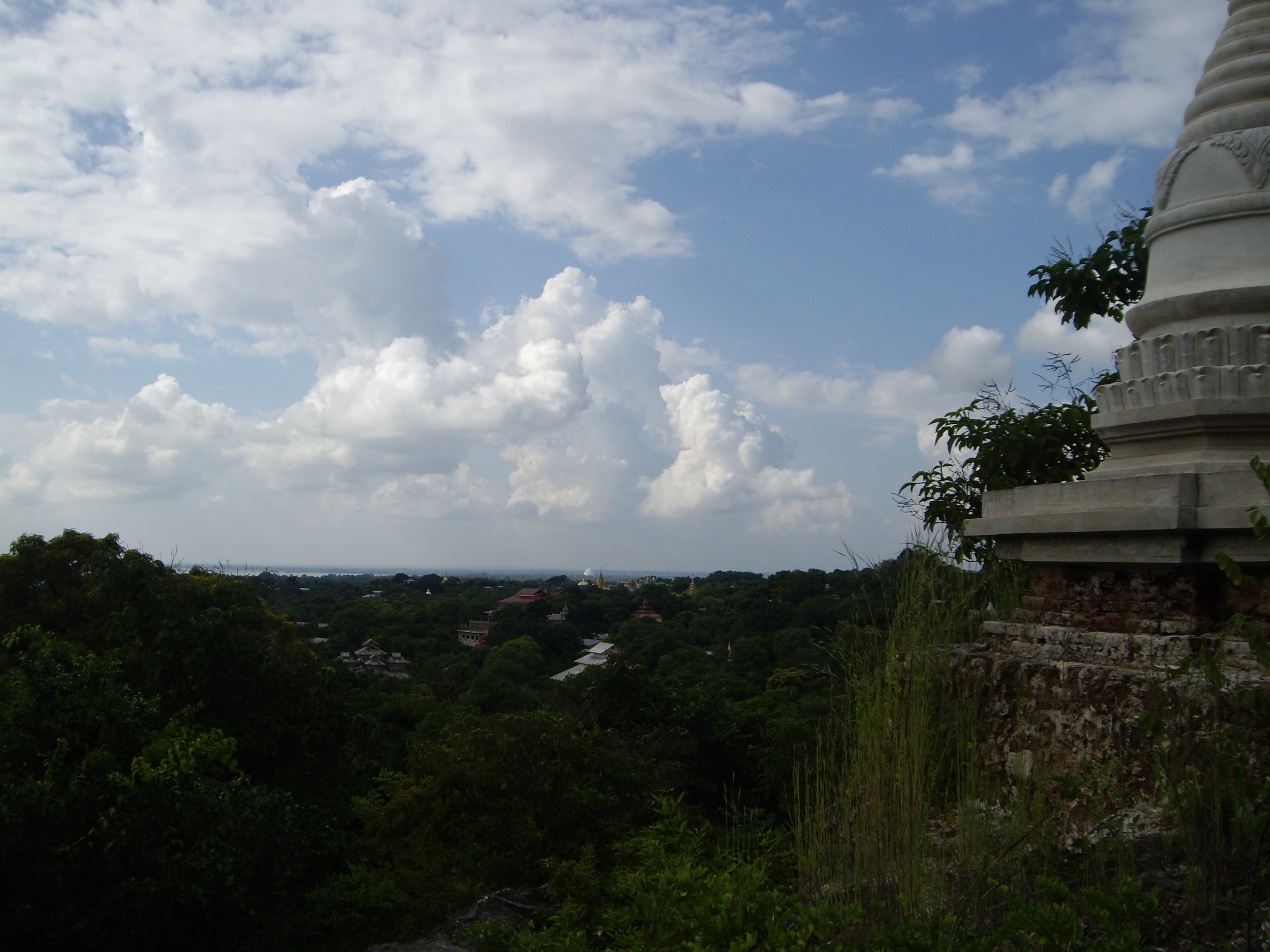
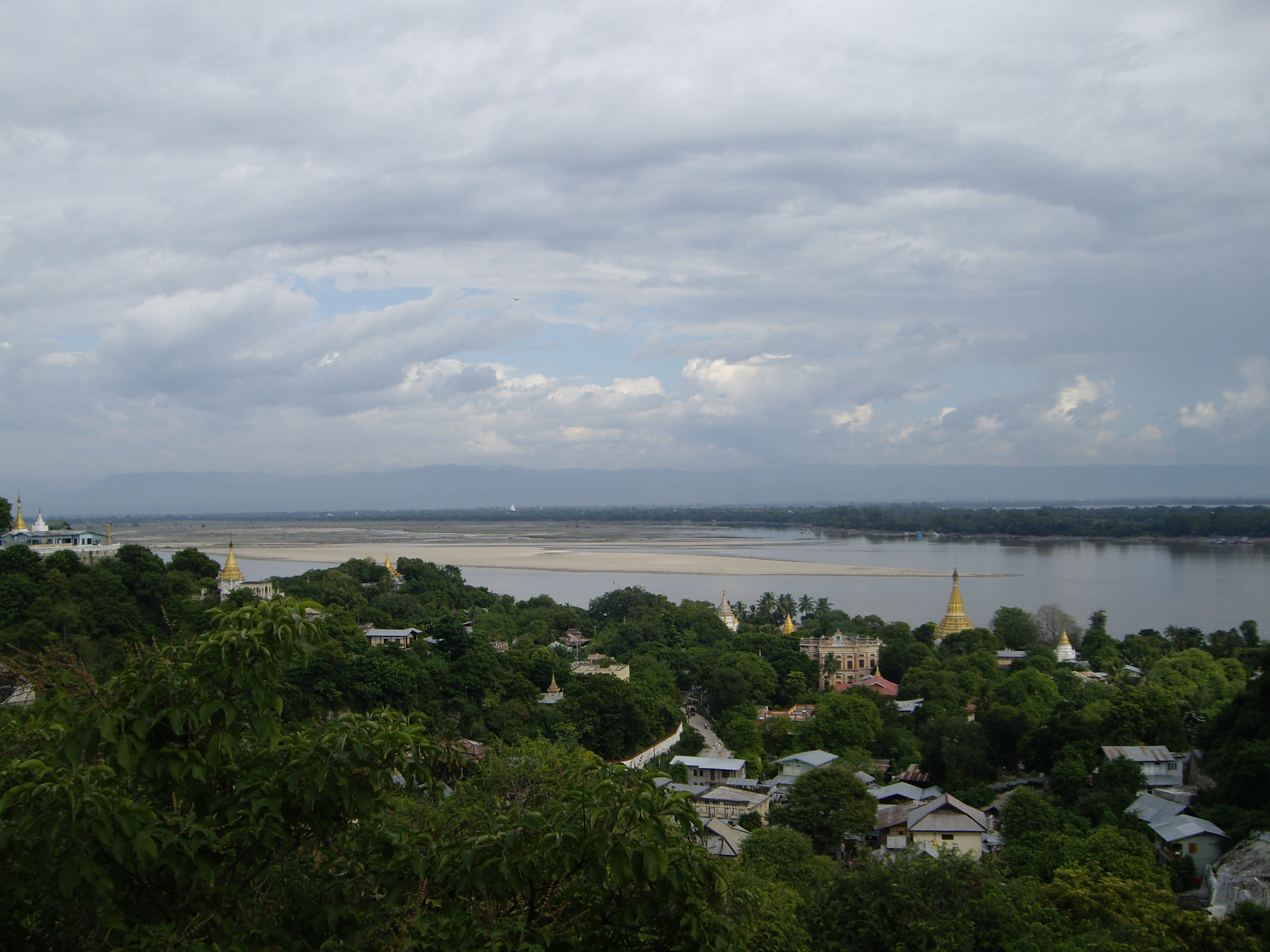
 The beautiful Sagaing Hills, an area some thirty kilometres out of Mandalay in central Burma, is home to a rich diversity of Buddhist retreat culture. There are hundreds of monasteries and nunneries, lay-retreat meditation centers, colleges and other educational institutions to be found there, housed in quiet hermitages, attractive old colonial outposts and more modern monastic facilities. There are innumerable examples of the typically golden-spired Burmese pagodas rising up out of the rich green foliage of the hills, that themselves border and rise away from the tranquil broad banks of the Irrawaddy River.

view of the Irawaddy

It is a remarkably serene, limpid place, only the occasional sound of amplified Buddhist chanting joining the atmosphere of repose and ease that imbues the life here. Sagaing is the Burmese equivalent of Indian ashrama culture, where many Burmese come after retirement to devote themselves to matters of the spirit, and a personal discipline in Buddhist study, meditation and ethical living. The often beautifully elegant pagodas, monastery temples and shrines are testimony to this culture; the people likewise, monastic and lay, move along the roads with a calm and gentle eye – even the numerous street denizens of dogs and cats suggest a life of renunciation from strife and discord.

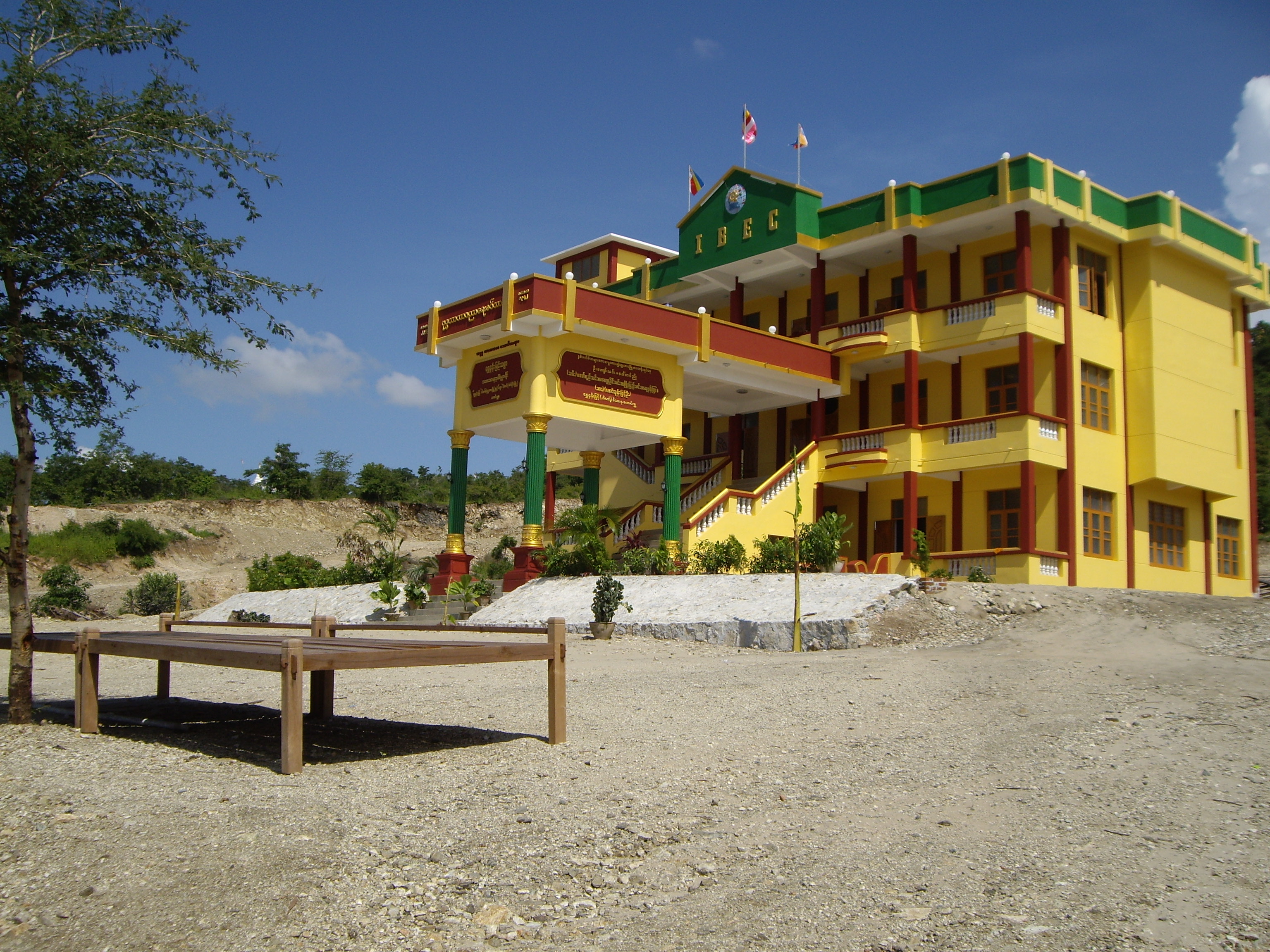
I.B.E.C. main building

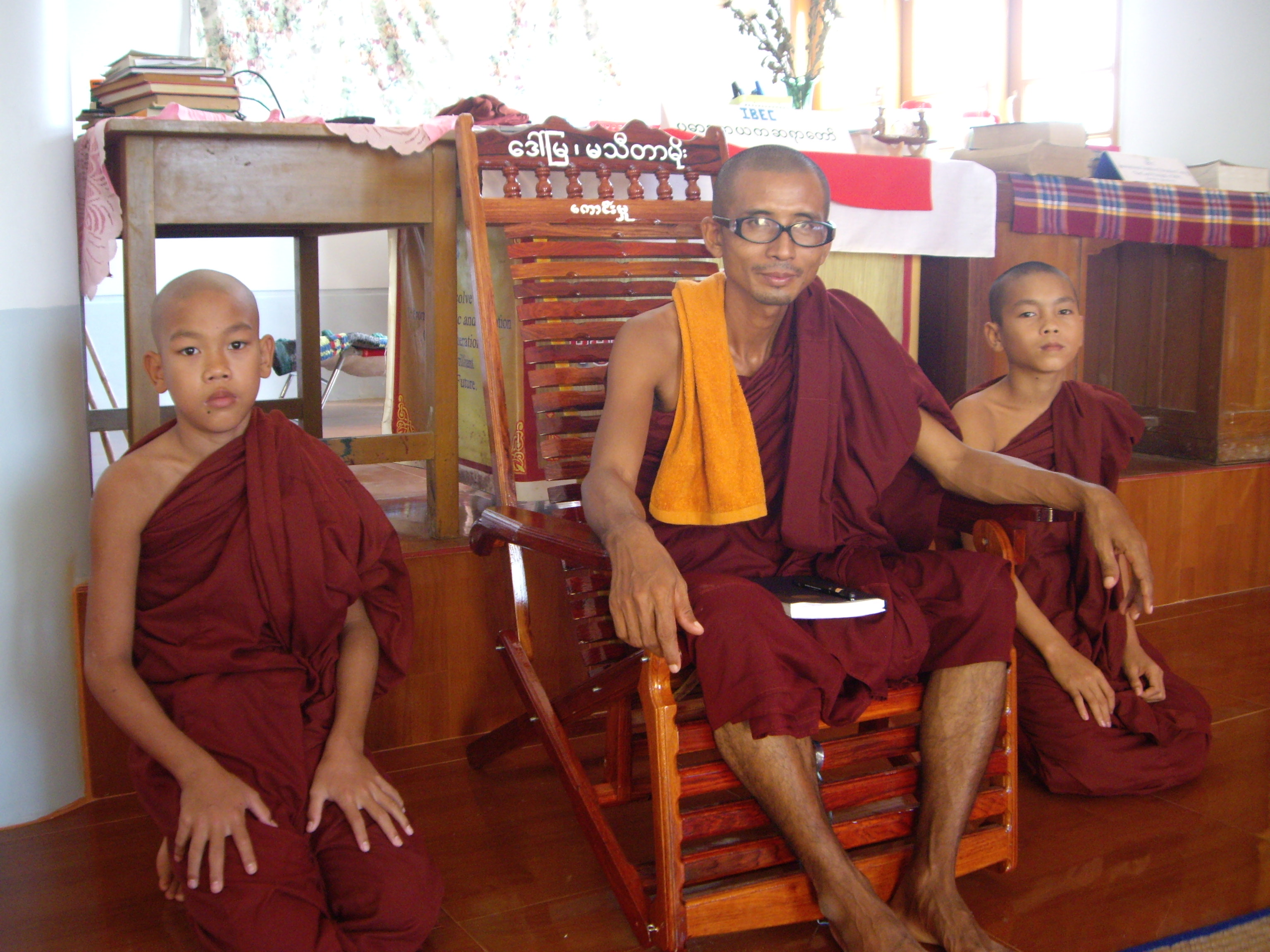
Beyond the dirt roads of a small village and rising high above the outlying area into the topmost of the range of the Sagaing hills, is the newly-developed International Institute of Buddhist Education (IBEC). Initiated in 2006, the new monastic and secular educational institution now houses nearly one hundred young monks, a new and impressive central teaching and administrative building (see attached photos), a library, classrooms, several outbuildings and an eating and cooking area. Its principal director is the Venerable Ashin Sobhita, a young but already highly respected Burmese senior monk who with eight other monk colleagues has been a guiding force for the establishment of IBEC since its founding.

Venerable Ashin Sobhita and monks

Many of the young monks who have come there have sought refuge from broken families, poverty and the vagaries of life under a totalitarian state regime. Their ages range from five to twenty years old. Many are orphans and others simply seeking a better educational prospect than the public schools often too expensive for their means. At IBEC the educational curriculum includes the secular national curriculum of the sciences, Burmese, English language, history and mathematics, as well as the Buddhist training program. This latter consists essentially of two main areas: Priyati, or the text-based study of the Pāli language in which the corpus of Theravada Buddhism (of Burma, Sri Lanka and Thailand) is written. This includes a thorough oral and aural training in the suttas, or original sacred texts of the Buddha, in the vinaya or monastic codes of discipline for Theravada monks (and nuns), and the abhidhamma, or more technical philosophical and psychological treatises analyzing the nature of mind, consciousness, emotions and samsaric ignorance, and the Buddhist path to awakening from such ignorance. All three of these areas of study constitute the three traditional ‘baskets’ of Theravada (indeed all Buddhist) study, the tripitaka.

Along with this category of priyati, goes the study of pripati, the practical aspect of meditation and devotional ritual which puts the more theoretical study of priyati into a dynamic context of self-enquiry, ethical relations with others and especially the teacher. In pripati also the monk develops a personal faith and devotional symbiosis with the symbol of the Lord Buddha, such that all his efforts and studies gain the added blessing of the richness of 2,500 years of Buddhist tradition inspired by its great founder. The Theravada in Burma, as elsewhere, is thus eminently pragmatic and rational in its philosophical orientation, as well as being steeped in values of respect, humility and selflessness.
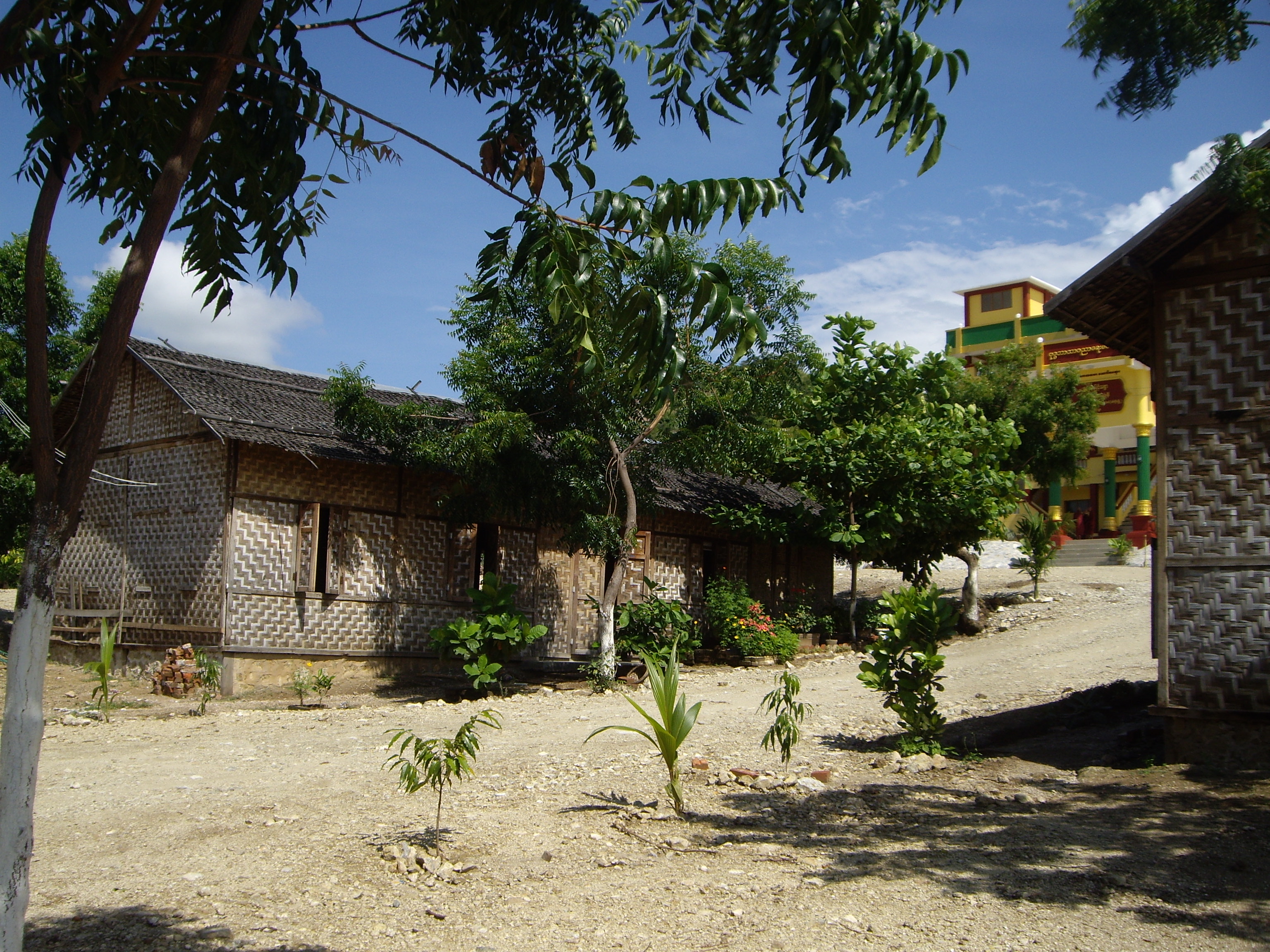
All the monks live together, sleep, eat and wash in common quarters, their only personal possessions being usually a tin trunk which designates their sleeping-space on the floor of one of the buildings, holding only their robes, books, study-materials and Buddhist ritual objects. The monks appear to live happily and comfortably in this traditional Buddhist manner. There is a lot of laughter, a lot of time for outdoor sports, or indoor reading during the hot hours of midday, as well as personal consultation with their teacher. Every morning and evening – a feature comparatively unique here, and not commonly practiced in the Tibetan monastic schedule for example – all the monks gather in an assembly for 45-minute sessions of meditation. Here, as in their more theoretical study, they follow the essential twofold practice of both samatha, and vipassana meditation methods, involving a foundation in mental calm-abiding, or equanimity, followed by analytic or insight, depth-meditation practices, respectively. Their teachers are always on hand to guide and supervise their practice. IBEC functions as a remarkably inter-dependent community of Buddhist enquiry and training, the intention for the Buddhist goals of awakening to wisdom and compassion that has its earliest beginnings in the first Buddhist sangha.

The secular educational component is also strong at IBEC, and some half-dozen trained, and often quite young, teachers live on the premises in their own dwellings, some distance from the central monastery buildings. Many of these teachers have received their education in Rangoon or Mandalay or other large cities, but prefer to live in the semi-retreat conditions of Sagaing in order to pursue their own Buddhist interest. Indeed, the entire institution functions as a Buddhist refuge for both monastic and lay interests; some teachers are part-time professionals who come to spend a shorter period living on the site and offering their expertise, whether it be English-language teaching, IT training or technical know-how. Some of them might be local people, educated but suffering personal travails that demand they seek some ‘time out’ from urban pressures.

Many others, and there have been at least a dozen teaching volunteers as well as newly-ordained monks and nuns, are Western travelers who come to appreciate the unusual and idyllic possibilities somewhere like IBEC, and its surrounding context, offers someone who in the West has perhaps less choice of lifestyle, and at a much higher cost. Those who come to IBEC as volunteer teachers receive food and board, along with the other resident teachers, at no cost. Several of the Western teachers have been able to ordain at IBEC as monks and nuns in the Theravada tradition, for shorter or longer periods, and with the full support of the resident sangha. Mandalay is only an hour or less away, so some volunteers also combine their experience at IBEC with commitments they might have in the city. The flexible ease of options at IBEC appears to work excellently for all concerned.

Venerable Sobhita hopes to add further extensions to the existing housing and teaching buildings on the site, as well as computer-lab and multimedia facilities for seminars, conferences and seasonal retreat services offered by IBEC in the future. He envisions IBEC and similar Buddhist institutions as offering an alternative to the state-run educational system, often limited in its scope and too expensive for poorer and disadvantaged people, and for developing a genuinely global and tolerant perspective on other religious faiths.

He also sees IBEC as being able to foster an ethical expertise in being able to train sangha and lay-people alike for many of the social and political challenges that face Burma as well as the world at large. He welcomes visits and/or donations to IBEC from anyone with a sincere interest in Theravada Buddhist teachings, and especially those who seek other possibilities of life in environs unlike those they know in the urban megalopoli of the East and the West.

Sagaing is a quiet, idyllic place where it is easy to forget the troubles of the greater world, yet where better to start the work Venerable Sobhita describes? And it would seem that the training and environment for Buddhist attainment could realistically be achieved here, where such an authentic example of the intentional Buddhist life flourishes so richly.

[N.B. Author’s note, May 2024. This article was first published here in late 2010. Since 2021 however, IBEC’s director Ashin Sobhita has become engaged in a public and international campaign to discredit the civilian effort to self-determination, and the PDF in particular, a stance with which I do not seek to be associated, and for which reason any prior support for Ashin Sobhita I entirely disavow. I’ve kept this article online purely in the interest of researchers on Buddhist institutions in Myanmar in the period around 2010.]

Read Full Post »

In early March 2002, Khin Zaw, pictured, stepped on a landmine while working as a hunter in the Wawlay Nyaing forest some four hours outside of the small Karen town of Myawaddy on the Thai-Burmese border. He lost his right leg, and with it any viable means of livelihood, and for eight years has lived exclusively from begging in the streets of Chiang Mai, in northern Thailand. Myawaddy is the site of recent (and decades-long) armed conflict between the Burmese military and a coalition of Karen independence fighters, including breakaway factions of the DKBA (Democratic Karen Buddhist Army) and the KNLA (Karen National Liberation Army). This more recent fighting of the past two months has killed many and resulted in a continuing exodus of more than 20,000 refugees from threatened villages into the Thai border town of Mae Sot, from where many are sent in short order back into Burma.

Among many of these refugees, in addition, are landmine victims, many non-combatants or farmers, or, like Khin Zaw, itinerant hunters pressed to work in dangerous areas to support, as he did, his family in the city. From that date in early-March, Khin Zaw has in fact not seen his wife and two children, now in their mid-teens, still living in Yangon. He has never been able to afford the ticket that far, and nor would his compromised physical condition permit him to find or be offered work in Burma – nor anywhere else. The stigma attached to the forced abandonment of his family and livelihood in Burma is palpable, and has in large part kept Khin Zaw from maintaining strong ties with his family in Burma. Nor does he have contact with brothers and sisters still living there.

While speaking with Khin Zaw, who I met begging on the main tourist strip of Chiang Mai (as he does seven days a week for four hours a day) discussion of his family introduces the only real moment of discomfort, clouds of pain overshadowing his otherwise warm, usually smiling face. Khin Zaw is learning English, when he can afford it, in Chiang Mai, but his friend and fluent English speaker Ajong offers to translate for us. They are both open and friendly, softly-spoken and tactful men, with an intelligent modesty of manner that seems to come naturally to many Burmese. It is a three-way conversation that illumines for me perhaps only some of the legal and socio-economic complexity lying behind the lives of Burmese illegal refugees in northern Thailand, though on the evidence it would seem Khin Zaw’s story is emblematic of many here, and in Mae Sot further south. As the conditions which have given rise to it are ongoing and critical, it seems equally as critical to bring awareness of such conditions to a wider audience. Khin Zaw expressed a happy willingness to tell me his story, and I am honoured to relate it here on his behalf.

When he stepped on the landmine, he relates, he was living alone but had work friends nearby who were able to carry him bodily through the jungle across the border into Thailand. The accident occurred at one in the afternoon, and they arrived at the Thai border town at nine that night, where the Mae Sot Hospital immediately took him into intensive care. Khin Zaw tells how he was largely unconscious during the journey and with the great loss of blood came very close to dying; were it not for the prompt and incredible service of his two friends, he would not have survived. He stayed in Mae Sot some three months in recovery, without cost, before being released into the general community. Dr. Synthia Maung from the Mae Tao Clinic in Mae Sot claims that 60 to 70 per cent of landmine victims who make their way there are civilians, many women and children. As an accident victim Khin Zaw could not be classified as a refugee, and nor did any of the NGO operations and their representatives approach him for economic or further social support. He relied exclusively on Burmese friends, until they too were unable to support him, and he felt he couldn’t expect more from their hospitality. So he returned, largely by necessity, to Myawaddy, and took up again in Wawlay district with his old workmates. But unable to work, having little longterm incentive to stay there either, and unable to reach his family in distant Yangon, he did as many do in his situation, and sought refuge in Chiang Mai, further north in Thailand.

But this is where the more intractable of Khin Zaw’s troubles began. As an illegal alien in Thailand, Khin Zaw, along with thousands of others seeking refuge from the fighting in Karen and Shan states, as well as the oppression in Burma generally, is constantly at risk of deportation. Indeed in the eight years since his accident he has been arrested nine times, imprisoned at length each time, and sent back into Burma at Tachilek, a crossover point for many refugees (and other travelers alike) linking to Mai Sai on the Thai side of the border. He is not entitled to a passport, or a visa for Thai residence, and in view of his injury, a work-permit. On every occasion of his arrests, the first in 2004, he has been forced to spend up to a month in jail each time, and most recently three and a half months, before the inevitable deportation to Tachilek. Altogether his periods of incarceration, an innocent victim of an illegally-planted landmine, have amounted to roughly nine months.

On each occasion also he has had to pay Thai police 5,000 Baht (c. US$165) in order to secure his release. Once across the border at Tachilek, which he soon leaves to return to Chiang Mai, he is ordered by Burmese soldiers to relinquish any valuables he might still have – whatever cash he carries, a watch, clothes-items, mobile-phone. His only saving-grace on the Burmese side of the border is that as an ethnic Burmese (Bamar), Khin Zaw is spared the beatings he has regularly seen meted out as a matter of course to his less-privileged, usually Shan (or other ethnic nationality) fellow-countrymen. It’s hardly surprising that under these conditions he chooses to risk again the uncertainty of life in Thailand, than remain in the effectively closed society of life under the military regime in Burma. He says that he loves his country dearly, but can’t live under those conditions. It is hard enough under most conditions available to him, as a handicapped man, but those in Burma make the suffering still worse.

Burma is one of only 17 countries that abstained from voting on a 2005 United Nations resolution to ban the use of landmines globally. The ruling SPDC (State Peace and Development Council), or its current manifestation in the nascent ‘government’ following the fraudulent elections of November 7, has similarly not acknowledged the Mine Ban Treaty. Recent figures on landmine accidents in Burma available from Landmine Monitor show a 90 per cent increase in 2007 from 2006 figures. The online Landmine and Cluster Munition Monitor reports that “In 2009 there were at least 262 new mine/explosive remnants of war (ERW) casualties in Myanmar…of the total, 259 casualties were civilians…In 2008, at least 213 civilian casualties (30 killed and 183 injured) were identified.” It adds that “Due to the lack of systematic data collection and varying sources of annual data, reporting does not reflect the full extent of mine/ERW incidents and casualties in the country. In 2009 the UN noted that many casualties remained unreported.” Other international monitoring organizations (such as Human Rights Watch) have also claimed that the Burmese military and insurgent armies using civilians to reconnoiter known landmine areas (known as minesweeping), acting effectively as mortal human shields, is prevalent as well. Other NGO workers, including Medecins Sans Frontiers, have withdrawn from working in Burma in part because of restrictions the government has placed on their access to landmine victims. The mines themselves are bought from, among other places, Italy and the U.S, and following Russia’s recent discontinuation of landmine use, Burma is now the sole non-participator in the aims of the global anti-landmine treaty.

Now 41 years, Khin Zaw remarried in Chiang Mai, and after a powerful conversion experience, became a Christian along with many of his fellow Burmese there. He speaks of the indubitable sense of the love of Christ, a direct emotional transference that he rarely felt in the more intellectual reasonings of his native Buddhism. He describes the doctrines of karma especially as too complicated and demanding to observe with real consistency, in contrast to the simple but deep faith in Christ that allows him to feel forgiven and purified whatever his current circumstance. Considering his consistent warmth and cheeriness, there is little doubt his Christian faith has given him much in pulling through the constant hardships of eight years.

I can only marvel at his resilience, as he lifts his carpet matting and crutches from his grubby spot on the street to catch a tuk-tuk home, after half a dozen ignore him as a social undesirable, an illegal, one of those of the social under-class in Thailand the local people tend  to avoid. It remains the case that no social support network can be relied upon by Khin Zaw in Chiang Mai, and even his church can’t afford supplements to his meagre earnings as a beggar – at most some 2000 Baht (US$66) a week. While I sit with him at his begging-post it is normal to watch long eddies of Western tourists and Thai party-goers pass him without notice, or for an occasional tourist flashing jewellery and cameras to stop and churlishly offer him a 20 Baht note (US 66 cents). Just around the corner the same tourist readily pays 400 – 600 Baht (US$13 – 20) to watch kick-boxing shows, or pay 170 Baht (US$6) for a drink. Such is life as usual in Chiang Mai, for Khin Zaw, and for those who pass him seemingly oblivious to this particular reality of the place and the time.

A day or so after our interview, Khin Zaw invites me to visit his church, and tells me he never fails to make it there every Sunday. I ask him how he gets there, and smiling expansively he says he takes a tuk-tuk. It costs him 100 Baht for the round journey, but he never resents the weekly cost. “I have faith,” he says, smiling. “You have to trust things will be ok”.


Read Full Post »

In downtown Yangon, exactly a fortnite before the country’s national ‘democratic election’ is due to be contested, life appears much as usual. People lounge and relax for hours over slow nickle pots of tea in street tea-shops, children run and play among vehicles and the detritus of roadwork, monks – and nuns, in miraculously clean, pink tunics with tan shoulder robes and brown umbrellas – make alm’s rounds through the streets, barefoot and impassive amidst noise, rain or traffic. Yangon is a colourful, if shambolic city, alive with a human warmth and vibrancy that rarely betrays a much deeper discontent beneath its vital surface.

Yet cracks do show, as much in the difficulties of daily life as in the spoken admissions of people from all walks of life. While the shaky infrastructure of much of Yangon is little different from that of a city in a poor Indian state (Patna or Kolkata for example) other less obvious constraints of communication and movement belie a much deeper malaise conditioning much of life here. My guesthouse proprietor is required to report to the local police registry office to submit details of all his current guests, sometimes more than once a day, reporting any knowledge of their movements and activities. This is ironic considering many areas of the country are off-limits to travelers, and even non-Burmese ethnic nationalities alike, so that both visitors and locals are unable to travel as freely as the expectation that they do so might allow. Perhaps the most practically curtailing proof of unreasonable control however comes in all online communication where even mainstream e-mail sites require overseas server providers in order to allow for a few snatched moments of web access, usually at the cost of a lengthy process of proxy transfer. Sometimes there is no access at all, and then the extent of Burma’s isolation from the world beyond comes clear, with a chill of recognition: much could happen here that could go unknown by both local and international news providers, or only until it might be too late. It is only a matter of moments before the barricades and cordons can be drawn up and lines of armed military personnel prevent any kind of open communication at all.

In my short time here, without eliciting any discussion of the election, I’ve been confided to by many people eking out a living as tea-shop owners, guesthouse workers, booksellers, taxi-drivers and beggars. Many have made it clear that they hold little faith in the coming election, others, especially younger educated people, try to preserve some optimism that a reasonably democratic procedure might begin to institute the reforms they expect is their due in voting at all.

Few have suggested to me that a boycott of the election is the only course to follow, and while emphasizing their fidelity to Aung San Suu Kyi and the now heavily compromised former NLD party, they profess her political power to be at an all-time minimum, and her career effectively closed. Yet they say this with a wistfulness that makes it very clear that while her political currency appears to have passed its peak, their personal faith in and love for who she is and what she means to their national identity is as undying as ever. Younger people I have spoken to look to the Student 88 party as most likely to hold some kind of legitimacy in the democratic cause, at least one with some political negotiating power, even as they are certain the USDP will win the election outright and current Prime Minister Thein Sein become the new leader of Myanmar under its auspices. It is hard to disagree with them, and everything seems to be confirming it by the day. Yet even this morning an apparent show of protest by some monks near the Shwedagon Pagoda, and the arrest of two of them, challenges that foregone conclusion. In this election anything could happen, and the coming two weeks hold much more radical surprises in store.

Trading English books with a bookseller all of eighty years, speaking through his two remaining betel-stained teeth, nothing was mentioned of the election until I was about to take leave of him. Then he cannily grinned and said, ‘And you don’t know anything about the election, do you?’ I quickly grinned back and agreed, saying, ‘Nothing at all! In fact, I’ve forgotten about it! What is it?’ He slapped his knees and burst out into laughter, two friends joining in, all of us laughing in a happy defiance as I crossed the road. A nearby police official looked askance at us, but we kept on laughing. There was a feeling that no matter who might be observing, the local people preserve an integrity and conviction intact precisely through such defiance, however passing. The irony also was that the book I’d exchanged with the old bookseller was a collection of Yevgeny Zamyatin’s short fiction: a great Russian writer repeatedly persecuted by Stalin’s Soviet regime, his life often threatened, until he had finally died in exile in Paris, obscure and largely unknown to the Russian reading public of the Stalinist and post-Stalinist periods. Yet his writing lives on, read now in English in Yangon. The old man shook my hand and thanked me and said he looked forward to reading the stories, brilliant parables of freedom eked out in unlikely places and through fragile human solidarities, just as it is in Burma today. In such ways the best of the human spirit survives, and triumphs in ways that Gen. Than Shwe and his minions seem deadened to, so great already is their loss.

Catching a taxi last night to the Shwedagon Pagoda to see the full-moon festival there, my driver (slightly drunk) told me almost as soon as I was inside how much he loved ‘Daw Suu Kyi’. By the time we arrived at the glittering golden stupa there were tears in his eyes, and he almost refused to accept my payment for the ride. Such is the warmth and faith of many of the Burmese people I have met here in only a short time. The overriding conclusion that can’t be avoided is that such a people deserve much better than the disrespect and humiliation the ruling regime mete out to them again and again in so many forms of curtailment of basic rights of expression, assembly, freedom of association and self-determination.

Two days ago I saw a man being led along Merchant Street, both his arms gripped hard by two black-uniformed military personnel on either side. The man was young, mild-faced and went passively; I don’t know what he had done that warranted his arrest, but he went almost willingly, as if he knew beforehand that it was only to be expected, had perhaps gone through the process before. I didn’t know if he had broken the law, or what passes for such in Burma, but it seemed certain that he, too, didn’t deserve to be led away, stallholders and bystanders craning their necks to see him go, to an unobserved interrogation, and perhaps many years in one of Burma’s notoriously inhumane prisons.

Life appears here to be business as usual, but deep beneath the surface a pride and strength of spirit speaks out loud, saying that the subjugation of fundamental freedom can only go so far, beyond which point everything will be risked to secure its eventual triumph. Perhaps this is the one thing in its people the ruling regime has failed to manouvre against, the one thing it will finally be unable to withstand. Whatever the election outcome in two weeks, the quest for genuine freedom isn’t over, and the election might only be its prelude. October 24, Yangon. Copyright © Martin Kovan
An edited version of this article was published in the online  journal The Irrawaddy on 28.X.2010, as “The Malaise Below the Surface”: http://www.irrawaddy.org/election/…/560-the-malaise-below-the-surface.html

Read Full Post »


Burmese girl with self portrait, Place Palais Royale, Paris, Nov. 2009

The above image was taken by the author at an open-air exhibition in Paris, Nov. 2009, of children’s self-portraiture from around the world. Unique among hundreds of images, this portrait shows itself fully cocooned, with eyes closed, mouth wide open as if in an endless silent scream. A faceless figure, or perhaps weapon, confronts the terrified figure. The photograph of the artist, a 5 yr-old Burmese girl living in a refugee settlement on the Thai border, shows her arms crossed, gazing distrustfully at the photographer. This also appeared to be unique among the literally hundreds of portraits on exhibit, which generally showed children smiling, dancing, moving in free space.

In the lead up to Burma’s first election in twenty years – in any form, let alone a properly democratic one – it might be useful to provide a general summary of the often complicated political landscape of the country. I use the country title of Burma rather than Myanmar to draw attention to the latter name having been imposed in 1989 by the military dicatatorship of General Ne Win (now deceased), its use by the international community only tending to legitimize an authority that has never either deserved, or legally warranted, such legitimization.

Burma as a title is problematic also as it refers more generally (as the derivation ‘Myanmar’ itself does) to the ethnic majority Burmese (or Bamar) people whom the ruling junta seek to make an absolute power – hence their policy of effective genocide against non-Burmese (so-called minority) peoples in the Karen, Mon and Shan states, as elsewhere. Yet ‘Burma’ is perhaps preferable to ‘Myanmar’ in its greater historical context which includes the founding of the nation as a modern state in the post-war period, under the inspiring, yet short-lived leadership of General (or Bogyoke) Aung San – Aung San Suu Kyi’s revered father, loved by democrats and conservatives alike within Burma. He was assassinated in 1947, at 32 years, just months before the independence of his country was achieved from the British Empire, killed by a haze of bullets that struck down many members of his party in an attack by political rivals. Burma’s freedom has been compromised by internecine antipathy from its beginnings.

The essential problem facing the democracy movement now both within and outside Burma is whether to engage with the electoral process at all, or if so, to what degree and with what kinds of reservations? Does to engage render any equally vital critique morally futile? Or is some form of engagement the only way to initiate or continue whatever existing level of dialogue currently exists with the regime of Senior General Than Shwe (himself lately de-commissioned as a general in order to play a civil-political role from hereon)? This is a difficult question as there are compelling ethical and politically pragmatic arguments informing both views.

What is clear however is that both those ASEAN countries surrounding Burma, and the Western powers in the U.N. and the E.U. could currently be doing much more to make these issues explicit points of discussion in their approach to Burma. As of early October the EU for example has not yet collectively chosen to support international efforts to end impunity in Burma for war crimes and crimes against humanity, by commiting to a U.N.-led commission of enquiry called for by U.N. Special Rapporteur Tomas Ojea Quintana. It appears rather that the Asia-Europe Meeting in Brussels this week will sideline the Burmese crisis just as the meeting of the U.N. General Assembly in New York did recently. Yet this follows the EU issuing in 2008 its Guidelines on Human Rights Defenders in Burma, itself requiring a direct follow-through on the maintenance of those ‘guidelines.’

The Burmese electoral process has been designed according to the terms of the 2008 electoral commission to entrench the military authority of the (aptly-named!) State Peace and Development Council (SPDC)  in the guise of a civil government.  The 2008 constitution (bitterly opposed by many in the democracy movement) effectively disallows essential aspects of open electoral candidature: freedom of expression, peaceful assembly and association. Given the restrictions of time for registration, limitations of assembly, the excessive costs demanded of non-junta parties and the latter’s easy access to state funding, the results of the election can effectively be seen as a fait accompli.

Pro-democracy actions are regularly disrupted and persecuted across the country, a number of parties have been kept from registration, individual candidates arrested or otherwise banned from competition, Aung San Suu Kyi herself still held under house-arrest despite repeated global calls for her release. By the terms of constitutional rulings she is disallowed from standing as a candidate because of her having been married to a non-Burmese (her late husband was British). Her status as a political prisoner has however been qualified insofar as she is now apparently able to vote, if not stand herself, only because she is formally under house-arrest rather than criminal conviction. These kinds of Orwellian double-speak can clearly be seen to operate as some of the quasi-legalistic means by which the regime maintains power, and tries to seduce international scrutiny to a passive acceptance of their manouvres. The power of faux-legal rhetoric, as spurious as it in reality is, nevertheless carries the false authority that itself allows for the intransigence of the regime to be accepted by the technocratic structures of international governance.

In the meantime the junta is certain to gain a 25% military representation alone in the parliament, as guaranteed by the 2008 constitution. The remaining majority of the vote will almost certainly go to the junta-backed Union Solidarity and Development Party (USDP) and related pro-junta parties such as the National Unity Party (NUP), led by former military chiefs of staff. Between them these proxy-junta parties will field about 2,000 candidates out of a total 2,500 to contest the 1,163 seats in the three levels of legislature formed by the 2008 constitution.

Further complicating the weakness of pro-democracy representation within Burma is the division that has come about from the dissolution of the National League for Democracy (NLD) party led by Aung San Suu Kyi. For the NLD to contest the election, Suu Kyi would be required to stand down as its leader which would itself defeat the purposes of the party’s resistance to the junta – perhaps largely symbolic, yet still powerful . Hence the NLD has been disbanded as a political party in view of maintaining its integrity. It seeks instead to exert influence and benefit for the people in social service work on the ground.

However, a faction within the NLD still hoping to contest the election as at least more proactive than general non-participation through boycott would be, has formed an autonomous party, the National Democratic Force (NDF) which in accepting the unjust terms of the election and constitution, sends an ambiguous message both to the people of Burma as well as the international community.This ambiguity thus characterizes both the election itself, the engagement of the democracy movement within Burma, and the attitude of the international community. There is a perception that humanitarian space and elections are naturally inclusive terms, post-election, and that with greater humanitarian operating freedom will also come greater political freedoms. Hence the U.S., for example, seeks to engage the regime (clearly on economic and trade-based goals and investments) as well maintain a clearly-voiced denunciation of human rights abuses within Burma. The junta is both legitimized in its greater potential inclusivity in the global-economic program, while its moral status as a regional stakeholder takes generally second place to this hope, clearly alive on both sides. In July and September of this year Senior General Than Shwe was able to visit India and China, respectively, under a general show of respect and impunity.

But given the record of engagement thus far, the junta has failed to meet even halfway with any of the requirements for a ‘free and fair’ election on November 7, let alone subsequent to it. The number of political prisoners has almost doubled in the three years since the Saffron Revolution. A request from U.N. Secretary General Ban Ki Moon’s chief of staff Vijay Nambiar to visit the new political capital of Naypyidaw either before or after the poll has been flatly denied. The very assumption of the term ‘free and fair’ is a misnomer. When Navi Pillay, the United Nations High Commissioner for Human Rights, recently said the world must exercise “utmost vigilance” to ensure the approaching elections in Myanmar are ‘free and fair,’ she betrayed the extent of the essential lack of insight into the Burmese crisis: firstly, that it is certain it will be near-impossible to exercise such vigilance, and that even could it be made it is, as before, certain to achieve little (as thus far) in terms of the protection of real freedoms on the ground. Secondly, such ‘free and fair’ conditions as a first assumption for the democratic process have never been in place to start with. For this reason U Win Tin, a venerated founding member of the NLD and former political prisoner having survived 19 years of incarceration in Burma, was able to write late last month that “there is no need to wait until the Election Day to make a judgement.”

His solution? “Meaningful political dialogue between the military, the National League for Democracy led by Ms. Aung San Suu Kyi, and ethnic representatives is the only way to solve problems in Burma peacefully. The military has no desire to talk. But if the international community seriously exercises strong and effective pressure on the regime, the combination of pressure from outside and peaceful resistance inside the country will force the regime to come to the dialogue table.”

Surely we can and must join Win Tin in his call for action, as belated as that action may already be, and as direly urgent as the call itself has for so much longer already been.

Martin Kovan © October 2010

Read Full Post »

An article written in 2006 that looks at the historical continuity of an aspect of the spiritual (in this case Buddhist) path, in which the security and identity made with a larger authority, more or less benign, is definitively left behind. Alan Clements is a contemporary maverick on the global dharma stage, a former monk in the Burmese tradition, whose provocative voice for a secular, engaged and dynamically creative autonomy is in many ways a re-casting of traditional elements of the biographies of the old Buddhist masters. The ‘second crisis of autonomy’ (after his departure from the palace of his family and kin) then refers to Siddartha Gautama’s eventual rejection of his contemporary teachers or authority figures as a condition for his own awakening. This article considers the nature of that ‘crisis’ and the grounds for Clements’ own passionately vocal version for our own time.

See Alan Clements’ World Dharma website: http://www.worlddharma.com/wd/media/interviews/Article%20-%20CrisisofAutonomy%20Martin.pdf

Read Full Post »

« Newer Posts