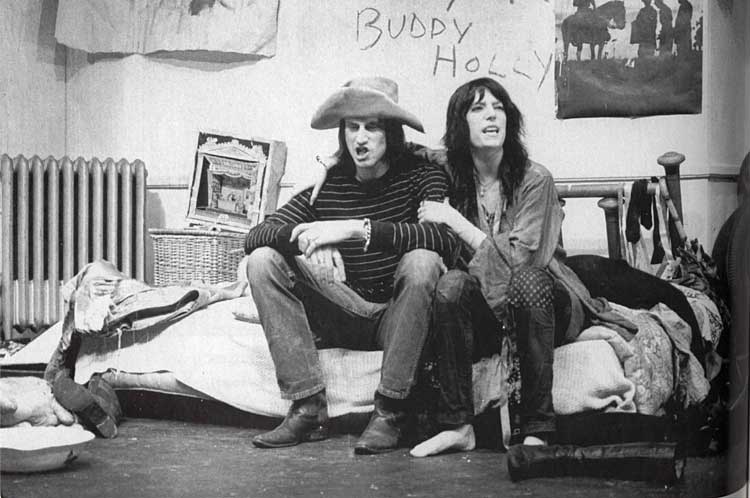
patti smith & sam shepard performing ‘cowboy mouth’ 1971
I
In the program notes to his 1971 collaboration with rock-poet/singer Patti Smith, playwright Sam Shepard offered the following statement in terms of his work in theatre: “I like to yodel and dance and fuck a lot. Writing is neat because you do it on a very physical level. Just like rock and roll. A lot of people think playwrights are some special brand of intellectual fruitcake with special awareness to special problems that confront the world at large. I think that’s a crock of shit” (Wade, 7). Two things, at least, are explicit in his statement: the assertion of a formal parallelism between the work of popular music, and that of his theatre, and the sense of the presentational, as opposed to representational, immediacy of that theatre given its absence of intellectualized mediation or over-conscious contrivance. Shepard’s theatre moves, assaults, seduces an audience with the kind of non-verbal, ritualized, kinetic and sensory receptivities attending any live rock event.
Shepard had, at least verbally, long resisted a formal identification of playwright, and in his relocation to London in 1971 actually sought an alternative creative life in rock music, and even judged the primacy of rock music as an artform more truly representative of his era than theatre or any other art practice (Gilman, xii). Music has generally always informed his understanding of art-practice; Laura Graham writes that “his influences were aural—the structure and rhythms of Rock and Jazz music. Shepard’s father trained him in jazz drumming in Shepard’s early teens; he witnessed the talent of some of the greats of American jazz while bussing tables at the Village Gate in New York. He participated in two groups [as drummer], the Moray Eels and the Holy Modal Rounders in the 1960s and ‘70s and admits to having practiced Jack Kerouac’s theory of jazz-sketching with words using the same principles as does a musician when jamming” (Graham, 3) and he has himself stated that “nothing communicates emotions better than music, not even the greatest play in the world” (1984: 179-80). With an imagination so deeply conditioned by the non-verbal modes of music—both in terms of an aesthetic of language more attuned to sound (and the emotive charge it carries, as above) than concept, as well as the personae of music performance—it is unsurprising that Shepard’s theatre is often dominated by an elevated figure representative of that music who partakes as much of mythology as of countercultural trend, is as much a necessary extension of an acutely ritualistic psyche as a canny codifier of contemporary cultural obsessions.
Much could be written about the musicality of Shepard’s theatrical language (and Robert Coe, in harmony with the playwright himself, speaks of “Shepard’s language as approaching the condition of Rock music” and compares him in that regard “with the Romantic poets who used language as evocative rhythmic sound in addition to its use as a vehicle of literal meaning” Graham, 5) but what is more compelling for this enquiry is to observe the way in which rock music and the varied mutations of its aesthetic and cultural significations, supports the erection, and as we will see, resurrection, of a mythic archetype.
In discussing Shepard’s particular codification of 20th century Romanticism, Graham writes that the romantic demonstrates “a stress on the individual and especially on the Hero and the actions of the Hero versus a corrupt or restrictive society; the Hero is seen as the potential savior of a weak society, and conflict in his later plays frequently devolves upon the attempted synthesis between society and the Hero/Individual” (ibid.). In the context of Shepard’s theatre practice of the late 1960s and early ‘70s, Graham’s formulation of the romantic hero serves well to describe its all-pervasive embodiment of the time: the rock ‘n roll star.
The heroic performers of the time, ranging from overblown psychedelic to polymorphous perverse to hermetic-apocalyptic ironic (one thinks of Morrison, Jagger and Dylan respectively) are legion, and in retrospect, eerily otherworldly, sometimes in possession of a skillfulness combined with sheer embodiment of novel expressivity so authentic that from the perspective of a tired neo-conservative post-turn of millennium, they would seem to verge on the divinely inspired (here one thinks perhaps most of all of Jimi Hendrix). Shepard and Smith’s writing, too, of Cowboy Mouth holed up together in the now-mythic Chelsea Hotel (Shepard reports that “She wrote her lines and I wrote mine” and that the play resulting was “the most important thing in my career” Oumano, 90) should be seen in the context of the deaths of some of the most powerfully iconic figures of the time: the years 1970-71 saw the overdose deaths of Jimi Hendrix, Janis Joplin, Jim Morrison alone. Others, such as Tim Buckley, Gram Parsons, and perhaps the ultimate rock ‘n roll savior of them all, John Lennon, were to follow.
The archetype and its profound force in the postmodern cultural psyche of the West is no less noticeable in our own time: the suicide of the ‘father of Seattle grunge’ Kurt Cobain in 1994 was globally mourned as if the passing of a veritable messiah, and not long after in 1997 the drowning death of Tim Buckley’s son Jeff Buckley is another, acutely romantic, loss of the Orphic voice which promises profound transference, only to leave those million—collective Eurydice to the lone Orpheus—abandoned in the strangely undefined yearning of a waking underworld. (The quite different martyrdom of Michael Jackson in his 2009 demise nonetheless embodied a triumphant puer Orpheus in his years of precocious ascension.)
In a number of plays of this period, Cowboy Mouth, Mad Dog Blues, The Tooth of Crime among them, Shepard invokes this yearning and offers up the rock hero/savior, Orphic representative of his time, as worthy sacrifice perceived “not through the intellect but through the ear, like music, through the eye, like visual art, and through the heart” (op. cit. 5), as in the modes of myth. Where Graham suggests that Shepard “shares the Romantics’ use of folk heroes as symbols, their emphasis on the theme of freedom versus conformity or societal restriction, their belief in the inherent superiority of intuition over reason and of subjective over objective reality and, in his later plays, the belief in the spiritual superiority of the Female” (Graham, 5), it will be questioned whether Shepard’s representation does in fact finally confirm to such attributes (in particular the last) or rather suggest a failure, or modified resignation, of the hero to achieve any idealized configuration.
Shepard’s appropriation of the archetype becomes, true of its postmodern surrounds, almost a critique of such long-rooted Western-humanist archetypal imperatives, as if his ambivalent rock-hero-saviours (reminiscent of Brecht’s anti-hero who in his early Drums in the Night refuses to go out and fight in war) would be saying ‘I really can’t do this, in this world, under these conditions, anymore.’ Shepard’s wielding of the mythic structures—and what Graham describes as his disclosure that the “myth is proven to be defunct; the Hero is shown to be inherently and irrevocably unheroic (the potential for Heroism is called into question); the Female becomes the survivor without the Male” (op. cit. 6)—prefigures the nominal deconstruction of such collective-cultural master tropes in our post-millenium. What is still interesting in these plays is the sense in which such negation is achieved even where by virtue of failure it points up the deep pathos of a contemporary culture still thirsting for the symbols it presumes to have de-naturalised itself of. The tale, the narrative, gets old-fashioned and dies, but the spectre in the psyche, the numen, always returns to haunt its neglect.
II
In an ironic reversal of Orpheus, as Cowboy Mouth opens, the male protagonist Slim (“who looks like a coyote…beat to shit” Shepard, 1972: 85) has also been exiled from his wife (and child) but here reluctantly “kidnapped…off the street with an old .45” by Cavale, “a chick who looks like a crow, dressed in raggedy black” (ibid.) already in the deeps of a bizarre and intimate rapport, where we are thrown into the semi-autistic static of their banter in media res. Cavale would seem to have already laid the groundwork for Slim’s transformation into rock ‘n roll savior, because already by his second speech-entry his response is unequivocal. Cavale, mad (later confessions reveal her past hospitalizations) or only strategically in denial, can’t hear Slim’s objections as she ferrets around for her dead, stuffed crow Raymond:
SLIM: Your Raymond! My wife! My kid! Kidnapped in the twentieth-century! Kidnapped off the street! Hot off the press! Don’t make no sense! I ain’t no star! Not me! Not me, boy! Not me! Not yer old dad! Not yer old scalawag! This is me! Fucked up! What a ratpile heap a dogshit situation! (87)
Slim’s rhetoric is unconvincing. Both he and Cavale are desperately in search of something the other only half-consciously appears to offer. Cavale, moreso than the remote, too-good wife and child, seems his truer lover and certainly muse, at least in this strange ritual—the eccentric chamber of their willed claustrophobia a substitute Hades where they are forced to work out the terms of an inchoate descent into the unconscious. Slim, though resistant, has already in his opening line spoken of “bad karma”, and in his passivity it is the elemental force of the with Cavale (she can talk to animals, even dead ones) who can lead him into some more radical meeting with himself and the time.
The adolescent in this pairing, Slim can only beat (“the shit out of”) drums and wail cheesy love-songs. Her depravity “makes me sick! It’s morbid and black and dark and dirty! Can’t you see what’s happening here?” (op. cit. 88.) She can, and she tells him “Fuck you […] Can’t you see what’s happening here? A dream I’m playing.” And Slim, long ago seduced, wants to know; like the little baby whose need of him he has just been appealing to, he begs her to “Tell me about Johnny Ace,” and submissive “goes to her and curls up in her lap” (ibid.).
Johnny Ace is Cavale’s first installment of the rock ‘n roll savior, but a flatly self-destructive one. Johnny Ace was “real cool, baby. Just like you” (88-89), but—
CAVALE: […] one day when all the girls were waiting, when everybody paid their fare to see Johnny Ace on stage in person singing sad and dressed in black, Johnny Ace took out his revolver, rolled the barrel like his 45 record, played Russian Roulette like his last hit record, and lost. Johnny Ace blew his brains out, all the people jump and shout […] (89).
The same image will close the play, but with a whimper, and not with Slim pulling the trigger. Though Cavale is quick to diminish its impact (“it don’t mean nothing, it’s just a neat story” 89) the metaphor for suicide as escape becomes her recurrent trope—escape being what Cavale, her self-chosen name, comes to signify at the very close of action. Not just hers, but deeply enmeshed in the rock archetype she’s seeking to perpetuate. Cavale’s savior, we see, is a gentle Jesus, who is meant to survive, but that other ‘saviour’, outside the frame of Cowboy Mouth, is the one Smith knows and draws on: were Buddy Holly, Hank Williams, Richie Valens, even Robert Johnson, and their more contemporary company cited above, suicides or accidents? (Note also the still photographs from the original American production published in the Winter House edition (1972). On the wall behind Shepard and Smith sitting on the “fucked-up bed” in the title roles, Buddy Holly has been prominently scrawled; and the mise-en-scène calls for “Photographs of Hank Williams and Jimmie Rodgers”, 85).
The bipolarity and intimations of annihilation alternate with endearments and sophomoric domesticity. Slim and Cavale role-play, cavort, cajole, caress, like an old couple dance a slow waltz. Cavale’s second installment of the doomed Orphic poet is the nineteenth-century French poet Gerard de Nerval, who “hung himself on my birthday. My birthday. And some lady tole my mom I was made from a hanged man. Poor bastard. And Slim, he had a crow too. Just like Raymond” (92). Cavale’s death-wish (“I’m sick of telling about people killing themselves, it makes me jealous”, ibid.) is almost as unconvincing as Slim’s attachment to his unreal family, but it spurs him to another musical effort, this time on electric guitar, with “Have No Fear”, which equalizes the worst with the best, finds acceptance of both and the avoidance of escape (“So don’t run/ Let it come/ Let it go/ Let it rock and roll”, 93) possible within the freedom of music and its invocation of the unconscious. Slim is practicing for Cavale’s molding of him despite himself.
They have in the meantime ordered extravagant food from the Lobster Man. Who is the Lobster Man? Dressed as a lobster, he brings plenitude, only grunts, but comes when called. As Slim will elaborate subsequent to this first appearance, lobsters inhabit the depths of oceans, have “an ancient, sea-green strength” (106) both implicative of something radically inscrutable, as well as passively amenable to the projections imposed upon it/him. Unable to articulate language, as Slim and Cavale almost unwillingly do, the Lobster Man can’t divulge his inner life in words, as their frustration with him confirms. Present, but obscure, obedient but silently unsettling, come from the deeps with its “strength of the ages” the Lobster Man is symbolic of the unconscious. It is Slim, notably, ambivalent Orpheus, who invites him in, who pesters him and turns on him when he can’t answer any of Slim’s questions. Here though, Slim is still only concerned with mundane nourishment, as he feasts on junk food, and continues to blame Cavale for his own blindness:
SLIM: […] You’ve put a curse on me! I have a wife and a life of my own! Why don’t you let me go! I ain’t no rock-and-roll star. That’s your fantasy. You’ve kept me cooped up here for how long has it been now? […] A long fucking time. And I’m still not a star! How do you account for that?
CAVALE: I don’t know. I never promised nothin’.
SLIM: But you led me on. You tempted me into sin.
CAVALE: Oh, fuck off.
SLIM: Well, it’s true. What am I doing here? I don’t know who I am anymore […]
CAVALE: You can go if you want.
SLIM: I don’t want! I do want! I don’t want! I want you! (107).
But just as Cavale’s bad-ass posturing is readily deflated by Slim’s suddenly untypical criticism of her grammar (how much are these characters simply Shepard and Smith? How much is theatre and how much meta-theatrical biography? ), the mystique built up around the rock savior is deconstructed via still another generic tone: emotional realism. Slim, seemingly closer to consensual ‘reality,’ wonders “How come we’re so unhappy?” (96), and after the kind of cognitive-behavioural therapy in which “we’ll change the time of year to fall” (ibid.) because it’s Cavale’s favourite season (and just as he’d earlier taken her on an imaginary walk down to an imaginary shoe-store to steal her an imaginary pair of tap-shoes, though she’d been after the real thing)—(which of them is the real con-artist?)—he quite genuinely asks of Cavale, as an audience-member might of the play: “…tell me what it means to be a rock ‘n roll star […] so I’ll have something to go by” (ibid.).
Graham’s suggestion that “elements of Absurdism, Surrealism and Expressionism are skillfully juxtaposed with elements of Realism to achieve a style which I will refer to as Metarealism” (Graham, 50) is helpful here. She suggests that “Cowboy Mouth…contains almost all elements which, by the time of this writing, have become quintessential Shepard. Unlike many of the early plays, in Cowboy Mouth Shepard employs elements of Expressionism, Absurdism and Realism in an almost balanced blend” (51). On this reading Slim might be said to be the voice of a recognizable realism, Cavale the hyperbolic expressionist, and the appearance of the Lobster Man the object of absurd inscrutability which adds a synthesizing apex to the antithetical, bi-polarized, even claustrophobic horizontal dynamic, of the sum of their parts.
Cavale does answer Slim’s earlier question, in a long monologue which is the thematic heart of the play. But not a Shepardian aria; Patti Smith’s earnest post-Beat romanticism is too evident and Slim’s monosyllabic punctuation like the practiced playwright Shepard sitting back, disengaged, to comment: “No, baby, it’s beautiful” (99). The important words are:
CAVALE: […] It’s like, well, the highest form of anything is sainthood […] People want a street-angel. They want a saint but with a cowboy mouth. Somebody to get off on when they can’t get off on themselves. I think that’s what Mick Jagger is trying to do…what Bob Dylan seemed to be for awhile. A sort of god in our image…ya know?
[…] I want it to be perfect, ‘cause it’s the only religion I got. […] in the old days people had Jesus and those guys to embrace…they created a god with all their belief energies…and when they didn’t dig themselves they could lose themselves in the Lord. But it’s too hard now. We’re earthy people and the old saints just don’t make it and the old God is just too far away. He don’t represent our pain no more. His words don’t shake through us no more. Any great motherfucker rock-’n-roll song can raise me higher than all of Revelations. We created rock-‘n-roll from our own image, it’s our child […] It’s like…the rock-‘n-roll star in his highest state of grace will be the new savior […] rocking to Bethlehem to be born. Ya know what I mean, Slim? (99).
Slim remains obdurate: “Well, fuck it, man. I ain’t no savior” (ibid.). Perhaps it’s the almost cloying naiveté of Cavale’s religiosity he distrusts. Her assumption, for example, that “the highest form of anything is sainthood” is loaded with a piousness otherwise repudiated by the hedonic ironies of the counterculture, once it had got over its salvific innocence destroyed, by most reckonings, in the violence of 1968 and the ensuing years of Vietnam. Cavale, for her part, fantasises sainthood herself: “and me…I dream of being one”, but something unclear disqualifies her for the role: “But I can’t. I mean I can’t be the saint people dream of now” (ibid.) The only distinguishing features she draws between the old-style saint and contemporary imperatives is that: “People want a street angel. They want a saint but with a cowboy mouth” (ibid.).
Cowboy mouth. Another metaphor central to the subtextual terms of the play, as the Lobster Man is symbolic of its non-verbal depths (where both musical expression and symbolism subsume and transcend the discursively verbal). Cowboy mouth:—street angel, rough diamond, hipster innocent, flawed genius, poète maudit, Western hero, solitary quester in unknown lands, restorer of natural justice in a climate where the civilized version has gone awry. We can’t be entirely sure just why Cavale can’t enact the dream—because she’s a woman? because she’s lame? too much a crafty hatcher of image and myth to be able to sustain one herself? (These queries are interesting also in the contrasting light of Smith herself, who in a musical period dominated by the male-shamanic stirrer of mass ecstasies has been able to successfully sustain her own version of the street angel-rock poet for forty years.) If it’s not obvious why Cavale can’t play the part, we can be sure that she projects the same fully and squarely onto the unremarkable, adolescent person of Slim. The eloquence of her long speech lines are answered by him with an ugly, unimaginative repudiation of her vision: “You fucking cunt!” or “I ain’t no savior” (100).
Slim might have the leaden masculinity of a cowboy, but does he have the necessary muse? If he’s Orpheus, perhaps it’s as an Orpheus maudit, a little like the sardonic Dylan or Lennon who weren’t entirely willing and didn’t quite fulfil, the spiritual expectations of their early devotees. Cavale tells Slim: “But you’ve got it. You’ve got the magic. You could do it. You could be it” (ibid.), though we see little evidence of what it might be in Slim. While Slim softens as the play progresses, Shepard’s writing of the character consistently downplays the kind of florid idealism Cavale is so intent on enacting. She’s the nerdy poet who pesters the nice-guy sports jock slumming it (Henry IV-style) in bohemia: he tolerates her but only for so long, to the point where it seems she and her fantasies are for real, and he can’t follow her.
The other telling assumption in Cavale’s speech is that “the old saints just don’t make it and the old God is just too far away. He don’t represent our pain no more” (99). Not merely a re-statement of the familiar post-war Existential, then countercultural, rejection of traditional Christian theism, Cavale’s article of faith would seem to also suggest that the common human pain is itself different now: “We’re earthy people,” but God’s “words don’t shake through us no more” (ibid.). Is her complaint merely one of form, such that the contemporaneous thirst for transcendence in rock lyrics can replace, and so improve upon, the old (dead?) Holy Word?: “Any great motherfucker rock ‘n roll song can raise me higher than all of Revelations.”
How much is Cavale’s version of spiritual insight a mature response to the received one she rejects, or merely a self-absorbed rebellion against a surrender of self she—the post-adolescent culture she speaks for—can’t risk? How much self-gratification is there in the desire to “get off on [somebody] when they can’t get off on themselves”? Her formulations refer back to herself and her needs: rock ‘n roll ‘raises her higher’, and perhaps an obvious betrayal of her solipsism: “We created rock ‘n roll from our own image, it’s our child…a child that’s gotta burst in the mouth of a savior” (my italics).
Why exactly does rock ‘n roll have to burst its boundaries, become spiritualized in the same or similar terms to that old religion Cavale/Smith disavows? Doesn’t her fervor conjure a more radical disjunction (more Dionysian than Christian) with civilization, entirely set free of old forms and rituals? (Again, think of the paroxysmic rock-highs of performers such as Hendrix and Joplin). Cavale’s rock triad of Rock ‘n Roll, the loss of God, and the hunger for a new Messiah can be read as pop culture, and the sexuality it encodes, rejecting History to produce a bastard offspring that keeps the features of the Father/father but disowns the spiritual authority H/he has carried thus far. Hence the dislocation, sense of abrupt discontinuities between these characters (and Shepard’s plays generally) and any kind of historical, even sacred, context that might form a ground to their contingency, avoid that inflation of self concomitant with the words messiah, rock ‘n roll star, savior, whether slouching, or as here “rocking to Bethlehem to be born” (99, my italics).
Richard Gilman’s words are helpful here: “’Identity’ and ‘roots’ merge as themes in Shepard. For if the American Dream means anything more than its purely physical and economic implications, it means the hope and promise of identity, of a ‘role’…Inseparable from this is the hope of flexibility, of suppleness in the distribution of roles—the opportunities of being seen—such as was largely absent from the more fixed and closed European world. In turn this promise, sometimes fulfilled, is met with the ironic condition of rootlessness, lack of continuity and ground. The effect of this in Shepard’s theater is either to crush or literally deracinate—tear the mind from its roots—the seeking self or to hyperbolize it into flamboyance, violence, or the ultimate madness, the fever for what we call ‘stardom’” (Gilman, xx). What Gilman describes as the ultimate madness, would seem to be just the mythology Cavale has entered into, the consummation of self she renews in pseudo-salvific terms. But how deep is her vision—is it one of madness or freedom from the fractured self and culture it has emerged from?
In looking beyond the modern Christian era, in its incorporation of absurdist, surreal and symbolic imagery—its invitation to the Other, the unconscious, the repressed and forgotten—Cowboy Mouth summons the pre-modern mythic imagination without quite knowing it. Slim probably is Orpheus, without knowing or quite wanting to believe it; Cavale is his Muse. They have intuitions of transcendence, trust in them without knowing why, hold ambivalently to the frail securities of the known (Slim’s family and home, their personal histories) while doubting their full reality or worth. Every time Slim is confused by words, he “gets up and stomps over to the drums […] starts bashing them violently” (97), flays his electric guitar or “jumps up and starts tearing the place apart” (100) in a blind access to an urgent expressivity he’s still barely conscious of. Cavale, similarly, “goes through a million changes. Plays dead. Rebels. Puts on a bunch of feathers and shit to look alluring […] hides in a corner” (97) and so on. Slim and Cavale are largely oblivious to their own experience, unaware of the unconscious motives propelling their behavior. The morphing of personality and desperate assumptions of varied personae are the most characteristic theatrical features of Cowboy Mouth. Nothing in this play is fixed, apart from the entrenched heterogeneity of its performativity.
Gilman, above, emphasizes the performative, “role-playing” nature of Shepard’s (post-Pirandellian) theatre; Cavale’s next words make this ritual play explicit. Slim asks her how he’s meant to become ‘the saviour’; he has no idea himself, a necessary guilelessness for a would-be messiah. He answer points to the eclecticism, the ragged and piecemeal postmodernist process of building a new sacrality of self and culture: “You gotta collect it. You gotta reach out and grab all the little broken busted-up pieces of people’s frustration. That stuff in them that’s lookin’ for a way out or a way in […] The stuff in them that makes them wane see God’s face. An then you gotta take all that into yourself and pour it back out. Give it back to them bigger than life. You gotta be unselfish, Slim. Like God was selfish, He kept Himself hid. He wasn’t a performer. You’re a performer, man” (100). (Perhaps indicating some of Smith’s creative genealogy, it is interesting to note that when asked in a TV interview late in his life what it was he had really sought to achieve in his work, Jack Kerouac had responded in all sincerity ‘I want God to show me his face.’)
Bigger than life. Again, the inflationary sense of Cavale’s vision is ambiguous: who is ultimately gratified—the audience, or the star; the saint, or the ‘sinners’? She does qualify the ‘biggerness’ however with its unselfishness. Yet what seems to make her savior different from the old is merely that the new one has to be a performer, actor of unreal images, which holds the possibility (already prefaced in Cavale’s story of Johnny Ace) that such of psychic authority and power has its inevitable nemesis in the failure of transcendence and the hysteria of the mob. Which again calls forth Orpheus.
III
In his telling of the Orpheus myth, Robert Graves says that “When Dionysus invaded Thrace, Orpheus neglected to honour him, but taught other sacred mysteries and preached the evil of sacrificial murder to the men of Thrace, who listened reverently. Every morning he would rise to greet the dawn on the summit of Mount Pangaeum, preaching that Helius, whom he named Apollo, was the greatest of all gods. In vexation, Dionysus set the maenads upon him […] First waiting until their husbands had entered Apollo’s temple, where Orpheus served as priest, they seized the weapons stacked outside, burst in, murdered their husbands, and tore Orpheus limb from limb. His head they threw into the river Hebrus, but it floated, still singing, down to the sea, and was carried to the island of Lesbos” (Graves, 1960: 112).
Seen in this context, Slim’s reluctance to assume the mantle of contemporary rock priesthood is prescient, though the analogy isn’t entirely smooth. Orpheus, at least in this version of the myth (Graves also gives others, where “Orpheus did not come in conflict with the cult of Dionysus; he was Dionysus” ibid.), is representative of non-violence as Christ is, but not of Dionysus as Cavale would have her countercultural 20th-century brethren be (“We’re earthy people and the old [Christian] saints just don’t make it”). Graves’ Orpheus is instead committed to the solar orderedness and restraint of classical Apollo, even “had condemned the Maenads’ promiscuity and preached homosexual love; Aphrodite was therefore no less angered than Dionysus” (op. cit. 112-13), which doesn’t sound like Cavale’s hetero-dominant territory (but does ring true with what we know of the sexual revolution of the 1960s and especially ‘70s as it was embodied in the ambisexual posturings of Jagger, Joplin, Morrison and other celebrities more reknowned for sexual excesses than musical importance).
What is compelling in Orpheus is the betrayal of the audience and the emotional mechanism that allows the power invested in those who “not only enchanted wild beasts, but made the trees and rocks move from their places to follow the sound of [their] music” (ibid., 111), be so entirely reversed to turn against rapture and destroy the object of projected enchantment. Slim has, like Orpheus, already lost his love (“My wife’s left me. She’s gone to Brooklyn with the kid and left me”, Shepard, 96); he’s hardly about to start a religious revolution, in real terms or the heightened illusory one of Cavale’s spiritual aspiration. All of Slim’s talk comes down to prosaic, small-town American domesticity (an adolescent rehearsal for the almost sepia-toned frontier Americana Shepard has made his own in his more mature work): his Tom Sawyer speeches are about having a dog (“Like any good American boy” op. cit., 95), making childhood dams in rivers (“putting more and more rocks and mud and sticks in to try to stop it”, 101). Cavale also has her prosaic stories (such as playing The Ugly Duckling in school and “when I first put my finger inside me and felt wonderment”, 102); they are the most apparently authentic stories she tells, and even pretends to a house-wifely domesticity herself—“I wanna electric dishwasher […] I don’t have any housewife shit. I want some stuff ladies have” (95-6).
Ultimately these vignettes of shared intimacy, each character attempting grounding in a contextual history almost subtending their immediate alienation, are overwhelmed by the intensity of Cavale’s dream, crippled as she is from the start. After Slim’s failure of conformity to the Orphic template, her disappointment could be Aphrodite’s (though neither of these mere theatrical ‘players’ will be torn limb from limb for their incapacity):
SLIM: […] Get out of my house! Get the fuck out of my house!
CAVALE: This ain’t your house. This is my house.
SLIM: It’s nobody’s house. Nobody’s house.
HE collapses, exhausted from his violence. CAVALE goes to him as if to soothe him, then realizes it’s her dream being busted and not his. SHE starts yelling at him while HE just lies there wiped out.
CAVALE: You’re fucking right—nobody’s house. A little nobody with a big fucking dream. Her only dream. I spread my dreams at your feet, everything I believe in, and you tread all over them with your simpy horseshit. […] I take your world and shake it. Well, you took my fantasy and shit on it. I was doing the streets looking for a man with nothing so I could give him everything. Everything it takes to make the world reel like a drunkard. But you have less than nothing, baby, you have part of a thing. And it’s settled. And if it’s settled I can’t do nothing to alter it. I can’t do shit. I can’t give you nothing. I can’t. I can’t. You won’t let me” (100-1).
The scene is the overt climax of the play, and also encapsulates it. Cavale is impotent, as a woman or visionary or both, dismisses the ‘reality’ of the majority, but her vision still tantalizes. Her words make Cowboy Mouth seem to be about love, or the need for it, the subordination of the woman, and the failure of intuition against the sobriety of domestic regenerativeness. But that’s a ‘realist’ reading, which privileges the stability of self and motivation Gilman has already observed Shepard’s theatre subverting. The climax of the deep image, the one which resonates, comes at the end proper. Cavale’s catharsis is short-lived and they each again quickly fall into quasi-shamanistic, ironic role-play, perhaps merely a projective screen set against their stronger motivations.
Because they soon decide to call the Lobster Man again (“just for laughs” this time, 103). Slim’s realist downhome reminiscences, Cavale’s expressionist melodrama have each played themselves out; the sub-reality of the ambiguous again comes to the fore. Cavale simply picks up the telephone and the Lobster Man is already on the other end. Cavale invites him/It(Id) over because “we need some cheering up” (104). Slim suggests they talk “About what it’s like to be a lobster man. It must be pretty weird, you know. Weirder than being us” (ibid.). Cavale is curiously defensive, the wounds of her previous outburst still close to the surface: “We’re not weird, man. He’s weird but we’re not weird” (ibid.). Each of their symbolic imaginaires is threatened at its roots by the unconscious real, but Slim is willing to risk the loss of what Cavale has so desperately sustained on their behalf. Slim, oblivious but intuitively true, touches the nerve-centre of the play: “We could ask what the bottom of the ocean is like” (ibid.)
It isn’t the woman, but the man, who plunges for the unknown, contra the privileging of feminine intuition Graham draws attention to in discussing the romantic hero in the Shepardian context, earlier. In Cowboy Mouth, the woman has all the admittedly wild words, the wisdom of poetic forebears, but he has the psychic means to will its entry. Cavale only confirms Slim’s sense by imagining the Lobster Man in a hypothetical movie called The Prophet. Slim speaks for Freud: the Lobster Man is “a wily old devil. He’s outfoxed all the fishermen for years and years. He’s never been caught” (105). Where Slim has resisted the Orphic role, here he is eager to plumb deeper, darker depths: less modernistic, post-Christian, salvational; more originary, primordial, atavistic. He wants to get to the innards of what the Lobster Man is, and could be. For the first time in the entire play Slim speaks from his, properly masculine, power: “I could cut through that hard shell and tear his heart out. I could eat his heart. You know that’s what warriors used to do. Primitive warriors. They’d kill their opponent and then tear his heart out and eat it. Only if they fought bravely, though. Because then they believed they’d captured the opponent’s strength” (ibid.).
On its arrival, Slim tells the Lobster Man “Listen, the little lady here and I were discussing how we’d like to get to know you on a more intimate level” (107), but we already know it can only grunt in response. Cavale: “We’d like to know your darkest nightmares, your most beautiful dreams, your wildest fantasies, your hopes, your aspirations” (ibid.). The turn is abrupt; psychoanalytically betraying herself Cavale decides the best way to deal with the unknown is to “just ignore [it] for a while. Pretend like it’s not here” (107-8). Just “leave him here alone […] Let the Lobster Man be the new Johnny Ace. It’s the Aquarian Age. Ya know it was predicted that when Christ came back he’d come as a monster” (108). Unable to stop weaving her discursive Ariadne-like web of reliances, Cavale is the theorist blind to the much more raw data before her. From there the Lobster Man’s transformation is seamless. Slim though tests himself with a confession of resolve he’s been seeking an object for all along:
SLIM: (to LOBSTER MAN) Pretty sneaky […] Squirmin’ yer way into our lives. Pretendin’ dumb. We know you can talk. We know you understand what’s goin’ on. You’ve got the silver, you’ve got the gold. Out with it! Out with it, Lobster Man, or the sun won’t shine on your shiny shell! (109)
Cavale and Slim are talking about a different revelation, with or without a saviour, now. Slim beckons the Other voice to sing, openly now, plays the classic 4-chord rock progression as the subterranean creature reveals its true form. Cavale is a proxy for its words, singing: “Come right here you know you’re not alone/ If you got no savior you can do it on your own” (111), and though the words are pedestrian, they contain a plea for embodiment that finally anchors the transcendence that has typified the tone—at least Cavale’s—of the drama: “Help me to do it/ I was always dreaming too high/ Help me pull my star down from the sky/ Down on the ground/ Where I can feel it/ Where I can touch it/ Where I can be it” (110-11).
Be it. Embodiment and a grounded knowing, an earthbound and a grounded knowing, an earthbound truth: the ‘moral’ of this play? Not quite; Smith and Shepard close, rather, on ambiguity: Slim hands the new rock ‘n roll saviour a gun, eyes off Cavale, and exits. Cavale talks him through what appears to be a conclusive denouement: rock ‘n roll, the Other, the wildcard quantity of the unconscious, the atavism of an Orphic transmission all converging in the singular moment and its singular symbol—summoning again the tragic de Nerval and his pet lobster. De Nerval, significantly, “had visions. He cried like a coyote. He carried a crow” (111). Cavale privileges the imagery of the irrational and the sensorium of the primitive: still the final arbiter, and the compulsions of self-knowledge still to be played out, as in Johnny Ace, de Nerval, Genet, Villon, and her other anti-heroes. Like Orpheus given the gift of oracular speech (Graves: “Orpheus’ head […] prophesied day and night until Apollo […] came and stood over the head, crying: ‘Cease from interference in my business; I have borne long enough with you and your singing!’ Thereupon the head fell silent” (Graves, 1960: 113), the rock ‘n roll savior, born of the unconscious, must risk his own annihilation.
The Lobster Man, too, ritualizes such death, playing Russian Roulette to Cavale’s final words. The pistol just clicks, emptily. Stephen Bottoms’s reading of this conclusion, where “ambiguity gives way to an outright skepticism which swamps the transcendent impulse completely” (Bottoms, 89), is too cynical, and instead of “a grotesque parody of a fantasy salvation” (ibid.), the Lobster Man enacts a suitably loaded restraint that successfully distances and re-configures the egoic exertions of illusory projection that have sent Slim and Cavale in circles all through the preceding. David de Rose (Roudané, 230) writes that “Shepard’s writings would suggest that the rock messiah is an unattainable ideal, the pursuit of which leads to self-delusion or self-destruction” but again this literal reading ignores the psychological imperative of the transference the pursuit, so consistent through cultural history, continues to enact. The Lobster Man, as their hitherto buried unconscious, is saved from total supression, as Orpheus was before his Muse was taken from him. But along with transcendence, the loss of the old self is always at stake. Slim opts out (his being in was only ever nominal, by proxy) just as Dylan or John Lennon, or more recently Kurt Cobain, in their putative (or in the latter’s case, necessary) rejection of the role of spiritual savior, did. Cavale, the poet-intellectual, brains behind the scenes, knows the words but not the numen, the knowing to bestow. What does the Orphic muse tell humanity? Graves, again, offers a variant to the original, another clue: “Some give a wholly different account of how Orpheus died: they say Zeus killed him with a thunderbolt for divulging divine secrets” (Graves, op. cit.).
Divine secrets. Smith and Shepard, in Cowboy Mouth aren’t willing to say what they are, not because they don’t know but because they can’t be said. (They won’t have to die young, as so many of their musical heroes did and would—indeed perhaps always will). Yet in Slim and Cavale, alienated romantic heroes of still another—here psychedelic—phase of Dionysus, they swear by the presence of them. The Lobster Man, left solitary and cold-sweat wet as the stage darkens, is everyone who ever made the same mute attempt, and those audience members—“people [who] want a street angel”—who understand the imperative of trying. The divine secrets are there (say Orpheus and his 20th-century incarnations) but you have to risk everything to discover them.
(Written April, 2000)
REFERENCES
Bottoms, Stephen J. The Theatre of Sam Shepard: States of Crisis. Cambridge: Cambridge University Press, 1998.
Gelber, Jack. “Sam Shepard: Playwright as Shaman” in Angel City and other Plays by Sam Shepard. New York: Urizen Books, 1976.
Gilman, Robert. “Introduction” to Sam Shepard: Seven Plays. New York: Bantam Books, 1981.
Graham, Laura J. Sam Shepard: Theme, Image and the Director. New York: Peter Lang, 1995.
Graves, Robert. The Greek Myths: Volume 1. Harmondsworth: Penguin, 1960.
Hart, Lynda. Sam Shepard’s Metaphorical Stages. New York: Greenwood Press, 1987.
Oumano, Ellen. Sam Shepard: The Life and Work of an American Dreamer. New York: St. Martin’s Press, 1986.
Roudané, Matthew (ed.). The Cambridge Companion to Sam Shepard. Cambridge: Cambridge University Press, 2002.
Shepard, Sam. The Winter Repertory 4: Mad Dog Blues and other plays. New York: Winter House Limited, 1972.
Wade, Leslie. Sam Shepard and the American Theatre. New York: Greenwood Press, 1997.
Wilcox, Leonard (ed.). Rereading Shepard: Contemporary Critical Essays on the Plays of Sam Shepard. London: Macmillan, 1993.
Copyright © 2013 Martin Kovan
Read Full Post »