Feeds:
Posts
Comments

Kalidasa’s Thirst

Dadaab_Sarah_Elliott32-1

The rain which comes down

hopelessly     pursuing itself

hunger for the woman

fierce gopi-girl

these words      fragment of torn stuff

rachitic curtain put up

against far plain knotted    space

between us

masque     (for dancing)

another veil         like this rain

shot through with holes –

the first to come in months.

Andhra Pradesh, June 2005

(published online in CHA: An Asian Literary Journal #27, April 11, 2015: http://www.asiancha.com/content/view/2015/489/)

A short talk for World Press Freedom Day celebrated at ExPPACT (Ex-Political Prisoners’ Advocacy, Counselling and Training) given Mae Sot, Thailand, May 1, 2011

as-150x150

The defense of genuine freedom of speech is one of the most critical issues in the world right now. It will decide a lot of things about our collective future. It also faces a lot of challenges. Everyone knows the Chinese writer Liu Xiaobo is still behind bars despite winning the Nobel Peace Prize, and that his colleague the artist Ai Wei Wei has disappeared; that the great U Gambira still languishes in a Burmese prison; that writers like Arundhati Roy in India receive regular death-threats for trying to expose government injustice; that Thai intellectuals, just this last week, are spuriously charged with insulting the Thai king; and that journalists all through the war-zones of Iraq, Pakistan and Afghanistan are lucky to find the truth, let alone free to report it. Last month in Tibet a Buddhist monk performed self-immolation in protest against Chinese abuse: the only way, he doubtless felt, to have his voice truly heard. I’ve been talking about China, and other Asian countries, but press freedom also has a hard time in so-called open Western societies. Everyone also knows about the investigative journalists and rights workers in Russia, who sixty years after Stalin, are assassinated at the hands of political or ideological hit-men. But the problem is also much closer to home. The courageous but perhaps slightly crazy Australian whistle-blower Julian Assange is someone who with Wikileaks has challenged American neo-imperial self-interest in a way that changes the rules of the game for good. Whether or not you agree with Assange’s shock-tactics is your own decision, but few could deny that he deserves the full protection of the law, and certainly in the U.S. the First Amendment, before being demonised as a ‘criminal’ as even the Australian Prime Minister did of him as soon as the Pentagon whispered something in her ear. No-one knows yet precisely how Assange and Wikileaks should be judged and that’s how it should be. Freedom of speech, including freedom of the press, also implies that we are each free to come to our own informed opinion given all the facts we have at our disposal. I’m not suggesting it’s an easy task to find the right level of responsibility towards different stakeholders, as a writer or a reader. But the bottom line is that the more true accounts of an event we have, the more informed we are. That is what Wikileaks seeks to do and in presenting previously withheld facts about the wars in Iraq and Afghanistan, Assange has done us all a great service. What really justifies Wikileaks’ guerilla tactics? The fact that these are our nations’ wars, we started them and now we have the right and responsibility for intelligently understanding them. The same thing can be said for the recent exposure of Guantanamo detainee documents. It often seems that freedom of speech is endangered, and I think that’s true, but Wikileaks, among many others, also proves that the defenders of press freedom are alive and well and ready to expose abuses of power; and that millions of journalists and concerned citizens stand behind them. But is it just by chance that Assange is currently also behind bars? Somehow I don’t think so. The long dark tunnel towards extradition has already begun for him, and he’s probably forfeited a real degree of freedom for the rest of his life, even if the U.S. Justice Department loses its case against him, as it probably will. Orwell once said that some of us are ‘more equal than others’, and it seems that in the U.S.A. as elsewhere, some are ‘more free to be free’ than others. But who has the right or power to decide who that is? No-one should have that right, or else everyone should. We know, of course, that genuine media freedom doesn’t really exist in Burma. Recently Burma was classified as the 2nd worst country in the world for Internet freedom, though recently President Thein Sein has promised more relaxed direct government censorship of print media. I’m not really qualified to talk about free speech in Burma, in front of men and women who have sacrificed so much for their beautiful country. But when I was there, in November last year during the so-called election, I did realize one thing I’ve never felt anywhere else. For more than a week during the election, Internet access where I was was completely shut down. I realized that at any moment, if they chose, the military could roll the tanks in, put up wire barriers and lines of troops, and there would be nothing me or anyone else could do. But what was almost worse was that it might prove pretty difficult, even impossible, to tell the rest of the world about it. For a moment I felt a fear I’d never known before. I could have been deaf or mute, completely locked in. That’s how it is for many in Burma and the world today, in their prison cells, or even in the privacy of their own homes: they can’t talk to us, or not easily, and tell us the truth. Or not until it’s sometimes too late. Think about this: were the passengers on the 9/11 planes, or the Twin Towers workers, any more free when they could phone their families and loved ones from cell-phones before the Towers went down? Perhaps it made all the difference to them to tell people how much they loved them, a radical freedom inside a certain hell. And in fact that is what Liu Xiaobo said, from his Chinese prison-cell. His Nobel Prize address was a love-letter to his wife; one of the most moving and original messages to come from any prison anywhere. I think all prisoners of conscience are really sending love-letters, sometimes in silence and sometimes in words, to those whose freedom they are trying to safeguard. Today we should recognize those who keep the value of free and transparent communication literally alive for the rest of us. They keep not only hope but the future itself alive. And the evidence is there: look at Tunisia, Egypt, Libya and Bahrain. They already prove there are no guarantees, but they also prove that hope dies last or not at all. The Burmese regime may be the next to fall, however long it takes. And it will be because of great defenders of the truth, like you here at EXPPACT, that freedom may be at hand. And for that we honour you.

(Originally published on the ExPPACT sites: http://exppact.org/?p=538http://borderlinereport.blogspot.com/2011/05/world-press-freedom-day-2011.html)

An interview with one of the central Buddhist-monk leaders of the 2007 Saffron Revolution of Burma, and his colleague Ashin Kovida, conducted in Mae Sot at the Best Friend Library, March 2011. We discussed the nature of the post-2007, and post 2010-election, resistance movement, what kinds of response to current conditions the movement is taking, and how it might be maintained in the long-term. The Best Friend Library, with a sister-branch in Chiang Mai, and formerly many more in Burma itself, is a buzzing hive of cultural, educational and social activity for young Burmese activists and refugees, Western aid workers and volunteers, and visitors from all over the world. Its Peace Cafe near the heart of the Burmese market has weekly film-screenings and discussions hosted by Garrett Kostin. At the heart of both places is the calm, twinkling presence of King Zero, also known as Ashin Issariya, and Ashin Kovida, both committed to bringing freedom and reconciliation to all Burmese, including those who continue to oppress them. They are at the rockface of nonviolent resistance in the world today, not least for their persistence, courage and sheer endurance in the face of what seem often intractable odds.

My interview with them can be read here: http://ashin-kovidach.blogspot.sg/2012/05/pen-is-sharper-than-sword-martin-kovan.html

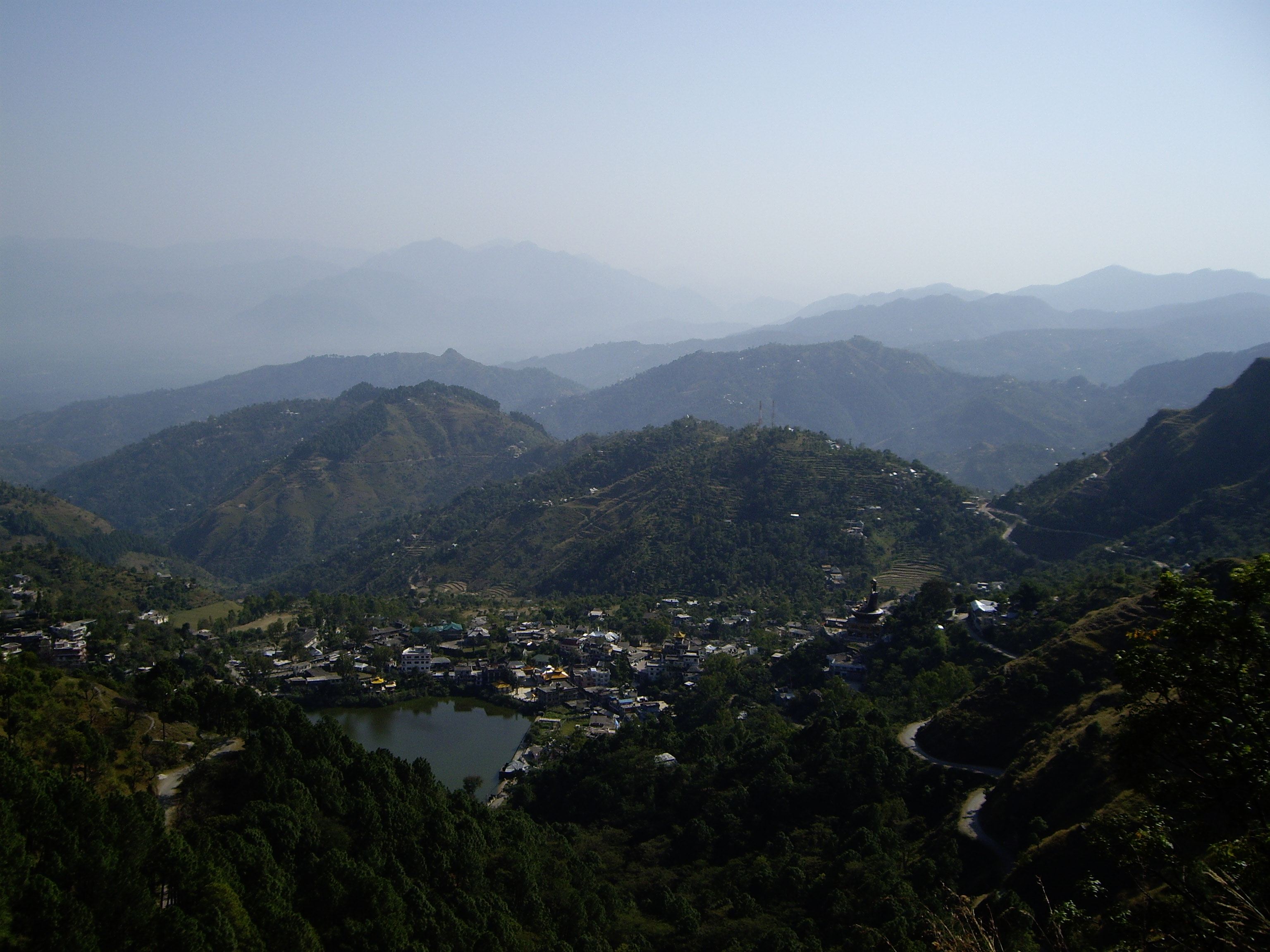
Rewalsar Lake

Tso Pema, Himachal Pradesh, November 2000

Tibetan mani mantra audio: Mani mantra

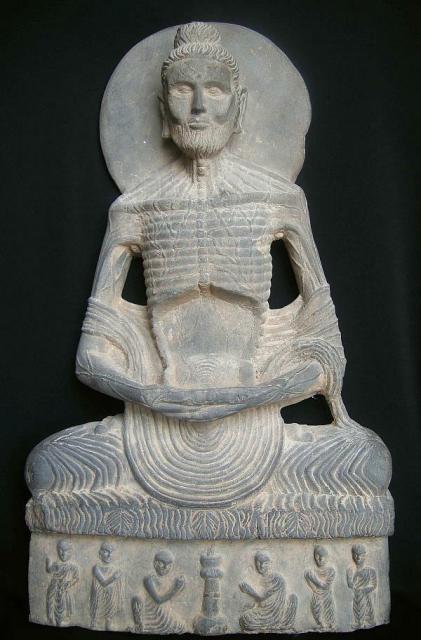
High-classic Gandhara style, Pakistan. Circa 2nd/3rd century AD. Carved from a hard grey schist. Recovered from Swat, Pakistan, early 1960’s.

 In his well-known advice to the Kalamas, who have expressed confusion and doubt around the truth-claims of different spiritual teachers, the Buddha makes a remarkable injunction. Walpola Rahula calls it “unique in the history of religions.” [1] In the Kalama Sutta, the Buddha says that

Yes, it is proper that you have doubt, that you have perplexity, for a doubt has arisen in a matter which is doubtful. Now, look you Kalamas, do not be led by reports, or tradition, or hearsay. Be not led by the authority of religious texts, nor by mere logic or inference, nor by considering appearances, nor by the delight in speculative opinions, nor by seeming possibilities, nor by the idea: ‘this is our teacher’.[2]

This extensive list of negations begs the question of just where the Kalamas might find the reassurance they seek. If Buddhism is valued as a religion teleologically grounded in praxis rather than metaphysics, such an injunction clearly carries a primary significance. The Buddha also, of course, recommends the Four Noble Truths and Eightfold Path and encourages the institution of a renunciate order which embodies and substantiates that model. Yet here at least the implicit suggestion is that prior to any concession to it, must come individual (rather than consensual or authority-mediated) judgement of the model as such.

One implication of the Buddha’s words is that the only source the Kalamas can look to for any certainty is one that is already in their possession, in their own capacity for judgement for what is (the Buddha goes on to say): ‘good and wholesome’ (kusala). The question still remains then, in what precisely does such judgement consist? And more specifically, in what final subjective authority does such judgement inhere? Because the Buddha has already made it clear that in virtually every sense it cannot derive from an external or social, and so in some sense unreliable, source. It can’t even, finally, rely on the revelation of the Awakened One himself: “a disciple should examine even the Tathagata himself, so that he might be fully convinced of the true value of the teacher”.[3] This clearly begs another question: How can a disciple judge the true value of a teacher without having some prior sense or understanding of what it is that makes a teacher valuable? That is, of knowing already, in some sense, what the teacher claims to know?

Siddhartha Gautama faces the same problem. He at least twice leaves everything to seek his own way.[4] He enters into a second renunciation when he leaves first his Brahmanic (probably Sankhya) teachers, and then his yogi colleagues after six years of forest austerities and practice with them, for an absolute solitude without the validation or religious succour of a worldly authority, or a rishi, or a father figure[5].

This moment of the Buddha’s pre-enlightenment experience – what I’m calling his second renunciation – has received little if any exclusive scholarly attention[6], and its possible ‘genetic’ relation to the developmental shifts of Buddhist practice beyond its traditional cultural bases, essentially none at all[7]. In their recent university-level textbooks for example, each published within the last 5 years, Prebish & Keown, and Donald Mitchell, are typical in framing Gautama’s progress as simply that of an aspiring mendicant who remains technically unsatisfied with existing yogic disciplines and their results. The question of autonomy as such, or its implied need, is not raised.

But Gautama’s second renunciation, much less generally remarked than that of his first, is different and more subtle because it appears to be a response to his own failure in the mission he has originally abandoned his worldly life to pursue. The deliverance Gautama has hoped to secure with his Sankhya teachers Alara Kalama and Uddaka Ramaputta has left him dissatisfied, despite the great discipline and awareness to which he has attained.[8] (Karen Armstrong at least, in her biography of the Buddha, thinks so). Gautama needs to go back, by going forward, to look at the assumptions and first ground from which he has started out. His received religious and intellectual structures have internally failed him, and the only thing he has left to guide him is his own intuitive process. That’s a rudimentary characterisation, but all that can really be said on the evidence, yet it is still telling enough for that. Because if it sounds familiar it might be because a similar state of spiritual affairs is being articulated with increasing transparency by many (not all) of the elders of what is known as ‘Western Buddhism’.

In a discussion of Buddhist studies in a postmodern context, the American scholar Mark Unno suggests that “the power to doubt thoroughly, to examine critically, and to recognise the truly radical character of intellectual, cultural, and religious diversity in a multicultural world are integral to the project of Buddhist thought in a postmodern world”.[9] Such doubt finds a lucid respone in the well-known theses of Stephen Batchelor, as a self-described “agnostic [now in 2010 an atheist] Buddhist.” Without dwelling on Batchelor’s well-rehearsed interpretations of rebirth, karma and Mahayanist cosmology, it is more to the point here to focus on how he grounds his sense of doubt in the existential immediacy of the question from which it emerges. He says,

The way of the Buddha is a living response to a living question. Yet whenever it has become institutionalised its vital response has become a well-formulated answer. The seemingly important task of preserving a particular set of answers often causes the very questions which gave rise to those answers to be forgotten.[10]

Stephen Batchelor

Batchelor values as primary the “stammering voice that asks the questions”[11] because without it authentic spiritual enquiry becomes compromised by that shift of focus which, after Heidegger, supplants “meditative questioning” with “calculative questioning”[12]. For Batchelor, calculative questioning based on a prescriptive reliance on dogma renders the original imperative of all spiritual practice misdirected: “Belief, whether in a teacher, a doctrine, or even one’s experience, retreats from the questions behind a shield of protective views and concepts”.[13]

For Batchelor, original ignorance is compromised by a largely conceptual, even defensive, frame of representation inadequate to the depth of need which introduced enquiry in the first place. Conceptual security is more serious than a category mistake, because what is really at risk is not so much truth as genuine insight. Significantly, the doubt that questions is also potentially “a response that leads not to further knowledge about any particular thing but to wisdom as a whole”.[14] He also suggests that “this existential perplexity is the very place within us where awakening is the closest. To deny it and adopt a comforting set of beliefs is to renounce the very impulse that keeps one on track”.[15]

Batchelor’s proposition points up a paradox: the doubt that maintains an authentic and so groundless frame for itself “can never rest content with any answer”,[16] yet it is only via such a consistent modus of uncertainty that questioning ultimately, at least for Batchelor, provides the space for a “wisdom of the whole” – not an ‘answer’ per se but a ‘response’ to questioning as a Gestalt – to emerge. The form the response takes cannot be necessarily pre-empted by any one view, Buddhist or otherwise – even where such a response might identify as a Buddhist one.

John Makransky’s critique of Batchelor’s “bad habit” of ahistoricism in “[asserting] a new hegemony over Dharma by re-constructing it narrowly within the presuppositions of his own place and time (in his case, a post Western-enlightenment agnosticism)” overstates the case, but would be true enough if Batchelor’s intention was purely that of an attempted re-authentication of the Buddha’s original teaching. But that is the lesser concern of Batchelor’s project, which is oriented purely to effective, meaningful praxis. And praxis in this case is a-historical, insofar as self-reflexive consciousness has no choice but to engage with the givens of its own phenomenological content, rather than try to historically objectify (and so conceptually mediate) everything it perceives.

Why Batchelor’s apparent bias towards a ‘post Western-enlightenment agnosticism’ is such a bad place to start from is also unclear. The position is shared by much of the advanced contemporary mind in its engagement with the latest research in science, social theory, ethics as well as religion. His Holiness the 14th Dalai Lama, for example, is very sympathetic to its sane humanity, as against (for example) exclusivist fundamentalism of any colour. Batchelor is only being true to his time, which on Makransky’s own analysis of the evolution of the dharma is what all travellers on the dharma-path must be in any case. How any temporal, conditioned, socially-constructed view is capable in any case of “asserting a hegemony over Dharma” (Makransky uses a Capital D), is left unexplained. Batchelor would be the first to disclaim even that possibility, and the dharma under that designation would seem big and old enough to look after itself. Despite the doubt and scepticism from which it emerges, Batchelor’s working position however is succinct and unambiguous, even while it leaves all answers open: “The end for which the Buddhist path is a means can only be the penetration of this mystery of being thrown into birth only to be ejected again at death”.[17]

Such an existential focus is central also to the work of Professor David Loy. As a speculative philosopher and Zen-contemplative of transpersonal social identities, Loy has for twenty years articulated many of the shifts of emphasis in evolving Western representations of the dharma. In Lack and Transcendence (1996), his recontextualisation of Buddhist doctrine provides a philosophical underpinning to the kind of emergent dharma evident in a wide cross-section of contemporary Buddhist practice.[18] Loy proposes that a deep intuition of the ontological un-reality, or groundlessness, of the subject-self, gives rise to the complex of anxiety and displacement reactions that characterise contemporary unhappiness.[19]

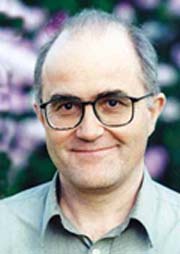
Professor David Loy

He says

our lives suffer from a lack of meaning that disguises itself as consumerism and a host of other addictions. Having lost our spiritual grounding […] and more recently our faith in technological progress as an alternative of self-grounding, we experience our groundlessness as an unbearable lightness of being. The tragic dialectic between security and freedom reasserts itself: having attained some measure of self-determination and confronted the lack at its core, we now crave the grounding that would connect our aspirations with something greater than ourselves.

Yet, we soon find, as does Siddhartha Gautama in his initial religious project, that such grounding isn’t ultimately forthcoming: the terms shift, states arise and pass, no final certainty waits on either the secular or religious horizon.

Loy describes both Western existential and psychoanalytical analyses of the ensuing anxiety as ones which recognise the repression of death-awareness (in Becker and Heidegger), as well as the ontological ‘nothingness’ inherent in consciousness (in Sartre), as the bases of human suffering, but suggests both analyses are inadequate to the further analysis which Buddhism provides: the ultimate emptiness (sunya), of selves, the phenomenal world, and consciousness itself.[20]

For Loy, Western anxiety as an epiphenomenon of ontological doubt is in fact a necessary and useful signal of authenticity: he aligns it with Kierkegaard’s positive analysis of Angst which when deeply contemplated potentially yields to an apprehension of the presence, and salvation, of God, or in Buddhist terms, the actual emptiness of self.[21] Unconscious Western attempts to displace the ontological insecurity of an illusory ‘I’ in reifying self-investments in fame, material wealth or the romantic projection of personal love, are all deferring the profound truth modern anxiety might be pointing to: that the foundational image of ‘self’ that Western civilisation both exacerbates and struggles with, in a vicious circle of dependency, has reached a critical point of self-doubt in the same way that Zen Buddhist contemplation, for example, deliberately struggles with its Great Doubt in order to ascertain the ‘right view’ of sunyata.[22] Religious (including Buddhist) faith itself might therefore for Loy function as only another ‘displacement’ of doubt, an aggrandisation of the illusory self, so still another form of ‘bad faith’.[23] In Loy’s analysis then, and much like Batchelor’s, doubt is a directly functional, already-pervasive and essential, element of authentic spiritual enquiry – ironically, the ‘ground’ of an ultimately illusory struggle that nonetheless is precisely the grist for the spiritual mill that must be faced before the truth of the so-called ‘Buddhist’ apprehension of sunyata might be realised.[24]

We can now briefly return to Gautama, the soon-to-be Buddha. Why does he register such repeated doubt, such moves toward some version of autonomy, a total freedom from his prior context? What is it saying about his process, that he is compelled to do so at all? Is it a frustration, or an essential development? John Caputo, with respect to the contemporary Western philosophy of religion, approves of a Derridean “messianic postmodernism”, or negative theology that is both radically subjectivised (after Kierkegaard) and post-secular, and with Derrida he invokes the Abrahamic “I am here!” as its fitting expression. Kyongsuk Min responds to such a focus on a radical, subjectivised alterity with the suggestion that “a periodic ‘contamination’ of religion with negative theology should be a wholesome exercise that would challenge each religion to transcend its determinacy and probe its own messianic depth for the impossible possibility of the wholly other.” Note the use of the word “wholesome”, or, returning to the Kalama Sutta, the Pali “kusala”. I would claim a congruent dynamic in the current case, both of Gautama’s process (pace progress), and some dimensions of that of Western Buddhism at the current time.

The Buddha’s ‘second renunciation’ interrogates the notion of progress itself, because most simply it is not clear what there is to be won. It is a moment that appears to escape, for example, a convenient explanation of ‘perennial’ vs. ‘culturally-constructed’ mystical experience (as if such experience need be so temporally-framed). The force of Gautama’s action, simple as it is, is both negation and aspiration towards an unknown, it metaphorises a nexus of conclusions, as well as new beginnings, to his journey. The Buddha is not yet a Buddha, he is a man merely, paradigmatic of the human condition in a form he will later not be accessible to as the Awakened One. There is a threshold between Gautama’s profane status as a man, and that of his divinity, where he will become both epiphanic Man, and wholly unrecognisable as ‘one of us’.[25]

Another senior Western post-Buddhist, who has made a career out of the testing of ambiguity is Alan Clements. As a former monk, Buddhist teacher, culturally engaged dharma-activist, stage-monologuist and (self-described) “spiritually-incorrect revolutionary of the spirit”[26], Clements is concerned to ground dharma practice in individual subjective experience, particularly insofar as that subject responds to the pressing background of human rights and critical global conditions.[27] Clements has spoken of his own apprenticeship as a monk  in Burma under the guidance of Sayadaw U Pandita:

I apprenticed with him [and]…learned the artistry, so to speak, of manifesting a more liberated expression of being. In that process, however, there was something else that came through that I would call ideology, dogma, religion…Suddenly, here was this whole Buddhist cosmology – a doctrine of totality – right in front of me. Resplendent with karma, rebirth, heaven, hell, nirvana, psychic powers and Buddhahood, spiritual perfection itself… One predicated on the belief that the Buddha was omniscient. It took me seven years…I downloaded an entire religion.[28]

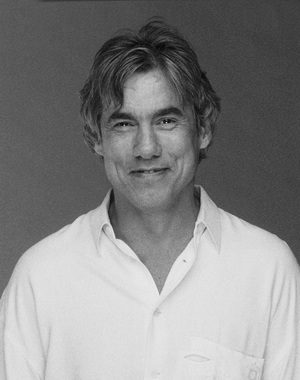
Alan Clements

After seven years as a monastic, Clements disrobed to work as a lay retreat-leader and teacher of Vipassana meditation. Some years later the country that had sheltered and taught him the centuries-old authentic practises of Theravada self-enquiry was engulfed in totalitarian tyranny: his fellow-monks and friends imprisoned or killed by the rampaging military of General Ne Win, threatened by the nation-wide thirst for democracy. Clements re-entered Burma illegally, with a spontaneous desire to aid his friends in their hour of need: a remarkable impulse, when he might easily have returned to the comfort of worldly security in the U.S.A. He describes the return as such: “Once in, my heart cracked open. No amount of meditation or spiritual training could have prepared me for what I witnessed. I walked into a full-scale ‘ethnic cleansing’…My views about life and the dharma have never been the same”.[29] His subsequent experiences in the former Yugoslavia during 1995, perhaps still more horrific, only confirmed this profound confrontation with life unmediated by a frame of potential transcendence, release into nirvana, hopes of a pure realm: such intentions became, literally, irrelevant.[30] The confrontation, however, could only result in a deep awe of actual conditions, not a supposed transcendence from them. It seemed to Clements that if there was such a thing as ultimate ‘freedom’ from such conditions, a state where their currency of suffering didn’t exist, it would only be by enquiring radically into the self-nature of the world as it is, rather than, emptiness-wise, as it isn’t, that it might be found.[31]

Further, the assumption of a transcendent freedom might have its own bases thereby interrogated, only narrowly engaged with the task of being ‘in’ life, rather than outside of it – somewhere, hypothetically, ‘else’.[32] Clements’ extreme experience was able to deliver a powerful moment of insight, an awareness of the indivisibility of experience as both the mysterium tremendum and only ontological ground from which to perceive the same: “there is no other life”.[33]

For Clements Buddhist practice also becomes grounded in a paradoxical reversal as well as fidelity to its traditional formulation: unless it is inspired by a thorough investment in this world and its multivalenced process (as against, for example, the total renunciation of the Theravada), it is a gratuitous project which loses meaning precisely by virtue of its unworldliness.[34] Yet insofar as it grounds itself in a commitment to the Other, it is also a classically Mahayana path, which only insists that renunciation, also, be revisioned as an engaged but unattached relation to the world, rather than a dualistic dismissal of it.[35]

Clements perhaps goes further than Batchelor in dismissing the idealist claims of full Buddhist enlightenment while preserving a genuine commitment to the dharma as a rubric of relatively ‘enlightened’ and compassionate action in the world from a cognitive dimension that perceives interdependent reality more accurately and truly.[36] While his repudiation of teleological enlightenment as unhelpful to his intentions now disclaims him as a Buddhist,[37] Clements is centrally concerned to acculturate Western, individualised agency to the kind of “revolution of the spirit” he adopts from Burmese pro-democracy leader Aung San Suu Kyi.

Again, like Batchelor, Clements’ scepticism towards the full spectrum of metaphysics doesn’t deny a fully engaged commitment to Buddhist ethics in lived life. With this realisation, and his subsequent evolution into what might be described as a non-aligned, non-religious, life-affirming, existential-immanent dharma, Clements articulates a difficult spiritual value that is both wholly traditional as well as radically contemporary. It is a position that valorises both, focussing deeply on its own expression of authentic freedom: that it is to be found in the given context of everything that has formed the unique self, rather than it’s ‘not-self’, even where that self partakes freely in an ancient and coherent class of universal religious values.[38] Clements is facilitating that empowerment in which the unique actual self, in its engagement with a plethora of competing metaphysics (even within the buddhadharma alone, let alone other religious systems), is able to enter into a process of awakening, itself necessarily unique, from the authentic ground of experience as-it-is.

The Buddha famously described the dharma as a raft that is used to cross the river of dukkha, but that it may confidently be relinquished once the other side of suffering is reached. The statement implies a truth the value of which is not merely that of a literal, diagnostic prescription, but more deeply symbolises the dharma as a container, a vessel, an alchemical crucible for the transformation of immaterial consciousness, and it too as empty of inherent existence.

Batchelor, Loy and Clements similarly seek a revalorisation of the primary, even primordial, intuitions of Buddhist enquiry: without such a focus on the properly individual sources of existential disquiet, any subsequent adoption of a rationalised schema for belief or action potentially risks neglecting the origins of authentic spiritual transformation. Such a stance, defined in the three moves of doubt, groundlessness and autonomy is confirmed almost to the word in Unno’s claim that

Doubt as a formal principle of enquiry, critical reason as an autonomous faculty of systematic thinking, and the self-reflexive location of subjectivity as integral to a larger, discursive objectivity are three important moments in the development of theology and religious studies in a diverse postmodern world…

But the story still requires a conclusion. Near Uruvela, on the banks of the Nairanjara River, Siddartha Gautama almost dies during his period of crisis. Armstrong vividly describes him as clad in hemp, or naked, growing dangerously malnourished, subsisting sometimes on only his own faeces and urine. Is this derelict the future Buddha? What has happened here, where are his dignity, his signs of inevitable transcendence? His spine meets his navel, his hair falls out, his skin withers and blackens. Even the gods, passing by, ignore him because he seems already a dead man. These details are in the Majjhima Nikaya, but what do they signify? Why would the Buddha be reduced to this just before his miraculous breakthrough? Because he must endure such trials in order to discover the unparalled life that lies on the other side of them? If so, is that also the case with what immediately follows?

Because what follows is that Gautama realises he has failed his ascetic companions, who look to him as their superior, and must leave them too. He could give up and return to his earlier teachers: for the company, to belong if anything to some human guild; he could even return to his wife and child waiting in the palace. (In some sense he hasn’t really succeeded even in leaving there, is still as “doomed to rebirth” as any householder).

But he doesn’t. He leaves – again. There is no-one who can tell him, now, where it is he needs to go. He could simply stay where he is, but he goes again, to somewhere new, and this time he goes there on his own. 

(A paper presented at the Australasian Association of Buddhist Studies (AABS) conference, Sydney, Dec. 2007)


Copyright © 2007 Martin Kovan


NOTES

[1] Rahula suggests it is “unique in the history of religions” (1974: 2-3).

[2] Sharma, Arvind 1997: 140

[3] Ibid. p. 141

[4] Armstrong, Karen 2000, p. 56-9.

[5] Trungpa, Chogyam 1985: 11-12.

[6] Prebish & Keown (2006: 33-35) and Mitchell (2002: 16) are representative in framing Gautama’s progress as simply that of an aspirant mendicant who remains technically unsatisfied with existing yogic disciplines and their results. The question of autonomy as such, or its implied need, is not raised.

[7] Doubt, however, as a functional dimension of dharma practice is considered in Sharma, 1997, Goldstein, Joseph 2002; cf. Nishitani, Keiji1983 and Abe, Masao 1986, 1997, on the “Great Doubt” of Zen.

[8] Armstrong, op.cit.

[9] Unno, in Jackson & Makransky, 2000: 196.

[10] Batchelor, Stephen 1990: 3

[11] Ibid.

[12] Ibid. p.37 ff.

[13] Ibid. p.3

[14] Ibid. p.4

[15] Ibid. p.16

[16] Ibid. p.4

[17] Batchelor, op. cit. p. 10

[18] Loy’s thinking works within a Western philosophical academic frame informed by a decades-long Zen Buddhist practice and residence in East Asia: any study of Buddhist theory requires, from the beginning, more than a purely cognitive apprehension of its ideas. By its nature, Buddhist metaphysics points towards a thorough cognitive, self-reflexive exhaustion of (erroneous and other) conceptual frames, with the direct view to seeing-into and beyond them. (Loy, 1996: 24, and Abe, 1986: 4). Similarly, in a discussion of the norms for contemporary academic Buddhist theology, Cabezon sees such equal valorisation of theory and contemplative praxis as grounded historically in the Indo-Tibetan tradition: “…it’s attempt to balance theory and practice – the conceptual study of doctrine and its internalisation in meditation – serves as a continual reminder that the Buddhist theological task must take both into account, and that it can be reduced to neither” (Jackson & Makransky, 2000: 34. Cf. also Alan Wallace, B. 2000: 67 ff. in the same volume.) This point also applies equally well to the work of Batchelor and Clements as longtime meditation teachers.

[19] Loy, 1996: 12ff.

[20] Ibid. p.xiii. Similarly, the Buddha struggled with a binary polarisation between the essentialism of the Hindu Vedanta and the substantial existence of an atman-Self, and the nihilism of absolute non-existence, before he could arrive at his own apprehension of the Middle Way emptiness of dharmas and selves. (Nagarjuna, 1986: 9).

[21]Loy, 1996: 64-5. (For a parallel analysis, cf. Abe, 1986: 6-7).

[22] Ibid. p. 172

[23] Ibid. p.62

[24] cf. Abe, 1986: 14.

[25] Schuon points to the ambiguity: “To transcend the ego is to transcend the human, although one could say, from another point of view, that this transcending is “human” in the sense that it constitutes the specific excellence of man or his supreme aim.” Schuon, Frithjof 1993: 13-14).

[26] cf. also Clements Spiritually Incorrect DVD, 2006.

[27] Clements, 2003.

[28] Inquiring Mind, Spring, 2003 (hereaf. IM).

[29] Ibid.

[30] Clements, 2003: 183 ff.

[31] Ibid. p. 184-8

[32] Ibid.

[33] Ibid. p. 195-6

[34] Ibid. p.186

[35] Ibid. p. 206 ff.

[36] Ibid. p.187

[37] personal communication, 6 July, 2006

[38] Clements, 2003: 244-9

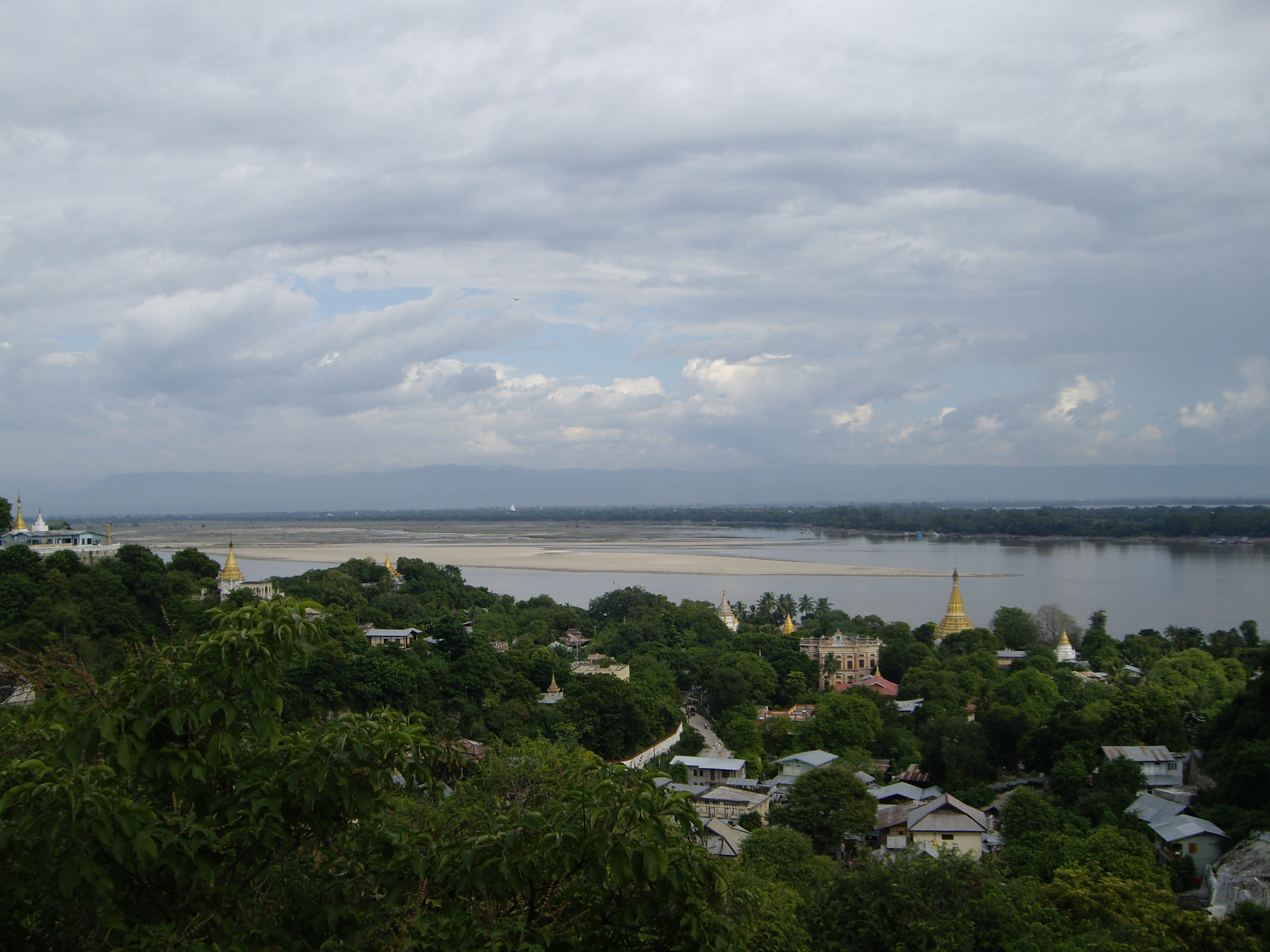
 The beautiful Sagaing Hills, an area some thirty kilometres out of Mandalay in central Burma, is home to a rich diversity of Buddhist retreat culture. There are hundreds of monasteries and nunneries, lay-retreat meditation centers, colleges and other educational institutions to be found there, housed in quiet hermitages, attractive old colonial outposts and more modern monastic facilities. There are innumerable examples of the typically golden-spired Burmese pagodas rising up out of the rich green foliage of the hills, that themselves border and rise away from the tranquil broad banks of the Irrawaddy River.

view of the Irawaddy

It is a remarkably serene, limpid place, only the occasional sound of amplified Buddhist chanting joining the atmosphere of repose and ease that imbues the life here. Sagaing is the Burmese equivalent of Indian ashrama culture, where many Burmese come after retirement to devote themselves to matters of the spirit, and a personal discipline in Buddhist study, meditation and ethical living. The often beautifully elegant pagodas, monastery temples and shrines are testimony to this culture; the people likewise, monastic and lay, move along the roads with a calm and gentle eye – even the numerous street denizens of dogs and cats suggest a life of renunciation from strife and discord.

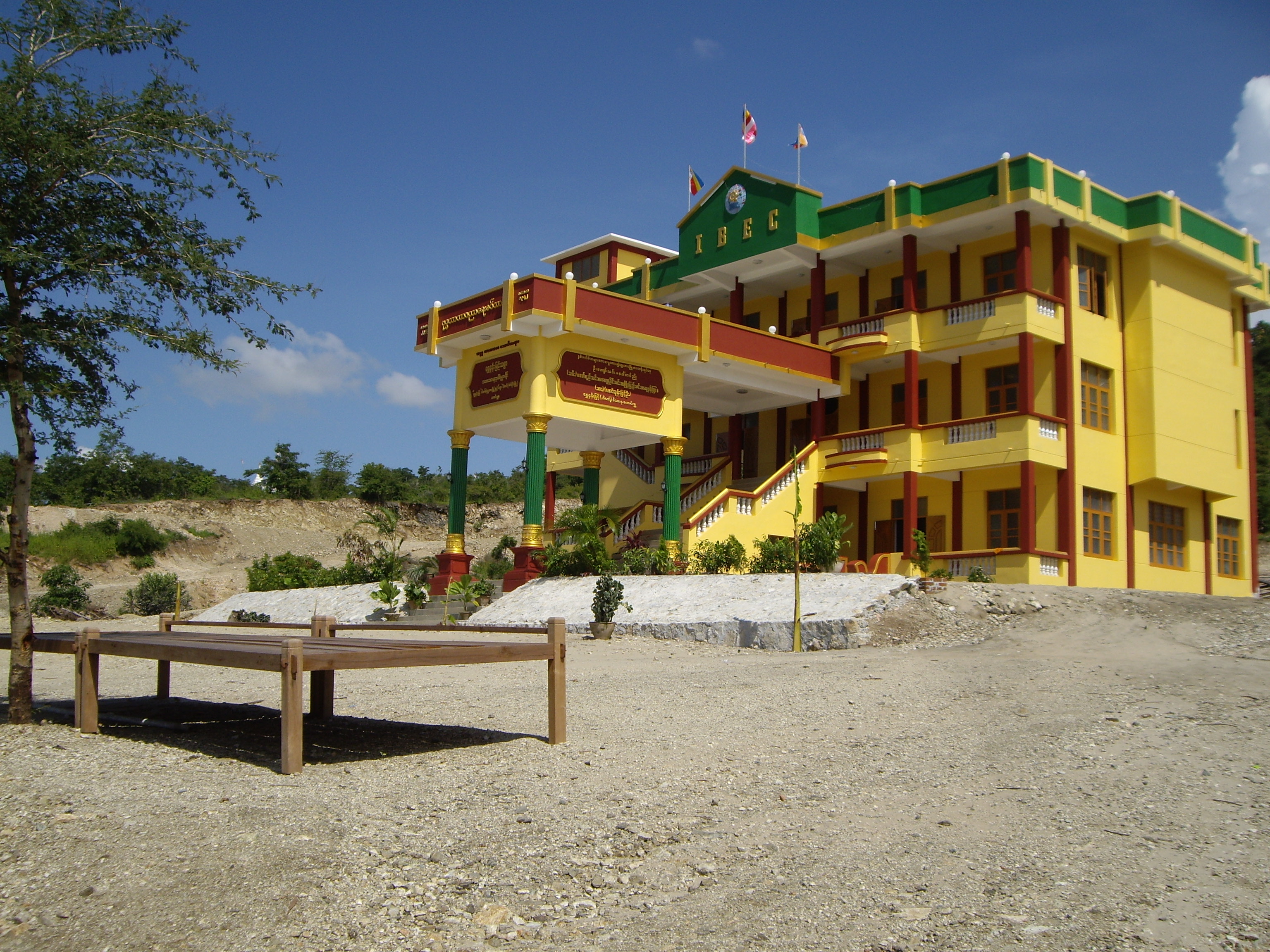
I.B.E.C. main building

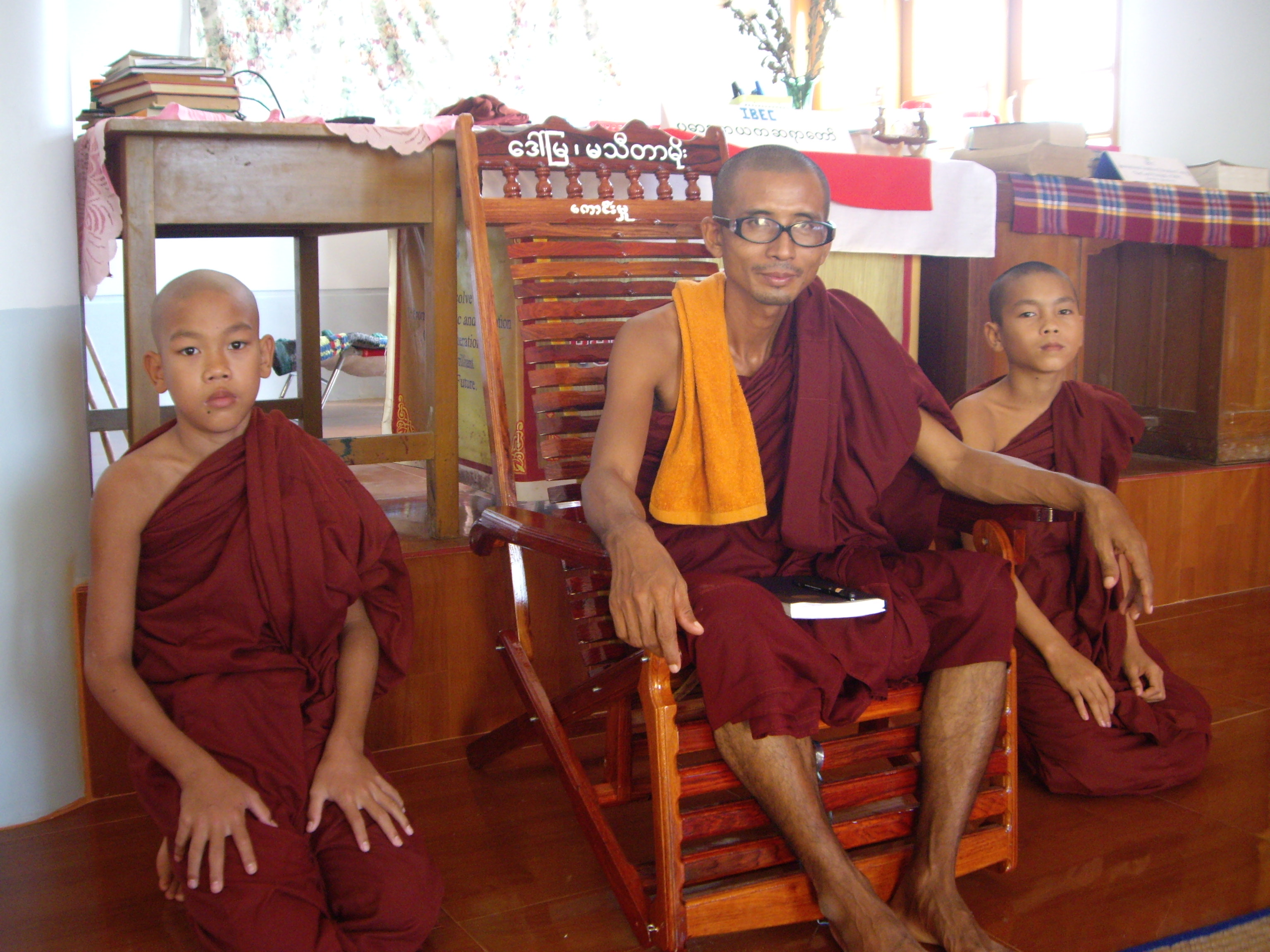
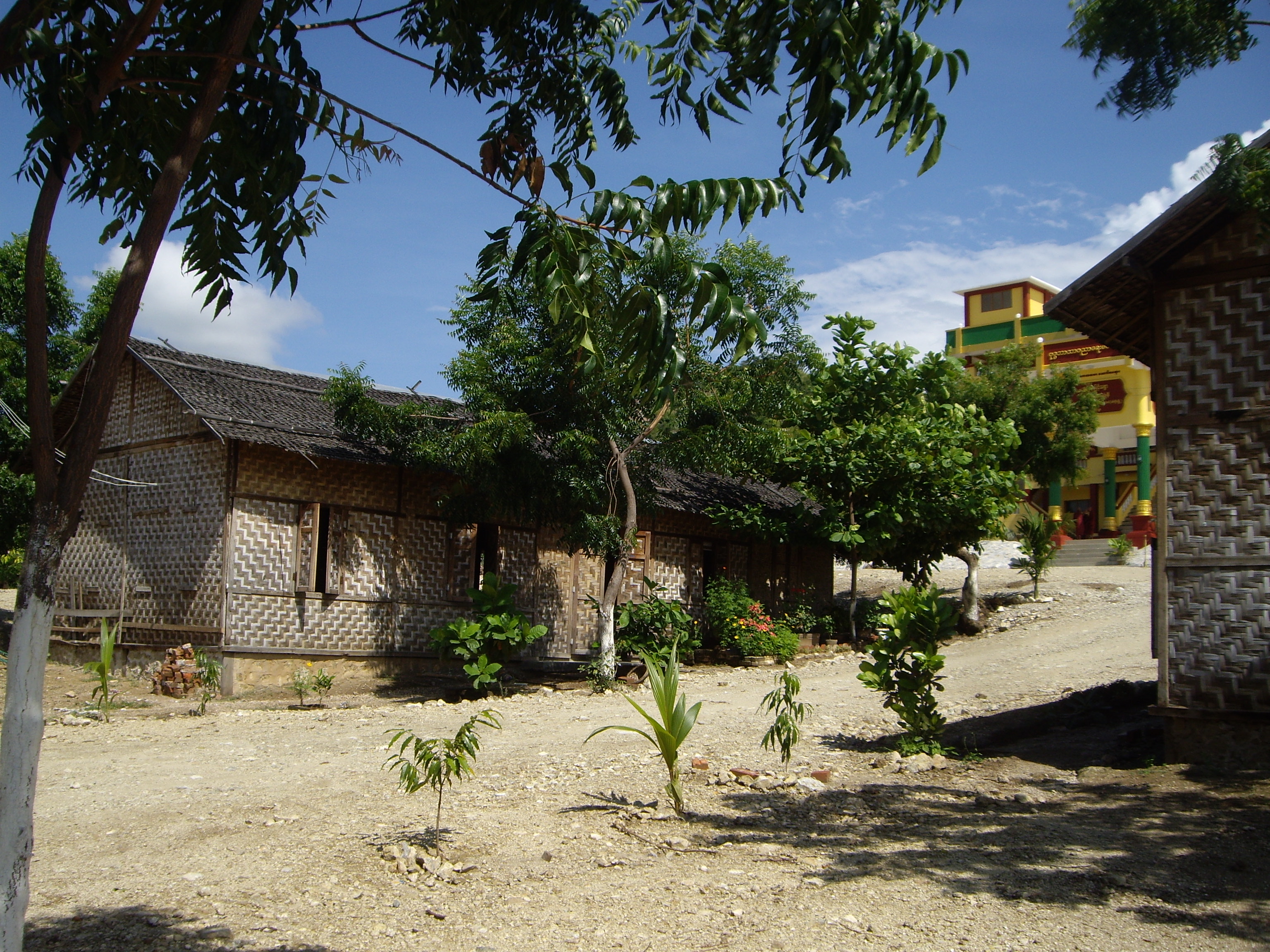
Beyond the dirt roads of a small village and rising high above the outlying area into the topmost of the range of the Sagaing hills, is the newly-developed International Institute of Buddhist Education (IBEC). Initiated in 2006, the new monastic and secular educational institution now houses nearly one hundred young monks, a new and impressive central teaching and administrative building (see attached photos), a library, classrooms, several outbuildings and an eating and cooking area. Its principal director is the Venerable Ashin Sobhita, a young but already highly respected Burmese senior monk who with eight other monk colleagues has been a guiding force for the establishment of IBEC since its founding.

Venerable Ashin Sobhita and monks

Many of the young monks who have come there have sought refuge from broken families, poverty and the vagaries of life under a totalitarian state regime. Their ages range from five to twenty years old. Many are orphans and others simply seeking a better educational prospect than the public schools often too expensive for their means. At IBEC the educational curriculum includes the secular national curriculum of the sciences, Burmese, English language, history and mathematics, as well as the Buddhist training program. This latter consists essentially of two main areas: Priyati, or the text-based study of the Pāli language in which the corpus of Theravada Buddhism (of Burma, Sri Lanka and Thailand) is written. This includes a thorough oral and aural training in the suttas, or original sacred texts of the Buddha, in the vinaya or monastic codes of discipline for Theravada monks (and nuns), and the abhidhamma, or more technical philosophical and psychological treatises analyzing the nature of mind, consciousness, emotions and samsaric ignorance, and the Buddhist path to awakening from such ignorance. All three of these areas of study constitute the three traditional ‘baskets’ of Theravada (indeed all Buddhist) study, the tripitaka.

Along with this category of priyati, goes the study of pripati, the practical aspect of meditation and devotional ritual which puts the more theoretical study of priyati into a dynamic context of self-enquiry, ethical relations with others and especially the teacher. In pripati also the monk develops a personal faith and devotional symbiosis with the symbol of the Lord Buddha, such that all his efforts and studies gain the added blessing of the richness of 2,500 years of Buddhist tradition inspired by its great founder. The Theravada in Burma, as elsewhere, is thus eminently pragmatic and rational in its philosophical orientation, as well as being steeped in values of respect, humility and selflessness.
All the monks live together, sleep, eat and wash in common quarters, their only personal possessions being usually a tin trunk which designates their sleeping-space on the floor of one of the buildings, holding only their robes, books, study-materials and Buddhist ritual objects. The monks appear to live happily and comfortably in this traditional Buddhist manner. There is a lot of laughter, a lot of time for outdoor sports, or indoor reading during the hot hours of midday, as well as personal consultation with their teacher. Every morning and evening – a feature comparatively unique here, and not commonly practiced in the Tibetan monastic schedule for example – all the monks gather in an assembly for 45-minute sessions of meditation. Here, as in their more theoretical study, they follow the essential twofold practice of both samatha, and vipassana meditation methods, involving a foundation in mental calm-abiding, or equanimity, followed by analytic or insight, depth-meditation practices, respectively. Their teachers are always on hand to guide and supervise their practice. IBEC functions as a remarkably inter-dependent community of Buddhist enquiry and training, the intention for the Buddhist goals of awakening to wisdom and compassion that has its earliest beginnings in the first Buddhist sangha.

The secular educational component is also strong at IBEC, and some half-dozen trained, and often quite young, teachers live on the premises in their own dwellings, some distance from the central monastery buildings. Many of these teachers have received their education in Rangoon or Mandalay or other large cities, but prefer to live in the semi-retreat conditions of Sagaing in order to pursue their own Buddhist interest. Indeed, the entire institution functions as a Buddhist refuge for both monastic and lay interests; some teachers are part-time professionals who come to spend a shorter period living on the site and offering their expertise, whether it be English-language teaching, IT training or technical know-how. Some of them might be local people, educated but suffering personal travails that demand they seek some ‘time out’ from urban pressures.

Many others, and there have been at least a dozen teaching volunteers as well as newly-ordained monks and nuns, are Western travelers who come to appreciate the unusual and idyllic possibilities somewhere like IBEC, and its surrounding context, offers someone who in the West has perhaps less choice of lifestyle, and at a much higher cost. Those who come to IBEC as volunteer teachers receive food and board, along with the other resident teachers, at no cost. Several of the Western teachers have been able to ordain at IBEC as monks and nuns in the Theravada tradition, for shorter or longer periods, and with the full support of the resident sangha. Mandalay is only an hour or less away, so some volunteers also combine their experience at IBEC with commitments they might have in the city. The flexible ease of options at IBEC appears to work excellently for all concerned.

Venerable Sobhita hopes to add further extensions to the existing housing and teaching buildings on the site, as well as computer-lab and multimedia facilities for seminars, conferences and seasonal retreat services offered by IBEC in the future. He envisions IBEC and similar Buddhist institutions as offering an alternative to the state-run educational system, often limited in its scope and too expensive for poorer and disadvantaged people, and for developing a genuinely global and tolerant perspective on other religious faiths.

He also sees IBEC as being able to foster an ethical expertise in being able to train sangha and lay-people alike for many of the social and political challenges that face Burma as well as the world at large. He welcomes visits and/or donations to IBEC from anyone with a sincere interest in Theravada Buddhist teachings, and especially those who seek other possibilities of life in environs unlike those they know in the urban megalopoli of the East and the West.

Sagaing is a quiet, idyllic place where it is easy to forget the troubles of the greater world, yet where better to start the work Venerable Sobhita describes? And it would seem that the training and environment for Buddhist attainment could realistically be achieved here, where such an authentic example of the intentional Buddhist life flourishes so richly.

[N.B. Author’s note, May 2024. This article was first published here in late 2010. Since 2021 however, IBEC’s director Ashin Sobhita has become engaged in a public and international campaign to discredit the civilian effort to self-determination, and the PDF in particular, a stance with which I do not seek to be associated, and for which reason any prior support for Ashin Sobhita I entirely disavow. I’ve kept this article online purely in the interest of researchers on Buddhist institutions in Myanmar in the period around 2010.]

In early March 2002, Khin Zaw, pictured, stepped on a landmine while working as a hunter in the Wawlay Nyaing forest some four hours outside of the small Karen town of Myawaddy on the Thai-Burmese border. He lost his right leg, and with it any viable means of livelihood, and for eight years has lived exclusively from begging in the streets of Chiang Mai, in northern Thailand. Myawaddy is the site of recent (and decades-long) armed conflict between the Burmese military and a coalition of Karen independence fighters, including breakaway factions of the DKBA (Democratic Karen Buddhist Army) and the KNLA (Karen National Liberation Army). This more recent fighting of the past two months has killed many and resulted in a continuing exodus of more than 20,000 refugees from threatened villages into the Thai border town of Mae Sot, from where many are sent in short order back into Burma.

Among many of these refugees, in addition, are landmine victims, many non-combatants or farmers, or, like Khin Zaw, itinerant hunters pressed to work in dangerous areas to support, as he did, his family in the city. From that date in early-March, Khin Zaw has in fact not seen his wife and two children, now in their mid-teens, still living in Yangon. He has never been able to afford the ticket that far, and nor would his compromised physical condition permit him to find or be offered work in Burma – nor anywhere else. The stigma attached to the forced abandonment of his family and livelihood in Burma is palpable, and has in large part kept Khin Zaw from maintaining strong ties with his family in Burma. Nor does he have contact with brothers and sisters still living there.

While speaking with Khin Zaw, who I met begging on the main tourist strip of Chiang Mai (as he does seven days a week for four hours a day) discussion of his family introduces the only real moment of discomfort, clouds of pain overshadowing his otherwise warm, usually smiling face. Khin Zaw is learning English, when he can afford it, in Chiang Mai, but his friend and fluent English speaker Ajong offers to translate for us. They are both open and friendly, softly-spoken and tactful men, with an intelligent modesty of manner that seems to come naturally to many Burmese. It is a three-way conversation that illumines for me perhaps only some of the legal and socio-economic complexity lying behind the lives of Burmese illegal refugees in northern Thailand, though on the evidence it would seem Khin Zaw’s story is emblematic of many here, and in Mae Sot further south. As the conditions which have given rise to it are ongoing and critical, it seems equally as critical to bring awareness of such conditions to a wider audience. Khin Zaw expressed a happy willingness to tell me his story, and I am honoured to relate it here on his behalf.

When he stepped on the landmine, he relates, he was living alone but had work friends nearby who were able to carry him bodily through the jungle across the border into Thailand. The accident occurred at one in the afternoon, and they arrived at the Thai border town at nine that night, where the Mae Sot Hospital immediately took him into intensive care. Khin Zaw tells how he was largely unconscious during the journey and with the great loss of blood came very close to dying; were it not for the prompt and incredible service of his two friends, he would not have survived. He stayed in Mae Sot some three months in recovery, without cost, before being released into the general community. Dr. Synthia Maung from the Mae Tao Clinic in Mae Sot claims that 60 to 70 per cent of landmine victims who make their way there are civilians, many women and children. As an accident victim Khin Zaw could not be classified as a refugee, and nor did any of the NGO operations and their representatives approach him for economic or further social support. He relied exclusively on Burmese friends, until they too were unable to support him, and he felt he couldn’t expect more from their hospitality. So he returned, largely by necessity, to Myawaddy, and took up again in Wawlay district with his old workmates. But unable to work, having little longterm incentive to stay there either, and unable to reach his family in distant Yangon, he did as many do in his situation, and sought refuge in Chiang Mai, further north in Thailand.

But this is where the more intractable of Khin Zaw’s troubles began. As an illegal alien in Thailand, Khin Zaw, along with thousands of others seeking refuge from the fighting in Karen and Shan states, as well as the oppression in Burma generally, is constantly at risk of deportation. Indeed in the eight years since his accident he has been arrested nine times, imprisoned at length each time, and sent back into Burma at Tachilek, a crossover point for many refugees (and other travelers alike) linking to Mai Sai on the Thai side of the border. He is not entitled to a passport, or a visa for Thai residence, and in view of his injury, a work-permit. On every occasion of his arrests, the first in 2004, he has been forced to spend up to a month in jail each time, and most recently three and a half months, before the inevitable deportation to Tachilek. Altogether his periods of incarceration, an innocent victim of an illegally-planted landmine, have amounted to roughly nine months.

On each occasion also he has had to pay Thai police 5,000 Baht (c. US$165) in order to secure his release. Once across the border at Tachilek, which he soon leaves to return to Chiang Mai, he is ordered by Burmese soldiers to relinquish any valuables he might still have – whatever cash he carries, a watch, clothes-items, mobile-phone. His only saving-grace on the Burmese side of the border is that as an ethnic Burmese (Bamar), Khin Zaw is spared the beatings he has regularly seen meted out as a matter of course to his less-privileged, usually Shan (or other ethnic nationality) fellow-countrymen. It’s hardly surprising that under these conditions he chooses to risk again the uncertainty of life in Thailand, than remain in the effectively closed society of life under the military regime in Burma. He says that he loves his country dearly, but can’t live under those conditions. It is hard enough under most conditions available to him, as a handicapped man, but those in Burma make the suffering still worse.

Burma is one of only 17 countries that abstained from voting on a 2005 United Nations resolution to ban the use of landmines globally. The ruling SPDC (State Peace and Development Council), or its current manifestation in the nascent ‘government’ following the fraudulent elections of November 7, has similarly not acknowledged the Mine Ban Treaty. Recent figures on landmine accidents in Burma available from Landmine Monitor show a 90 per cent increase in 2007 from 2006 figures. The online Landmine and Cluster Munition Monitor reports that “In 2009 there were at least 262 new mine/explosive remnants of war (ERW) casualties in Myanmar…of the total, 259 casualties were civilians…In 2008, at least 213 civilian casualties (30 killed and 183 injured) were identified.” It adds that “Due to the lack of systematic data collection and varying sources of annual data, reporting does not reflect the full extent of mine/ERW incidents and casualties in the country. In 2009 the UN noted that many casualties remained unreported.” Other international monitoring organizations (such as Human Rights Watch) have also claimed that the Burmese military and insurgent armies using civilians to reconnoiter known landmine areas (known as minesweeping), acting effectively as mortal human shields, is prevalent as well. Other NGO workers, including Medecins Sans Frontiers, have withdrawn from working in Burma in part because of restrictions the government has placed on their access to landmine victims. The mines themselves are bought from, among other places, Italy and the U.S, and following Russia’s recent discontinuation of landmine use, Burma is now the sole non-participator in the aims of the global anti-landmine treaty.

Now 41 years, Khin Zaw remarried in Chiang Mai, and after a powerful conversion experience, became a Christian along with many of his fellow Burmese there. He speaks of the indubitable sense of the love of Christ, a direct emotional transference that he rarely felt in the more intellectual reasonings of his native Buddhism. He describes the doctrines of karma especially as too complicated and demanding to observe with real consistency, in contrast to the simple but deep faith in Christ that allows him to feel forgiven and purified whatever his current circumstance. Considering his consistent warmth and cheeriness, there is little doubt his Christian faith has given him much in pulling through the constant hardships of eight years.

I can only marvel at his resilience, as he lifts his carpet matting and crutches from his grubby spot on the street to catch a tuk-tuk home, after half a dozen ignore him as a social undesirable, an illegal, one of those of the social under-class in Thailand the local people tend  to avoid. It remains the case that no social support network can be relied upon by Khin Zaw in Chiang Mai, and even his church can’t afford supplements to his meagre earnings as a beggar – at most some 2000 Baht (US$66) a week. While I sit with him at his begging-post it is normal to watch long eddies of Western tourists and Thai party-goers pass him without notice, or for an occasional tourist flashing jewellery and cameras to stop and churlishly offer him a 20 Baht note (US 66 cents). Just around the corner the same tourist readily pays 400 – 600 Baht (US$13 – 20) to watch kick-boxing shows, or pay 170 Baht (US$6) for a drink. Such is life as usual in Chiang Mai, for Khin Zaw, and for those who pass him seemingly oblivious to this particular reality of the place and the time.

A day or so after our interview, Khin Zaw invites me to visit his church, and tells me he never fails to make it there every Sunday. I ask him how he gets there, and smiling expansively he says he takes a tuk-tuk. It costs him 100 Baht for the round journey, but he never resents the weekly cost. “I have faith,” he says, smiling. “You have to trust things will be ok”.


In downtown Yangon, exactly a fortnite before the country’s national ‘democratic election’ is due to be contested, life appears much as usual. People lounge and relax for hours over slow nickle pots of tea in street tea-shops, children run and play among vehicles and the detritus of roadwork, monks – and nuns, in miraculously clean, pink tunics with tan shoulder robes and brown umbrellas – make alm’s rounds through the streets, barefoot and impassive amidst noise, rain or traffic. Yangon is a colourful, if shambolic city, alive with a human warmth and vibrancy that rarely betrays a much deeper discontent beneath its vital surface.

Yet cracks do show, as much in the difficulties of daily life as in the spoken admissions of people from all walks of life. While the shaky infrastructure of much of Yangon is little different from that of a city in a poor Indian state (Patna or Kolkata for example) other less obvious constraints of communication and movement belie a much deeper malaise conditioning much of life here. My guesthouse proprietor is required to report to the local police registry office to submit details of all his current guests, sometimes more than once a day, reporting any knowledge of their movements and activities. This is ironic considering many areas of the country are off-limits to travelers, and even non-Burmese ethnic nationalities alike, so that both visitors and locals are unable to travel as freely as the expectation that they do so might allow. Perhaps the most practically curtailing proof of unreasonable control however comes in all online communication where even mainstream e-mail sites require overseas server providers in order to allow for a few snatched moments of web access, usually at the cost of a lengthy process of proxy transfer. Sometimes there is no access at all, and then the extent of Burma’s isolation from the world beyond comes clear, with a chill of recognition: much could happen here that could go unknown by both local and international news providers, or only until it might be too late. It is only a matter of moments before the barricades and cordons can be drawn up and lines of armed military personnel prevent any kind of open communication at all.

In my short time here, without eliciting any discussion of the election, I’ve been confided to by many people eking out a living as tea-shop owners, guesthouse workers, booksellers, taxi-drivers and beggars. Many have made it clear that they hold little faith in the coming election, others, especially younger educated people, try to preserve some optimism that a reasonably democratic procedure might begin to institute the reforms they expect is their due in voting at all.

Few have suggested to me that a boycott of the election is the only course to follow, and while emphasizing their fidelity to Aung San Suu Kyi and the now heavily compromised former NLD party, they profess her political power to be at an all-time minimum, and her career effectively closed. Yet they say this with a wistfulness that makes it very clear that while her political currency appears to have passed its peak, their personal faith in and love for who she is and what she means to their national identity is as undying as ever. Younger people I have spoken to look to the Student 88 party as most likely to hold some kind of legitimacy in the democratic cause, at least one with some political negotiating power, even as they are certain the USDP will win the election outright and current Prime Minister Thein Sein become the new leader of Myanmar under its auspices. It is hard to disagree with them, and everything seems to be confirming it by the day. Yet even this morning an apparent show of protest by some monks near the Shwedagon Pagoda, and the arrest of two of them, challenges that foregone conclusion. In this election anything could happen, and the coming two weeks hold much more radical surprises in store.

Trading English books with a bookseller all of eighty years, speaking through his two remaining betel-stained teeth, nothing was mentioned of the election until I was about to take leave of him. Then he cannily grinned and said, ‘And you don’t know anything about the election, do you?’ I quickly grinned back and agreed, saying, ‘Nothing at all! In fact, I’ve forgotten about it! What is it?’ He slapped his knees and burst out into laughter, two friends joining in, all of us laughing in a happy defiance as I crossed the road. A nearby police official looked askance at us, but we kept on laughing. There was a feeling that no matter who might be observing, the local people preserve an integrity and conviction intact precisely through such defiance, however passing. The irony also was that the book I’d exchanged with the old bookseller was a collection of Yevgeny Zamyatin’s short fiction: a great Russian writer repeatedly persecuted by Stalin’s Soviet regime, his life often threatened, until he had finally died in exile in Paris, obscure and largely unknown to the Russian reading public of the Stalinist and post-Stalinist periods. Yet his writing lives on, read now in English in Yangon. The old man shook my hand and thanked me and said he looked forward to reading the stories, brilliant parables of freedom eked out in unlikely places and through fragile human solidarities, just as it is in Burma today. In such ways the best of the human spirit survives, and triumphs in ways that Gen. Than Shwe and his minions seem deadened to, so great already is their loss.

Catching a taxi last night to the Shwedagon Pagoda to see the full-moon festival there, my driver (slightly drunk) told me almost as soon as I was inside how much he loved ‘Daw Suu Kyi’. By the time we arrived at the glittering golden stupa there were tears in his eyes, and he almost refused to accept my payment for the ride. Such is the warmth and faith of many of the Burmese people I have met here in only a short time. The overriding conclusion that can’t be avoided is that such a people deserve much better than the disrespect and humiliation the ruling regime mete out to them again and again in so many forms of curtailment of basic rights of expression, assembly, freedom of association and self-determination.

Two days ago I saw a man being led along Merchant Street, both his arms gripped hard by two black-uniformed military personnel on either side. The man was young, mild-faced and went passively; I don’t know what he had done that warranted his arrest, but he went almost willingly, as if he knew beforehand that it was only to be expected, had perhaps gone through the process before. I didn’t know if he had broken the law, or what passes for such in Burma, but it seemed certain that he, too, didn’t deserve to be led away, stallholders and bystanders craning their necks to see him go, to an unobserved interrogation, and perhaps many years in one of Burma’s notoriously inhumane prisons.

Life appears here to be business as usual, but deep beneath the surface a pride and strength of spirit speaks out loud, saying that the subjugation of fundamental freedom can only go so far, beyond which point everything will be risked to secure its eventual triumph. Perhaps this is the one thing in its people the ruling regime has failed to manouvre against, the one thing it will finally be unable to withstand. Whatever the election outcome in two weeks, the quest for genuine freedom isn’t over, and the election might only be its prelude. October 24, Yangon. Copyright © Martin Kovan
An edited version of this article was published in the online  journal The Irrawaddy on 28.X.2010, as “The Malaise Below the Surface”: http://www.irrawaddy.org/election/…/560-the-malaise-below-the-surface.html

Don’t wait

                 traveler

        for the ride before it comes

you’ve already seen so many

         take your place before you

    all those still yet to come –

                             pilgrims on the mountain sides

                                        highways and arterials

         streaming amoebic duty

 Egyptian files of willing workers

                                          cracking heads in the crush

                              to make or save civilization.

Where do you go

                       to take your place?

            the pure space to receive you

    bearing a child                   laying stone

                                 putting down what foundations

             to impermanence?

There will be no haste

                           to carry you there sooner

                 than you need arrive.

 you are there already

              turning memory’s soil

                          hitting metaphysical paydirt

in the hour of the sun…

Let go your belongings

                                    drop the needless wait

                           noplace to stay            or go

                                                                         On the Way.

Paris, September 2010

In 1995 to 1996 Alan Clements, an American former monk in the Burmese Buddhist tradition, entered Burma to record dialogues with the lately-freed democracy icon and legitimate leader of the country, Aung San Suu Kyi. These dialogues were published as the “The Voice of Hope” in 1997, reissued in 2008. Today, in October 2010, Daw Suu Kyi is once again incarcarated under house-arrest, with her imminent release slated for mid-November. I spoke with Clements about Daw Suu Kyi’s significance not only for the Burmese democracy movement but also her contribution to the turn towards a global freedom movement grounded in Buddhist and secular values of non-violence, the mutual tolerance and respect of dialogue over armed conflict, the rights to free expression, assembly and self-determination. Clements is currently engaged in a project (www.useyourliberty) to restore up to 50 hours of documentary audio and video footage of Aung San Suu Kyi and her Burmese pro-democracy colleagues, previously thought lost but recently recovered from Burma. His website is www.worlddharma.org.

Paris – L.A. Dec. 14, 2009

MARTIN KOVAN: Alan, as we speak Aung San Suu Kyi [ASSK] is going into the first months of her fifteenth year of incarceration under the military regime in Burma. At the same time Foreign Policy magazine this year named her 26th in a list of a hundred of the world’s “top thinkers”, for “being a living symbol of hope in a dark place.” We’ve heard that kind of appraisal of ASSK for many years now, since she won the Nobel Peace Prize in 1991, and though increasingly people all around the world are aware of her, and despite the efforts of Obama’s administration during 2009, this appraisal hasn’t necessarily translated into decisive international policy. Alan, you’ve known her personally, you’ve co-authored a well-known book with her, The Voice of Hope, re-issued in 2008. Maybe you can offer us a different kind of insight into her dedication to democratic freedom in Burma?

ALAN CLEMENTS: Martin, my personal experience of being with her for a period of six months in 1995 and 1996, soon after her first release following her first six years of incarceration, was as a friend of Burma, having been a Buddhist monk there, a friend of her principal mentor U Tin U, who was once the general of the army, ironically, under the dictator Ne Win who imprisoned her. Upon U Tin U’s release he became a monk in the monastery in Rangoon where I lived – the Mahasi Sayadaw Center. And, ironically, as I tried to study and practice some understanding of the nature of my own mind, ie. the pursuit of enlightenment, I was getting a tutorial, if you will, on the psychology of dictatorship and totalitarianism from the general himself.

KOVAN: U Tin U was a full general?

CLEMENTS: Yes, the head of the army. And he makes this archetypal transformation from ‘natural born killer’ to Gandhian freedom fighter, and mentor of ASSK. So it was through him that I was respectfully introduced to her. So I came to her from the dhamma, the nature of experiential Buddhist practice put into dynamic action, as we see today in Burma. So my experience of her is as a ‘dharma-sister’, if you will, someone whose being, her voice, her expression, her thought, are integral to her understanding of the qualities of consciousness that are most responsible for the liberation of the human mind from fear, anger and greed. And that’s why she calls her struggle for democracy in Burma as a revolution first and foremost of the human heart, or a revolution in her words, of the spirit.

So my experience of her is really the exploration of what informs this remarkably courageous non-violent struggle: why is non-violence preferable to armed struggle? What is the value of metta, of loving-kindness, in confronting military injustice and so on? I became acquainted with the psyche of a Buddhist-informed revolutionary. Now within that she’s very human: perhaps one of the most unpretentious human beings I’ve ever met, remarkably joyous in the midst of this inferno of hell in Burma with 50 million people in her country held like slaves by this dictatorship. You have this woman who’s enjoying, in a strange kind of way, her own sovereignty as an independent entity, yet inseparably connected to her, and as a ‘global mother.’ She has a deep relatedness, it seems to me, to the archetypal feminine, who’s able to nurture differences rather than destroy and fight against those differences. She wants to talk about the differences, and  – I can’t say that I embody it – but I love it as an ideal: let’s talk not kill, let’s be kind not be cruel. Let’s elevate, rather than denigrate. That’s her message to the generals, that’s her message to the world: if we can’t heal the divisions of our own inner being, how can we expect to heal the divisions in our politics and in our racial understanding? So, she comes from a ‘one world’ model, Martin, and I think that’s a very important message in today’s world, where we’re teetering on the brink of “just war.”

KOVAN: Insofar as you approach her from your Buddhist background, and she obviously could respond to that as a Buddhist herself, you also describe her as somebody invested with profound human qualities that embody in one person – as you say, a ‘one world’ figure – not merely a Buddhist or Buddhist-inspired resistance, but one who can speak from its secular basis as well.

CLEMENTS: Yes.

KOVAN: Obviously religious figures such as His Holiness the Dalai Lama [HHDL] were doing similar things in that late-80s period as well, but like Nelson Mandela with whom she is often compared, she managed to touch a universal chord that continues to resonate also with Western people. How would you elaborate on that particular connection with the ‘Western’ consciousness, or the Western ethical conscience, and that larger symbol that she embodies that we respond to so deeply?

CLEMENTS: Well, it’s interesting how one finds within someone something to identify with, that inspires something in you to look more deeply or to be more alive in the values that you consider to be your dharma or your spirituality. For me ASSK touches upon qualities that I can identify with that are trans-monastic, trans-renunciatory.’ She’s revisioning, without even knowing it I think, the entire motif of the bodhisattva model of how this mosaic of energies called the paramis (or paramitas in Sanskrit), how these energetics of love, compassion, tranquillity, of energy, poise and patience could be brought forward to define the emotional landscape of who we are right now in this deep intersubjectivity. She’s relating from that place of revolution that ‘consciousness is the forefront of the so-called battle’ because ‘I’m not going to hit you, I’m not going to use a gun, I’m not a believer in that. I’m believing in the interface of consciousness with consciousness.’ She’s Oxford educated, a Burmese national with a tremendous literary background and Buddhist-rooted understanding, in a culture with thirteen different major ethnicities, who speak perhaps up to 170 different dialects, primarily Buddhist but not only Buddhist – there’s Muslims, there’s Sikhs, Catholics, Baptists, atheists, and animists. So we have this rich tapestry of languages and ethnicities, religions and diversities of styles of behavior, and she’s coming through this as a woman who’s not wearing the flag of religious nationalism, no matter how refined that may be. She’s saying ‘I’m a woman, a person, and these timeless principles are not anyone’s alone.’ Metta isn’t Buddhist, any more than compassion is Christian. So she’s taken it out of the vessel, and she’s saying revolution is first and foremost of the spirit, where one takes responsibility for their own state of mind, and there can be no lasting change in society without first and foremost a change of consciousness. That to me is a very inspiring place to identify with her as both a spiritual person and as a political leader because she’s melding in a unique way radically contemporary spiritual truths, simple as they may be, and harsh, intense political realities. And she’s not afraid of that, of merging the spirit with politics. She draws that remarkably beautiful distinction that consciousness is inseparable from the basis of civilized society. She has a working experiential understanding in other words of the Universal Declaration of Human Rights as a type of secular template for the dharma. That’s pretty unique.

KOVAN: Could it be that it’s so unique – to be challenging by exactly those qualities a current of geopolitical, but also religious, misguidedness – that in a way it could be too threatening? I ask the question because it almost seems as if international leaders who respect her at the same time have to hold the gauntlet of nonviolence she offers at arm’s distance. She demands a personal integrity that challenges some of the deepest egoism endemic to leadership or vested interest generally.

CLEMENTS: She could be ahead of her time, there’s no doubt about it. But she stands as a diamond in the midst of whatever this world is that we see, however we interpret it – of course in Burma it’s a totalitarian nightmare. So her luminosity is very beautifully juxtaposed there. Is it too much for the world to see this light? I don’t think so. My sense is that she’s so sincere, I think that’s the scalding fire, if you will, the burning light that’s too much for some predator-patriarchal models that are driven by uniform and testosterone, money and might. And how do you throw the cool water of intimacy on the reptilian consciousness of violence?

KOVAN: A saint’s task. But turning the focus a little back on the ‘Western’ experience, she seems to represent a lot for Western consciousness and yet what strikes me in a general way is that many people don’t seem to be so aware of ASSK.

CLEMENTS: Yes, true.

KOVAN: Perhaps this is more of a question about the Western sense of engagement, but why do you think it might be that at the same time that she’s held in such esteem, vast numbers of educated people don’t really know what’s going on in Burma?

CLEMENTS: Again, that’s an interesting point. To go from obscurity to household name – that psychology and that elevation requires, I guess, a person-to-person transmission of importance in how one brings that larger world into your own personal relationships: ASSK as a name, as a person, what she stands for, what would that define, Burma as a country, what it stands for, and so on. Perhaps it took the “Free Mandela” concert, in ’88, twenty-four years into his incarceration, for people to see this worldwide, and all of a sudden ‘Nelson Mandela’ was a name previously never known to a lot of people. There’s a way in which ‘Aung San Suu Kyi’ has to become something more than an iconic symbol by understanding that this name is connected to a body and this body’s connected to a people and this people is connected obviously to a nation. Another simple way to understand, for example, is with Al Gore and An Inconvenient Truth which presented to the world the urgency of understanding global climate change, and to some extent empowered people to become agents of positive change, to understand how they could participate in no longer being part of the problem but being part of the solution.

And ASSK for me, not that she’s the only one, but she stands pretty high in the pantheon of people in the world who represent not just global human rights, and bringing them to the forefront of the international stage, but also embodies the living essence of freedom, because it’s juxtaposed with one of the most harsh and brutal military regimes in the modern era. She’s existing in the context of a remarkably repressive circumstance, and she’s saying ‘no’ to violence and ‘yes’ to love. She’s saying ‘no’ to cruelty and ‘yes’ to freedom, and she’s saying ‘you are part of the solution, you’re not the enemy, I refuse to demonise you.’ And those types of deeply embedded personal mnemonics that define the dharma, or ontology of liberation, the personal experience of being at that core level, those are remarkably threatening to people. Intimacy is threatening to people at times, sharing is threatening at times. And to me that’s a remarkable gift that she’s bringing to the forefront for all of us to check into and play with, download, associate with. ‘Wow – there’s a person who says freedom is more important than fear. There’s an alternative to division and militarization.’

So we can identify with and tap into this woman as a leader in taking something as pedantic as ‘global human rights’ – what does that mean to me as a human being, here and now? That’s one of the qualities that she brings into focus for people in her country, and also in my presence, Martin, which was: what is freedom, here, and now, with you, not with me alone? She has a deep relatedness to the contextual understanding of freedom as a process, not as the usual mistranslation of Eastern understanding or of Buddhism of ‘my freedom’ as somehow a vacuum from the innate relatedness to life and others’ freedom.

KOVAN: Alan that’s a real illumination of where she stands and also of what you’ve experienced in your personal encounter with ASSK. But it would seem at the same time that unless we are in some way able to meet that, on an individual, a collective, on a national and international level at the same time, then perhaps the situation in Burma itself remains at something of a standstill. Now when you speak of ASSK holding to a practice of non-violence, it’s difficult to see how even President Obama with all of his extraordinary achievement thus far is able to engage with ASSK on that level: he supports capital punishment and he’s willing to fight a just war. How do we as Western democracies take into our own psychic economy, so to speak, what ASSK is offering?

CLEMENTS: Yes, a very interesting point. I have looked at President Obama’s Nobel Peace Prize speech a number of times since he’s delivered it. I praised his speech in that he was honest with himself and the world. I’ve been wanting that declaration of reality from him. He is of course saying as Commander in Chief that, essentially, Gandhi cannot be a President, Luther King cannot be a President. King can be a civil-rights movement leader. ASSK essentially by inference here cannot be a prime minister or president. One must understand that being human today in the world, and perhaps as far as we can see into the future, requires someone who is willing to pull the gun, if not, support people who do pull the gun, if not pull the switch on those who commit crimes, if not – who knows – shoot a nuke? I don’t know where it ends, when you take the ideology of a just so-called war. He’s selling ideologies rather than being accountable as a leader, and I think in his position as an honourable man wanting to restore America’s image to the world, that there’s a way to do that and it’s to be accountable for misdeeds, to be accountable for deceptions, to be accountable for misguided behaviours. ASSK in my brief experience with her, is a lady of integrity – she’s the first to admit her own faults. She’s basically standing firm in the position of an honest attempt at deep dialogue with her adversaries. Now, I would only assume that Obama in one year went from ‘deep dialogue as ambitious challenge to dictatorship,’ to a rallying call that ‘I’m willing to kill in the name of our needs.’ Well, what about going another step or two deeper into ‘Hey, it’s not easy to negotiate with the leaders of Al Qaeda’, anymore than it would’ve been easy to negotiate with the leaders of the Third Reich. But nonetheless, we can’t constantly fall back on those…stratospheric examples, when in fact there is a way to dialogue in Afghanistan, there is a way to dialogue in Pakistan, there is a way to dialogue with the Palestinians and the Israelis, and there is a way of dialoguing with the American people and the Republicans and the Democrats and there is a way of dialoguing with your own consciousness. And I think that that is the missing element in American politics and global politics that ASSK brings: she brings a respect for the nature of understanding human consciousness. The other day I was watching a Bill Moyers special from forty-five years ago, back when President Johnson was taking over as president after Kennedy’s assassination, and he was pondering, in Bill Moyers’s profoundly put-together hour-piece, what it was like for President Johnson to consider the build-up and the invasion ultimately of Vietnam. Obviously it was in comparison prior to President Obama’s decision to send in 30,000 new troops to Afghanistan. We get to hear him speak to his principal advisors about ‘should we invade, should we build up, should we pull out?’

And I’m sure it’s the same dialogue that President Obama had with all of his advisors giving him the pros and cons of either staying in Iraq, or leaving Afghanistan, or committing more troops there. But my point is, you thought that there would have been some insight into this dialogue but it was just so black and white: either we look weak and pull out, or we go in and it’s a merciless no-win situation. When are we ever going to learn from history, in other words, that there is an alternative to military solutions? Military solutions would work if their stated goals were met. But they’re not met in Iraq, they’re not met after eight years in Afghanistan, and gazillions of dollars are spent while Americans are going broke by the second, homes are in for closures, people are being evicted from their homes and can’t pay the rent, people are sleeping in their cars, the highways are filled with motels with families in rooms 2, 3, 4 and 5, and all the while we’re sending more troops into a decimated, blown-apart country of Afghanistan – for a hundred Al Qaeda? It’s at a really kind of farcical and almost Monty Python level where Al Qaeda isn’t in the dust of Afghanistan – they’re in the internet system worldwide. 9/11 hatched from within America, not from the dustbowl of Afghanistan.

KOVAN: The eternally unreachable enemy. But if we could just bring that back to the Burmese context for a moment, because I think it relates to what you’re saying. The Burmese junta themselves defend their policy by virtue of preserving order within Burma against the ‘internecine nationalist struggles’ of ethnic minorities. What do you think would be the political reality of a liberated Burma with that apparent level of internal conflict? Theoretically ASSK herself and the NLD party would have to face internal Burmese conflict, so again we’re dealing with this tension between political and ethnocentric realities and Buddhist-inspired social redemption. There’s obviously a dichotomy there between historical-political appearances and ethical-spiritual aspirations.

CLEMENTS: It’s not really an accurate portrait of Burma’s political landscape. The reality is that the regime with its 500,000 soldiers are committing degrees of mass-killing, if not ethnic-cleansing, in a lot of the ethnic areas around the borders with their neighbouring countries, whether it be the border of Thailand or China or Bangladesh and Malaysia, and even in the north with the Kachins, where they border Tibet. You’ve got a killing machine there that is by and large just going through villages at will and destroying life as we know it, and one asks why? It’s for no other reason than an embedded legacy of some form of ethnocentricity and moha, or ignorance, that’s led and fed by the banality of a propaganda and indoctrination system in that country based on ‘if you don’t kill you get killed, if you kill you get fed, if you kill you get fed and your parents can eat as well.’ It’s this cycle of aggressive authoritarianism playing itself out at a very reptilian, lethal level. It’s not really about rivalries of ethnic groups, that’s an ancient scapegoat for a central regime that feeds on killing.

ASSK is a remarkably unifying figure, and she’s not just playing partisan politics within the NLD, she’s deeply inviting. I know this from direct experience of having been with her and her principal colleagues, that they know the heart of the Burmese people, and it’s no mystery why they won something like 89% of the popular vote back in the May 1990 elections, which included vast numbers of the ethnic minorities of the country, other than the majority of Burmans. And having lived and travelled, Martin, through a number of the different ethnic regions to see and to speak with the Mons and the Shans and the Karens, and to other remote areas in the north and areas bordering the Bangladesh area and even down in the south, I’ve spoken to many, many people, leaders of these ethnic groups and even leaders of the ethnic armies. I was even there at the formation of the alliance of the NCGUB, the National Alliance of the Government of all the United Ethnicities back in 1990, and they really do have a unified hand-in-hand approach, they just want to be given basic rights, basic respect for religion and autonomy but they don’t want to be having to deal with a genocidal army that for the last twenty-one years has just been laying ruin to their men, women, children, livestock and crops. So it’s like, really, give peace a chance, and let’s see what a nation that has been brutalized by incessant war can do. From 1962 until the modern moment we have a country that’s been progressively run down socially, politically, environmentally, spiritually, on every level imaginable to the point now where one of the largest standing armies in the world does one thing: oppress, kill, torture, rape its own people. And one asks, why?

Why? One has to look psychologically at some of the reasons for this collective national trauma in being so brutalized. I would only say in the simplest of terms, as an American speaking here, that my country goes into a great amnesia about its own roots while at the same time projecting its own terror onto other people and attacks, whereas the Burmese invert their trauma and seem to attack their own people. But it does point to the same issue that ASSK raises over and over and over again, to come back to her – when will the cycle of violence ever end? Unless we ourselves interrupt that cycle in our own heart and mind, how can there ever be lasting change? And she’s asked the question: is non-violence a spiritual principle or is it a political tactic? And she says ‘it’s just smart. It may be the slowest thing in the long run, but those who see us take power by the gun, they’ll eventually differ with us because human minds differ with one another and they’ll assume that since we did it, they can do it. So we have to set an example, someone has to put down the gun first. And it may not be in my lifetime that we see democracy in our country but I must stay true to the principle that it’s far preferable to talk than to kill.’ That’s it, and she’s saying it in ways that aren’t so Christian, Buddhist, or Muslim, she’s not speaking from being a Burmese Buddhist, she’s speaking from just being a woman, she’s saying this is just practical good sense.

KOVAN: Alan, I think it would be fair to say that of all of the world leaders currently visible to us, HHDL is perhaps the only other figure who apart from his religious affiliation is essentially saying the same thing. And yet I think it could fairly be said of both of them that despite the power and depth, which has obviously been recognized also in their Nobel Prizes and elsewhere, of what they’re saying, both Burmese and Tibetan contexts remain seemingly intractable, dogged by a paralysis that requires just as much explication as the kind of misguidedness that you’ve just been describing. Let’s summarise what we’re talking about: the London-based Burma Justice Committee recently publicized the crimes against humanity committed by the Burmese junta: regular forced displacements, forced labour, routine torture, sexual violence including systematic rape, extrajudicial killings. These are very clear now, the Harvard Law School report Crimes in Burma has stated categorically that already-existing U.N. documents are sufficient to hold the Burmese junta accountable for their actions. But we all know that, much as in the case of Tibet, the U.N. Security Council has been compromised in any really decisive response to these problems. I know that unpicking the politics of the U.N. is not an easy thing to ask, but could you give your particular take on that problem?

CLEMENTS: How do we engage epic tyranny and expect Stone Age consciousness to think in terms of how we relate to the Declaration of Human Rights and further, how we empower our own sense of consciousness as ‘true conscience’? How do we get through to these generals in other words, to these men who are intractable, so to speak?

KOVAN: Concretely, what in fact do we do if we can’t get through to them, which seems to be the case at the moment?

CLEMENTS: Well, this is my belief of what can be done. It’s a twofold form of activism or leadership – call it the “cash method” and the “conscience method.” Cash and conscience. If I were to just simply do the “cash method” first, obviously if you belong to Al Qaeda today or if you’re connected to the Bin Laden family or have some links to terrorism, you will find yourself in jail, ASAP, your money gone, your home gone, your family lost, whatever – they track you to the penny. Now, obviously the U.N. is an honourable body, and even Pol Pot managed to get a seat for the Khmer Rouge there. So we’ve got the U.S. ambassador for Burma there, but Burma wants to play on the international landscape, they want to be respected, rather than just be the international pariah that they are. However, they are not an army, they’re men dressed in uniform and there’s a lot of them. But they’re called ‘a government.’ Let’s call them by their true name – they’re a terrorist organization that terrorizes their own people. Now if we were to apply “terrorist organization” to Burma very much like Americans once did to the ANC, then Mandela, despite being the moral hero that he is in the world, was once a terrorist according to the world.

OK, point taken? The Burmese regime is not a ‘regime’, it’s not a junta, it’s not a government. They’re a bunch of men who act like serial killers and if you took the top five of them and put them on the streets of L.A. they’d be a street-gang and they’d be given capital punishment, under Obama, because they’ve killed so many people. But because they’re a so-called government, men in uniform, we talk to them as if they’re civilized human beings. Rather, dealing with the cash issue, they should be treated as terrorists, and in doing so not to demonise them so much as to take away their blood – which is money. So I would offer an international re-labelling of who they are, in as much as it becomes law that all of their money, wherever it’s found in the banks of Switzerland or Singapore or China, or perhaps even in America – I don’t know where they keep their money, but it’s certainly not in Burma – that it be tagged, noted and confiscated. Absolutely dry up their dollars. So that’s one method. Two methods is – who’s giving them the guns? And this is again a big problem because America exports more guns than all countries in the world combined, and yet we’re the most civilized nation. Who’s giving the guns to the regime in Burma, and whose money is paying for it? Guns and cash. Take the guns out of their hands, they have no enemies, they’re only killing their own people. Take the cash out of their hands, and they’ll go –  Humpty Dumpty came falling down. Two good reasons.

KOVAN: But insofar as foreign countries – you’ve just named a few, we can also name India, Russia, and Thailand to some degree – have vested interests in arms, in military trade, in oil and gas extraction, in nuclear power infrastructure, and commercial trade, taking away the Burmese terroristic cash also means taking away a large economic investment for the West as well.

CLEMENTS: All I can say is that in order to be an activist or a leader in some way, maybe I’m naïve, but – you have to personalize something, it’s like, OK, the Burmese people are ‘my father.’ Well, it’s not cool to give money and guns to a neighbor who’s going to chop off the legs of my Dad. There’s got to be some distinction here between complicity with murder and sanity of economic civilization. I mean for God’s sake in America, I don’t know about the EU or other countries around the world, but if someone says that you’re complicit with a drug sale, you can go to jail (laughs). These people are complicit with genocide! When does it become a crime against humanity to sell weapons to a regime that’s known for ethnic cleansing?

To me, this is where ASSK comes in, and I think we’re at this edge of evolution where – these words are so preposterous, I hear myself speaking with you, and as I know you to be a learned man, these are preposterous simplicities that we’re talking about. We’re dealing with a level of evolution or the lack of evolution, where we have to see that we’re confronting the archetypal issue: can we co-exist in the world without killing eachother, or sell weapons to support those who kill people who are distant from us for the sake of our own economic needs? And so that’s one level. The other level is internal – let me just get to this one. There’s an internal way to drop this regime to its knees. This is my belief, it’s been time-tested to stop work. In America there’s no need to stop work because everyone’s forced to stop work today. But in Burma, you’re a slave to the regime, I mean some people who do work only make a hundred dollars a year. And when you think about the generals living with billion dollar bank-accounts in mansions with multiple Mercedes Benz and private planes and jewels and so on and so forth, it’s a disparity that’s insane.

My point is that the people of Burma don’t have a whole lot left to lose. And it wouldn’t be surprising to me if someone were to coordinate a collective stop-work order that was done on a progressive basis so that rather than marching on the streets where the regime is known to kill – even monks as we know, and nuns – people could stay indoors and stop working so that once a month on, say the full moon next month, everyone in the country who believes in freedom and democracy doesn’t go to work that day. The next month, on the new moon and the full moon, those two days of the month, no-one goes to work. On the third month, on the quarter-moon, the new moon and the full moon, three days of the month, and we work into twelve months and twelve days of the month. Or, twenty-four days of the month or all thirty days of the month til eventually the whole nation has stopped work and I wouldn’t even be surprised by the sixth month that even the military’s not showing up to pay homage to their ridiculous leaders. And it may even be that the leaders themselves weep, because they no longer have any life because no-one’s projecting anything into them anymore: there’s no money and there’s no more power and Humpty Dumpty was just a balloon that got deflated. It’s possible.

I want Burma to be victorious, just as Mandela and de Klerk shared the Peace Prize, I would weep with joy for this planet, for my daughter’s future and her children’s future, should she have children. That a man like Than Shwe – and he’s not just Than Shwe, but any man, that that place in my heart too, that finds hope through the endeavour of crossing over the divisions of my own duality, can hold hands and break bread and drink wine and dance with the opposition. Because I know that I can’t live without you. We can’t kill everyone off because of that which we see in others but don’t want to recognize in ourselves. So the time has come where ASSK is a living model and there are other ones in the world, who are basically saying the heart is filled with dualities as we know, but I’m not afraid of integrating those dualities and I’m going to include you too, I’m going to reclaim my projection. And take responsibility for my mind and my fear and my anger and say listen, ‘I want you as my friend.’ To me that’s a method that we need to follow. You know, it’s one thing to have a poster of ASSK on your wall. It’s another thing to know something about her, it’s another thing to know what she stands for, it’s another thing to embody what she stands for, it’s another thing to embody what she stands for and communicate that embodiment naturally to others. That’s the process that we’re looking at here – is how to take your poster of her off your wall, and how to take the icon off your psyche of ‘over there.’

KOVAN: But it appears that a lot of people prefer the icon. I live in Paris and in October just in front of the town hall a large number of French intellectuals, writers and cultural celebrities sat holding a candle-lit vigil in front of a large portrait of ASSK. I at least had to ask myself how many of them had driven there in cars or taxis with gas pumped from Total gas-company pumps, that has come directly from highly lucrative trade with the Burmese regime.

CLEMENTS: Well, this is the imperfection of the human existence – that all of us are complicit in this big, strange inter-relatedness called equal doses of ignorance and wisdom, pleasure and pain. I think we are playing at a new edge here where if we can lay down the gun and give peace a chance, it may be that we breathe something innovative into this collective, physical, cyclical Gaia-sphere we’re in – who knows? I just think that the static and the hell of predatory narcissism using guns just has to stop for awhile. That’s all. And I think that’s what ASSK is advocating, and it can be done in Burma. It can be done, if enough people say, yes we can. It did for Obama. Everyone in the world now has someone larger than Obama to admire, and that’s ASSK and she’s just again one person who represents the felt reality of global human rights, that I think is the oxygen of our present-day survival and the future of life. Everyone knows as well that the pollution in Shanghai affects the quality of air in Paris, but we do not know that the oppression of a political prisoner in Burma affects the quality of your life in Paris. That’s the the experiential edge that we’re trying to talk to here. What is that?

I was just watching some of the video footage [of my conversations with ASSK] that was smuggled out of Burma the other day and one of her mentors was commenting, actually at her house – I forgot this – that a woman back in  ’95 who had simply put flowers on ASSK’s mothers’ grave in Rangoon, was given a five-year prison term. So one looks at how lethal and maniacal this regime is – how do you get through to this? Is it the teachings of the more refined level of bodhisattvic activity, where you go into deep khanti as a dharma where patience, and the determination within that patience, of non-retribution is your energetic mantra and you just wait, and sit, and wait and sit, and play the old game that ‘give them enough rope that they’ll hang themselves’? How much of the world has to come into play here, like people you spoke of in Paris, where they walk to the vigil rather than drive, or they refuse to buy petrol, they do their homework first to see the interrelatedness of their own complicity with the killing-machine? So we need to do our homework on the deep root level of how our existence is interconnected to the economy of the world, and to rid ourselves as much as possible of how we’re unconsciously using dollars, unknowingly, to support oppression in our own home or elsewhere. And then to do the actions that really may make a difference.

This is where I think, again coming back to what I was saying earlier about taking down the icon, taking the poster off the wall, no longer projecting the image of ASSK at your concert, Bono: let us hear her speak, don’t speak for her anymore. Let us hear her song…to “I’m staying, I’m not walking on.” Let us hear her talk, free her voice. Let us hear her voice of hope become a voice of hope by freeing her voice. It’s like the Dalai Lama being locked away in a dungeon in the Potala Palace and only every now and again maybe a word is eked out. I’m not bringing any kind of glory to myself in this case, but I had a very rare opportunity, I don’t know why it happened, back in ’95 and ’96, to spend six months with her and her colleagues and at the same time tape it, and although we couldn’t smuggle the tapes out the transcripts got out, and I look back fifteen years later now that these things have been smuggled out and it’s like having de Klerk let me spend six months with Mandela, eighteen years into his incarceration!

And this book, The Voice of Hope, it should’ve been called The Text of Hope. But if people who saw her words heard her speak them, I think we would have an immediate inspiration far beyond the vigils, the posters, and the beautiful things that people sing and dance to. And it’s that voice that the regime wants to silence. My job, my duty, my love right now is to free her voice. She may not be free – but to free her voice. What will she say to the world?

KOVAN: It’s a great aspiration, and the parallel with the Dalai Lama is again very interesting because we have someone who in all other senses is in a similar position except that he is free, and we can thankfully hear what he has to say. I wonder if you could comment on that parallel between where ASSK is and where HHDL is in what he’s able to do with his freedom? In a way ASSK’s incarceration acts as a kind of concentration or a magnification of her integrity in a way that perhaps for the Dalai Lama gets diffused in a kind of global, media-driven, celebritised diffusion of what’s existentially at stake here.

CLEMENTS: They’re both deeply committed to not just the power of non-aggression but transformation through consciousness, transformation through the understanding of human inter-relatedness in a peaceful way, politics through a deep understanding of the constituents of consciousness for peaceful co-existence. Those ontological architectures, those foundations must become the new templates of education in school, the university and politics. Just as we wouldn’t tolerate malfunctioning software in our Word files, we can’t afford too many more malfunctioning political leaders that don’t work within the template of deep co-existence through time-tested ways. These aren’t a new form of socialized politics but allow for deep individuality and uniqueness at the same time, so that human rights are not only safe-guarded and protected but they’re also liberated from the box of sectarianism and dogma, and we have a huge celebration of originality on earth. I think those templates could be so well learned, that my sense is me, little ordinary me, has even learnt it some degree. I’ve seen mentors of mine, like ASSK’s mentor U Tin U, who was a natural-born killer, the son of a dictator, general of an army, make the archetypal transformation on his own, unprompted, to go from killer to apostle of peace. So we’ve really got examples of Angulimala, the serial killer of Buddhist myth who became a saint.

KOVAN: But let’s be concrete, U Tin U made that in the context of a religious tradition, namely the Buddhist tradition, and certainly in Burma that tradition is  –

CLEMENTS: From my understanding he made it in the context of deep introspection within his own psyche and soul.

KOVAN: Yes, but culturally and in terms of the container which he required in order to consolidate that initial interior existential leap, so to speak, was the monastery, was the respected role of the ordained monk in Burmese society, similarly with the Tibetan context as well –

CLEMENTS: No, no – he became a meditator, not a monk, first. Someone threw in his prison cell, it’s worthy of note, when he was alone there, and taken off the pedestal as general of the army, a little meditation book written by the Mahasi Sayadaw who was, as you know, one of the great teachers of Satthipatthana [a sutta on meditation] in the world, and he practiced meditation based upon this little instruction book. As a result of that he had very positive experiences in prison, in solitary, he said he could see somewhat objectively – his anger for example was different from his own being.

KOVAN: I think that’s a really good point. I’m emphasizing the ways in which a potential freedom from, for example, his previous history, or on a national level a previous self-image which has ceased to serve a country, generally requires some form of at least culturally or intellectually understood liberation. And I think a lot of the time through history, for example in the era of the Civil Rights Movement it was definitely Martin Luther King’s Christian-influenced ahimsa, definitely in India there was old Hindu, Jain and other extra-Hindu traditions which were inspiring Gandhi, and I think in the context of ASSK she is not making explicit but nevertheless refers most profoundly to Buddhist metaphysics and Buddhist ethics.

CLEMENTS: Yes.

KOVAN: So the question is, when we look at a Western ability to resonate with that depth of transformation that you describe in U Tin U, how perhaps are we from our side sabotaged by a lack of that kind of deep cultural context?

CLEMENTS: It’s because I think we still see the constellation of ‘the Bull’ on the stars rather than seeing the stars and the points of luminosity themselves. I think in the case of ASSK and U Tin U, I don’t detect in my dialogues with them that they’re relating to Buddhism as a supportive structure of being. Rather they’re relating to understandings that have brought them into direct experiential relationship with the ever-present nature of Thisness that we’re in, this large sphere of inter-related consciousness that everyone inhabits. For example, ASSK and U Tin U, rather than relying on Buddhist dogma to be compassionate, relate more from the simplicity of the Shantideva insight of putting oneself in the body of another to understand the nature of compassion. And so to do that on a felt-reality level more and more, to actually pause and inhabit such a presence with another requires a deep level of stopping and facilitating entry into something other than your own narcissism, to feel potentially another person’s pain as that of your family or yourself. That was U Tin U’s transformation, he began to see how arbitrarily distant he was from the innate understanding of our inter-relatedness. It wasn’t a projection of karma – ‘if I kill therefore I’ll find some future lifetime in hell.’ He actually dropped into a felt experience – ubuntu or bodhisattva direct experience. And so I think that’s the thing we get hung-up on, we think of these mystical teachings in the West as coming from ‘the East,’ but to take them way out of the container of ‘East’ and ‘religion’, and to introduce the basic metaphysics of Interbeing, to use a Thich Nhat Hanh phrase, I think that is where education needs to be going today.

KOVAN: Having clarified that insight, I wonder if you could tie that back into the more general nature of the Saffron Revolution of August 2007, when potentially dogmatized Buddhist monastics themselves were able to make that felt leap themselves and take to the streets in a way that went beyond what would be expected of a traditional Burmese Buddhist context. Are you seeing the same thing playing out on a much larger cultural level in that sense as well?

CLEMENTS: You know that’s a very interesting question, because when I met ASSK back in ’95 and ‘96, at that time the monks and nuns weren’t playing such an active role as we saw in 2007 when they led a nation-wide uprising that most people refer to as the Saffron Revolution. She said that, ‘If only the monks and nuns would just simply stand up for an hour then the country would probably have democracy.’ And it’s really about seeing as she said that all people are inter-related – it may sound like an obvious statement, but this brings up an issue for me. My personal edge – not so much edge but my ‘desire system’, my ‘dharma desire system,’ my cetana or my intention, is to understand deep inter-relatedness, deep intersubjectivity, deep objectivity, deep inter-related mindfulness. Who are we? Why are we? Where are we…going? And I find the experiential methodology for that untraversed dharma in our cosmos – and I’m assuming it’s an open universe rather than a sealed one – is that it feels better in more sacred, less violent conditions.

I think ASSK and the people of Burma, and not just them alone, are offering the adventure of caring – caring for a universe that’s miraculous, mysterious and maddening, that can either be an adventure or a transcendence of a hell. If you need the fiction of a heaven, maybe there is one, but maybe there’s something along the way that’s the journey itself. And that journey seems best to be satisfied by caring for the welfare and happiness of others. It’s one thing to constantly look at your own ‘Now,’ but to see that that shared presence is a deeply inter-related one is another: that another person’s mind and body and feelings, knowingly and unknowingly affect our own interior worlds, just like the oxygen does to our own quality of clarity and cognition and biological integrity. ASSK’s offering an invitation to this deep inter-relatedness and so to me the operative word here is solidarity to a dharma beyond our nation, our sect, our tradition, our club, our guru, our teacher, our book, our best culture, or whatever it is. This solidarity to me is very vital and very important, non-violent human rights elevating into something new that’s never been done before. A freedom that’s larger than our own sense of nirvana.

That possibility, that hope is in the courage to care about a new frontier, and therein lies the solidarity where Buddhists are the most basic, foundational space we can coalesce around: Buddhist monks and nuns in Burma, Buddhist secular lay society in Burma. Where are the Buddhist monks and nuns and the Buddhists in the world to align in solidarity with the Buddhists in Burma, and Tibet? That to me is the labour union for this cause. How can we best support our fellow Buddhists in need? I mean, there was once a Cambodia that had a Buddhist infrastructure – it’s all been decimated. The Dalai Lama himself, what ten, twelve years ago, Martin, said we have maybe two years left, or there’ll be no Tibet to save: it’s 2010, on the cusp, how many more times can we say these things?

KOVAN: What’s fascinating there Alan is that everything you’re describing is a description of something that already exists. I mean, a kind of technocentric perspective would suggest that we do live in a virtual world already, we have a form of communications whereby people can communicate online about anything at all. It’s analogical to what you’re describing as an ethical virtuality, a trans-Buddhist global recognition of the other which is immediate, direct, it doesn’t need to be mediated by the institutions of religion or of politics or of other forms of Church. And yet what we find is that that level of intersubjectivity lacks, at least on the analogy of the internet, a kind of ‘deep ethics’ so to speak. The kind of thing you’re proposing is a deep focus, it’s a real discipline too, because it requires not just a personal ‘trawling of the soul’ but a collective trawling of the collective social soul.

CLEMENTS: Our Buddhist family is being sodomised and killed, raped in a genocide. If we just stop for a minute, drop beyond the language as much as we can, not trying to be too melodramatic here, and do a moment of deep inter-related felt reality of a political prisoner – just one. One political prisoner alone in a cell who perhaps has just been beaten badly for chanting the Metta Sutta, which is now outlawed in Burma. OK, how does our dharma inter-relate with this defrocked nun, of whom there are a number in Burmese prisons, what can we do? And that’s my mother, that’s the Buddha, that’s Yasodhara, that’s Maitreya’s wife, that’s the archetypal Buddha Mother, the archetypal Allah Mother, that’s God’s mother. Call it what you will to get into deep intimacy with, but that’s our blood and our soul and our oxygen. That’s the dharma of today, that’s ‘the Now,’ that’s the meditation of tomorrow. What will be that which allows us access into that cell, into that girl’s heart as family and take action on a day-to-day level that isn’t politically varnished with patience (laughs) and all the kind of things that we need to do, and pragmatisms and compromises? So calling all Buddhists, calling on all dharma people – the word ‘dharma’ is almost ubiquitous, it’s almost a ‘trance’ concept – you’re entranced by a concept that should free you! Do we have a collective awakening here that sees things bigger than ‘my breath,’ bigger than my network, bigger than my sangha, bigger than my tithing’?

KOVAN: It strikes me Alan that you’re speaking also as somebody who has actually seen firsthand the horrific realities that you’re speaking of both in Burma and in Yugoslavia during the Balkan War of ‘94 – ’95. And that the kind of more than symbolic intimacy which you’re describing is a kind of depth that people can respond to or from when they have actually seen what you have seen.

CLEMENTS: That’s an interesting comment to me Martin. This is exactly the same argument as with people like President Obama, I’ve been advocating that prime ministers, priests, politicians and people of power, should do mandatory things as part of what they professionally encounter. Perhaps spiritual teachers, meditation and dharma teachers should be included: basic mandatory requirements. That’s where activists, and people like you and me and all of us out here who care, are trying to find new curriculums for human consciousness to reawaken to something that perhaps is already innate, or discover in tandem something that’s new. And that’s all we’re doing, reinventing practices – the Buddha offered practices, he didn’t offer ‘Buddhism.’ So we get a living architecture in the collective consciousness of, ‘Guess what, you can engage consciousness in its own environment and enhance its luminosity, its clarity, its understanding of its own environment.’ How can we care for our own family called Burmese Buddhist, Shan Buddhist, Shan Christians, Muslims, how can we care for life? In the same way we would do the environment – we have to begin to see it, we’ll be forced to see it as our oxygen for survival.

When I started speaking about Burma in 1990, we collected seven people in Berkeley. It was the first NGO in the world for Burma and now I’m here in Los Angeles today and there’s no less than 50 Hollywood celebrities who just can’t stop speaking ASSK’s name. I watched the U2 concert and ten million people are listening to the Edge and Bono speak about ASSK, bless their heart. So it’s come a long way in a short twenty years. No-one can rest until the child is rescued. There’s no happiness until Suu and 2,100 political prisoners who represent the global prisoner is liberated, and the people of Burma are liberated, and there’s health care for all and sanity among leaders and the war machine is relaxed and gone into the big slumber. We begin to see that thought experiments and emotional experiments of the heart are more important than putting out the fires of a projected hate. ASSK offers inspiration and guidance and I think the more leaders who get inspired, the latent inspiration in the heart will be activated and we’ll find them springing up all over the world. I think it’s really about how do we liberate ourselves from every little obstacle that we feel and get more into the business of how we support the saving of life. How quickly can we act to bring an end to human suffering? Again, the study of consciousness and the interplay of conscience with consciousness, is to me the edge of where the dharma is in my own life, and I love that.

I’m a believer that if we can get it right in Burma, that if the world could just stop and begin to have a dialogue of more and more turning towards non-military solutions to conflict, then there’s hope for our kids to have a future. ‘Cause there’s only so much more time that we’ve got before one of those little nukes that got built way back, gets into the hands of the wrong person and – or maybe the ‘right person’ and that “just war” becomes a nuclear just war. There’s no future with killing in other words. The guns get bigger, and bigger, and more destructive and how many times already can we blow up the earth? So it’s pretty much a no-brainer right now: de-escalating in language and energy and emissions is the only hope for survival of the planet. And if that’s not going to be the way then we really need to reinvent NASA and begin to build some kind of space-travel where people just go off like in a cosmic Noah’s Ark and hopefully lay nests somewhere where there’s a more peaceful civilization.

KOVAN: Well, that could prove the most realistic of them all – I hope not, but, who knows?

CLEMENTS: All avenues.

KOVAN: We’ve travelled quite a lot of territory ourselves, Alan, I just thought we might bring it to a close by your letting us know – you travel around the world speaking on behalf of Burmese democracy, on behalf of secular spirituality, could you tell us what you’ll be doing in 2010 vis-à-vis Burma and your own work?

CLEMENTS: It’ll be a continuation of what you’ve mentioned and what I’ve been doing – speaking on behalf of ASSK, freedom, political prisoners in Burma, the liberation of Burma, global human rights. But specifically, as I mentioned earlier, I’ve brought a team of people together to create a film based on smuggled audio and video tapes of my time in Burma with ASSK and her colleagues. We’re going to do a documentary film about revolution in action that frees her voice and the voices of the people and the voices of support for freedom in the world, to hopefully a new level of understanding so that we begin to hear and know and feel who is ASSK, where is Burma, what is Burma, why should we care, what can we do to help? Now.

Burma is a country that’s needing help, it can come from anyone in the world, it can come from even the regime that’s oppressing its own people. That right there – ‘show us a change of heart, I do not feel any need to demonise you. Give us an archetypal reason for hope.’ They have it in their hand, it’s possible that in Burma, with enough focus on elevating the status of their own repressed fear to a place of recognition where love may crack the surface of their own consciousness – it’s possible, Martin, we might have an example of archetypal redemption in Burma where comments like President Obama who’s saying that it’s impossible to negotiate or convince Al Qaeda leaders to lay down their arms – well maybe we see that…maybe, it’s not impossible.

KOVAN: And not even that that might well be the case, but simply that even saying that is already a shift of emphasis.

CLEMENTS: There you go. That’s what we’re talking to here, the shift of emphasis to a hope however small that dedicates to an endeavour, a shift in the greater context to just simply – less suffering. I think to go right back to the Buddha, one of the abiding beauties of that teaching is, and it was a life-saver for me, ‘Listen, If you’re born inevitably you’ll encounter circumstances of complexity and suffering – here’s a way to address that suffering, don’t hide, don’t fear, there’s hope, you can enter it and transform it. And with that transformation, if you can do it, others can do it and the absence of suffering is often the absence of pain, and in the absence of that kind of pain we get to live in the reality of dreams and make dreaming real.’

Copyright © 2009 Martin Kovan & Alan Clements