Feeds:
Posts
Comments
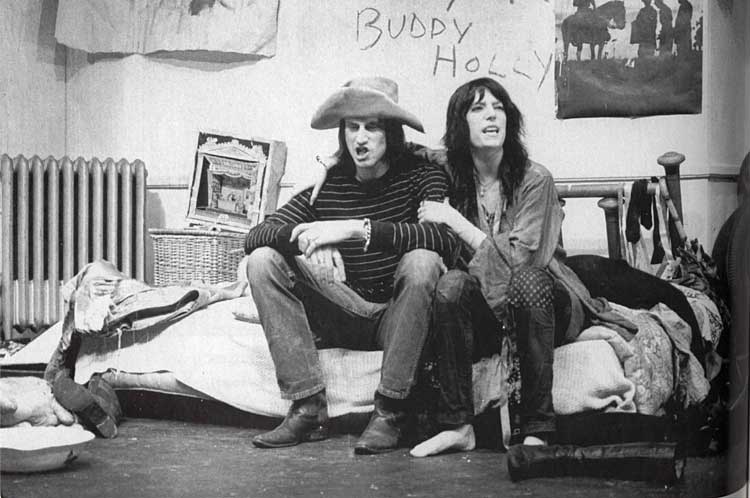
patti smith & sam shepard performing 'cowboy mouth' 1971

patti smith & sam shepard performing ‘cowboy mouth’ 1971

I

In the program notes to his 1971 collaboration with rock-poet/singer Patti Smith, playwright Sam Shepard offered the following statement in terms of his work in theatre: “I like to yodel and dance and fuck a lot. Writing is neat because you do it on a very physical level. Just like rock and roll. A lot of people think playwrights are some special brand of intellectual fruitcake with special awareness to special problems that confront the world at large. I think that’s a crock of shit” (Wade, 7). Two things, at least, are explicit in his statement: the assertion of a formal parallelism between the work of popular music, and that of his theatre, and the sense of the presentational, as opposed to representational, immediacy of that theatre given its absence of intellectualized mediation or over-conscious contrivance. Shepard’s theatre moves, assaults, seduces an audience with the kind of non-verbal, ritualized, kinetic and sensory receptivities attending any live rock event.

Shepard had, at least verbally, long resisted a formal identification of playwright, and in his relocation to London in 1971 actually sought an alternative creative life in rock music, and even judged the primacy of rock music as an artform more truly representative of his era than theatre or any other art practice (Gilman, xii). Music has generally always informed his understanding of art-practice; Laura Graham writes that “his influences were aural—the structure and rhythms of Rock and Jazz music. Shepard’s father trained him in jazz drumming in Shepard’s early teens; he witnessed the talent of some of the greats of American jazz while bussing tables at the Village Gate in New York. He participated in two groups [as drummer], the Moray Eels and the Holy Modal Rounders in the 1960s and ‘70s and admits to having practiced Jack Kerouac’s theory of jazz-sketching with words using the same principles as does a musician when jamming” (Graham, 3) and he has himself stated that “nothing communicates emotions better than music, not even the greatest play in the world” (1984: 179-80). With an imagination so deeply conditioned by the non-verbal modes of music—both in terms of an aesthetic of language more attuned to sound (and the emotive charge it carries, as above) than concept, as well as the personae of music performance—it is unsurprising that Shepard’s theatre is often dominated by an elevated figure representative of that music who partakes as much of mythology as of countercultural trend, is as much a necessary extension of an acutely ritualistic psyche as a canny codifier of contemporary cultural obsessions.

Much could be written about the musicality of Shepard’s theatrical language (and Robert Coe, in harmony with the playwright himself, speaks of “Shepard’s language as approaching the condition of Rock music” and compares him in that regard “with the Romantic poets who used language as evocative rhythmic sound in addition to its use as a vehicle of literal meaning” Graham, 5) but what is more compelling for this enquiry is to observe the way in which rock music and the varied mutations of its aesthetic and cultural significations, supports the erection, and as we will see, resurrection, of a mythic archetype.
In discussing Shepard’s particular codification of 20th century Romanticism, Graham writes that the romantic demonstrates “a stress on the individual and especially on the Hero and the actions of the Hero versus a corrupt or restrictive society; the Hero is seen as the potential savior of a weak society, and conflict in his later plays frequently devolves upon the attempted synthesis between society and the Hero/Individual” (ibid.). In the context of Shepard’s theatre practice of the late 1960s and early ‘70s, Graham’s formulation of the romantic hero serves well to describe its all-pervasive embodiment of the time: the rock ‘n roll star.

The heroic performers of the time, ranging from overblown psychedelic to polymorphous perverse to hermetic-apocalyptic ironic (one thinks of Morrison, Jagger and Dylan respectively) are legion, and in retrospect, eerily otherworldly, sometimes in possession of a skillfulness combined with sheer embodiment of novel expressivity so authentic that from the perspective of a tired neo-conservative post-turn of millennium, they would seem to verge on the divinely inspired (here one thinks perhaps most of all of Jimi Hendrix). Shepard and Smith’s writing, too, of Cowboy Mouth holed up together in the now-mythic Chelsea Hotel (Shepard reports that “She wrote her lines and I wrote mine” and that the play resulting was “the most important thing in my career” Oumano, 90) should be seen in the context of the deaths of some of the most powerfully iconic figures of the time: the years 1970-71 saw the overdose deaths of Jimi Hendrix, Janis Joplin, Jim Morrison alone. Others, such as Tim Buckley, Gram Parsons, and perhaps the ultimate rock ‘n roll savior of them all, John Lennon, were to follow.

The archetype and its profound force in the postmodern cultural psyche of the West is no less noticeable in our own time: the suicide of the ‘father of Seattle grunge’ Kurt Cobain in 1994 was globally mourned as if the passing of a veritable messiah, and not long after in 1997 the drowning death of Tim Buckley’s son Jeff Buckley is another, acutely romantic, loss of the Orphic voice which promises profound transference, only to leave those million—collective Eurydice to the lone Orpheus—abandoned in the strangely undefined yearning of a waking underworld. (The quite different martyrdom of Michael Jackson in his 2009 demise nonetheless embodied a triumphant puer Orpheus in his years of precocious ascension.)

In a number of plays of this period, Cowboy Mouth, Mad Dog Blues, The Tooth of Crime among them, Shepard invokes this yearning and offers up the rock hero/savior, Orphic representative of his time, as worthy sacrifice perceived “not through the intellect but through the ear, like music, through the eye, like visual art, and through the heart” (op. cit. 5), as in the modes of myth. Where Graham suggests that Shepard “shares the Romantics’ use of folk heroes as symbols, their emphasis on the theme of freedom versus conformity or societal restriction, their belief in the inherent superiority of intuition over reason and of subjective over objective reality and, in his later plays, the belief in the spiritual superiority of the Female” (Graham, 5), it will be questioned whether Shepard’s representation does in fact finally confirm to such attributes (in particular the last) or rather suggest a failure, or modified resignation, of the hero to achieve any idealized configuration.

Shepard’s appropriation of the archetype becomes, true of its postmodern surrounds, almost a critique of such long-rooted Western-humanist archetypal imperatives, as if his ambivalent rock-hero-saviours (reminiscent of Brecht’s anti-hero who in his early Drums in the Night refuses to go out and fight in war) would be saying ‘I really can’t do this, in this world, under these conditions, anymore.’ Shepard’s wielding of the mythic structures—and what Graham describes as his disclosure that the “myth is proven to be defunct; the Hero is shown to be inherently and irrevocably unheroic (the potential for Heroism is called into question); the Female becomes the survivor without the Male” (op. cit. 6)—prefigures the nominal deconstruction of such collective-cultural master tropes in our post-millenium. What is still interesting in these plays is the sense in which such negation is achieved even where by virtue of failure it points up the deep pathos of a contemporary culture still thirsting for the symbols it presumes to have de-naturalised itself of. The tale, the narrative, gets old-fashioned and dies, but the spectre in the psyche, the numen, always returns to haunt its neglect.

II

In an ironic reversal of Orpheus, as Cowboy Mouth opens, the male protagonist Slim (“who looks like a coyote…beat to shit” Shepard, 1972: 85) has also been exiled from his wife (and child) but here reluctantly “kidnapped…off the street with an old .45” by Cavale, “a chick who looks like a crow, dressed in raggedy black” (ibid.) already in the deeps of a bizarre and intimate rapport, where we are thrown into the semi-autistic static of their banter in media res. Cavale would seem to have already laid the groundwork for Slim’s transformation into rock ‘n roll savior, because already by his second speech-entry his response is unequivocal. Cavale, mad (later confessions reveal her past hospitalizations) or only strategically in denial, can’t hear Slim’s objections as she ferrets around for her dead, stuffed crow Raymond:

SLIM: Your Raymond! My wife! My kid! Kidnapped in the twentieth-century! Kidnapped off the street! Hot off the press! Don’t make no sense! I ain’t no star! Not me! Not me, boy! Not me! Not yer old dad! Not yer old scalawag! This is me! Fucked up! What a ratpile heap a dogshit situation! (87)

Slim’s rhetoric is unconvincing. Both he and Cavale are desperately in search of something the other only half-consciously appears to offer. Cavale, moreso than the remote, too-good wife and child, seems his truer lover and certainly muse, at least in this strange ritual—the eccentric chamber of their willed claustrophobia a substitute Hades where they are forced to work out the terms of an inchoate descent into the unconscious. Slim, though resistant, has already in his opening line spoken of “bad karma”, and in his passivity it is the elemental force of the with Cavale (she can talk to animals, even dead ones) who can lead him into some more radical meeting with himself and the time.

The adolescent in this pairing, Slim can only beat (“the shit out of”) drums and wail cheesy love-songs. Her depravity “makes me sick! It’s morbid and black and dark and dirty! Can’t you see what’s happening here?” (op. cit. 88.) She can, and she tells him “Fuck you […] Can’t you see what’s happening here? A dream I’m playing.” And Slim, long ago seduced, wants to know; like the little baby whose need of him he has just been appealing to, he begs her to “Tell me about Johnny Ace,” and submissive “goes to her and curls up in her lap” (ibid.).

Johnny Ace is Cavale’s first installment of the rock ‘n roll savior, but a flatly self-destructive one. Johnny Ace was “real cool, baby. Just like you” (88-89), but—

CAVALE: […] one day when all the girls were waiting, when everybody paid their fare to see Johnny Ace on stage in person singing sad and dressed in black, Johnny Ace took out his revolver, rolled the barrel like his 45 record, played Russian Roulette like his last hit record, and lost. Johnny Ace blew his brains out, all the people jump and shout […] (89).

The same image will close the play, but with a whimper, and not with Slim pulling the trigger. Though Cavale is quick to diminish its impact (“it don’t mean nothing, it’s just a neat story” 89) the metaphor for suicide as escape becomes her recurrent trope—escape being what Cavale, her self-chosen name, comes to signify at the very close of action. Not just hers, but deeply enmeshed in the rock archetype she’s seeking to perpetuate. Cavale’s savior, we see, is a gentle Jesus, who is meant to survive, but that other ‘saviour’, outside the frame of Cowboy Mouth, is the one Smith knows and draws on: were Buddy Holly, Hank Williams, Richie Valens, even Robert Johnson, and their more contemporary company cited above, suicides or accidents? (Note also the still photographs from the original American production published in the Winter House edition (1972). On the wall behind Shepard and Smith sitting on the “fucked-up bed” in the title roles, Buddy Holly has been prominently scrawled; and the mise-en-scène calls for “Photographs of Hank Williams and Jimmie Rodgers”, 85).

The bipolarity and intimations of annihilation alternate with endearments and sophomoric domesticity. Slim and Cavale role-play, cavort, cajole, caress, like an old couple dance a slow waltz. Cavale’s second installment of the doomed Orphic poet is the nineteenth-century French poet Gerard de Nerval, who “hung himself on my birthday. My birthday. And some lady tole my mom I was made from a hanged man. Poor bastard. And Slim, he had a crow too. Just like Raymond” (92). Cavale’s death-wish (“I’m sick of telling about people killing themselves, it makes me jealous”, ibid.) is almost as unconvincing as Slim’s attachment to his unreal family, but it spurs him to another musical effort, this time on electric guitar, with “Have No Fear”, which equalizes the worst with the best, finds acceptance of both and the avoidance of escape (“So don’t run/ Let it come/ Let it go/ Let it rock and roll”, 93) possible within the freedom of music and its invocation of the unconscious. Slim is practicing for Cavale’s molding of him despite himself.

They have in the meantime ordered extravagant food from the Lobster Man. Who is the Lobster Man? Dressed as a lobster, he brings plenitude, only grunts, but comes when called. As Slim will elaborate subsequent to this first appearance, lobsters inhabit the depths of oceans, have “an ancient, sea-green strength” (106) both implicative of something radically inscrutable, as well as passively amenable to the projections imposed upon it/him. Unable to articulate language, as Slim and Cavale almost unwillingly do, the Lobster Man can’t divulge his inner life in words, as their frustration with him confirms. Present, but obscure, obedient but silently unsettling, come from the deeps with its “strength of the ages” the Lobster Man is symbolic of the unconscious. It is Slim, notably, ambivalent Orpheus, who invites him in, who pesters him and turns on him when he can’t answer any of Slim’s questions. Here though, Slim is still only concerned with mundane nourishment, as he feasts on junk food, and continues to blame Cavale for his own blindness:

SLIM: […] You’ve put a curse on me! I have a wife and a life of my own! Why don’t you let me go! I ain’t no rock-and-roll star. That’s your fantasy. You’ve kept me cooped up here for how long has it been now? […] A long fucking time. And I’m still not a star! How do you account for that?
CAVALE: I don’t know. I never promised nothin’.
SLIM: But you led me on. You tempted me into sin.
CAVALE: Oh, fuck off.
SLIM: Well, it’s true. What am I doing here? I don’t know who I am anymore […]
CAVALE: You can go if you want.
SLIM: I don’t want! I do want! I don’t want! I want you! (107).

But just as Cavale’s bad-ass posturing is readily deflated by Slim’s suddenly untypical criticism of her grammar (how much are these characters simply Shepard and Smith? How much is theatre and how much meta-theatrical biography? ), the mystique built up around the rock savior is deconstructed via still another generic tone: emotional realism. Slim, seemingly closer to consensual ‘reality,’ wonders “How come we’re so unhappy?” (96), and after the kind of cognitive-behavioural therapy in which “we’ll change the time of year to fall” (ibid.) because it’s Cavale’s favourite season (and just as he’d earlier taken her on an imaginary walk down to an imaginary shoe-store to steal her an imaginary pair of tap-shoes, though she’d been after the real thing)—(which of them is the real con-artist?)—he quite genuinely asks of Cavale, as an audience-member might of the play: “…tell me what it means to be a rock ‘n roll star […] so I’ll have something to go by” (ibid.).

Graham’s suggestion that “elements of Absurdism, Surrealism and Expressionism are skillfully juxtaposed with elements of Realism to achieve a style which I will refer to as Metarealism” (Graham, 50) is helpful here. She suggests that “Cowboy Mouth…contains almost all elements which, by the time of this writing, have become quintessential Shepard. Unlike many of the early plays, in Cowboy Mouth Shepard employs elements of Expressionism, Absurdism and Realism in an almost balanced blend” (51). On this reading Slim might be said to be the voice of a recognizable realism, Cavale the hyperbolic expressionist, and the appearance of the Lobster Man the object of absurd inscrutability which adds a synthesizing apex to the antithetical, bi-polarized, even claustrophobic horizontal dynamic, of the sum of their parts.

Cavale does answer Slim’s earlier question, in a long monologue which is the thematic heart of the play. But not a Shepardian aria; Patti Smith’s earnest post-Beat romanticism is too evident and Slim’s monosyllabic punctuation like the practiced playwright Shepard sitting back, disengaged, to comment: “No, baby, it’s beautiful” (99). The important words are:

CAVALE: […] It’s like, well, the highest form of anything is sainthood […] People want a street-angel. They want a saint but with a cowboy mouth. Somebody to get off on when they can’t get off on themselves. I think that’s what Mick Jagger is trying to do…what Bob Dylan seemed to be for awhile. A sort of god in our image…ya know?
[…] I want it to be perfect, ‘cause it’s the only religion I got. […] in the old days people had Jesus and those guys to embrace…they created a god with all their belief energies…and when they didn’t dig themselves they could lose themselves in the Lord. But it’s too hard now. We’re earthy people and the old saints just don’t make it and the old God is just too far away. He don’t represent our pain no more. His words don’t shake through us no more. Any great motherfucker rock-’n-roll song can raise me higher than all of Revelations. We created rock-‘n-roll from our own image, it’s our child […] It’s like…the rock-‘n-roll star in his highest state of grace will be the new savior […] rocking to Bethlehem to be born. Ya know what I mean, Slim? (99).

Slim remains obdurate: “Well, fuck it, man. I ain’t no savior” (ibid.). Perhaps it’s the almost cloying naiveté of Cavale’s religiosity he distrusts. Her assumption, for example, that “the highest form of anything is sainthood” is loaded with a piousness otherwise repudiated by the hedonic ironies of the counterculture, once it had got over its salvific innocence destroyed, by most reckonings, in the violence of 1968 and the ensuing years of Vietnam. Cavale, for her part, fantasises sainthood herself: “and me…I dream of being one”, but something unclear disqualifies her for the role: “But I can’t. I mean I can’t be the saint people dream of now” (ibid.) The only distinguishing features she draws between the old-style saint and contemporary imperatives is that: “People want a street angel. They want a saint but with a cowboy mouth” (ibid.).

Cowboy mouth. Another metaphor central to the subtextual terms of the play, as the Lobster Man is symbolic of its non-verbal depths (where both musical expression and symbolism subsume and transcend the discursively verbal). Cowboy mouth:—street angel, rough diamond, hipster innocent, flawed genius, poète maudit, Western hero, solitary quester in unknown lands, restorer of natural justice in a climate where the civilized version has gone awry. We can’t be entirely sure just why Cavale can’t enact the dream—because she’s a woman? because she’s lame? too much a crafty hatcher of image and myth to be able to sustain one herself? (These queries are interesting also in the contrasting light of Smith herself, who in a musical period dominated by the male-shamanic stirrer of mass ecstasies has been able to successfully sustain her own version of the street angel-rock poet for forty years.) If it’s not obvious why Cavale can’t play the part, we can be sure that she projects the same fully and squarely onto the unremarkable, adolescent person of Slim. The eloquence of her long speech lines are answered by him with an ugly, unimaginative repudiation of her vision: “You fucking cunt!” or “I ain’t no savior” (100).

Slim might have the leaden masculinity of a cowboy, but does he have the necessary muse? If he’s Orpheus, perhaps it’s as an Orpheus maudit, a little like the sardonic Dylan or Lennon who weren’t entirely willing and didn’t quite fulfil, the spiritual expectations of their early devotees. Cavale tells Slim: “But you’ve got it. You’ve got the magic. You could do it. You could be it” (ibid.), though we see little evidence of what it might be in Slim. While Slim softens as the play progresses, Shepard’s writing of the character consistently downplays the kind of florid idealism Cavale is so intent on enacting. She’s the nerdy poet who pesters the nice-guy sports jock slumming it (Henry IV-style) in bohemia: he tolerates her but only for so long, to the point where it seems she and her fantasies are for real, and he can’t follow her.

The other telling assumption in Cavale’s speech is that “the old saints just don’t make it and the old God is just too far away. He don’t represent our pain no more” (99). Not merely a re-statement of the familiar post-war Existential, then countercultural, rejection of traditional Christian theism, Cavale’s article of faith would seem to also suggest that the common human pain is itself different now: “We’re earthy people,” but God’s “words don’t shake through us no more” (ibid.). Is her complaint merely one of form, such that the contemporaneous thirst for transcendence in rock lyrics can replace, and so improve upon, the old (dead?) Holy Word?: “Any great motherfucker rock ‘n roll song can raise me higher than all of Revelations.”

How much is Cavale’s version of spiritual insight a mature response to the received one she rejects, or merely a self-absorbed rebellion against a surrender of self she—the post-adolescent culture she speaks for—can’t risk? How much self-gratification is there in the desire to “get off on [somebody] when they can’t get off on themselves”? Her formulations refer back to herself and her needs: rock ‘n roll ‘raises her higher’, and perhaps an obvious betrayal of her solipsism: “We created rock ‘n roll from our own image, it’s our child…a child that’s gotta burst in the mouth of a savior” (my italics).

Why exactly does rock ‘n roll have to burst its boundaries, become spiritualized in the same or similar terms to that old religion Cavale/Smith disavows? Doesn’t her fervor conjure a more radical disjunction (more Dionysian than Christian) with civilization, entirely set free of old forms and rituals? (Again, think of the paroxysmic rock-highs of performers such as Hendrix and Joplin). Cavale’s rock triad of Rock ‘n Roll, the loss of God, and the hunger for a new Messiah can be read as pop culture, and the sexuality it encodes, rejecting History to produce a bastard offspring that keeps the features of the Father/father but disowns the spiritual authority H/he has carried thus far. Hence the dislocation, sense of abrupt discontinuities between these characters (and Shepard’s plays generally) and any kind of historical, even sacred, context that might form a ground to their contingency, avoid that inflation of self concomitant with the words messiah, rock ‘n roll star, savior, whether slouching, or as here “rocking to Bethlehem to be born” (99, my italics).

Richard Gilman’s words are helpful here: “’Identity’ and ‘roots’ merge as themes in Shepard. For if the American Dream means anything more than its purely physical and economic implications, it means the hope and promise of identity, of a ‘role’…Inseparable from this is the hope of flexibility, of suppleness in the distribution of roles—the opportunities of being seen—such as was largely absent from the more fixed and closed European world. In turn this promise, sometimes fulfilled, is met with the ironic condition of rootlessness, lack of continuity and ground. The effect of this in Shepard’s theater is either to crush or literally deracinate—tear the mind from its roots—the seeking self or to hyperbolize it into flamboyance, violence, or the ultimate madness, the fever for what we call ‘stardom’” (Gilman, xx). What Gilman describes as the ultimate madness, would seem to be just the mythology Cavale has entered into, the consummation of self she renews in pseudo-salvific terms. But how deep is her vision—is it one of madness or freedom from the fractured self and culture it has emerged from?

In looking beyond the modern Christian era, in its incorporation of absurdist, surreal and symbolic imagery—its invitation to the Other, the unconscious, the repressed and forgotten—Cowboy Mouth summons the pre-modern mythic imagination without quite knowing it. Slim probably is Orpheus, without knowing or quite wanting to believe it; Cavale is his Muse. They have intuitions of transcendence, trust in them without knowing why, hold ambivalently to the frail securities of the known (Slim’s family and home, their personal histories) while doubting their full reality or worth. Every time Slim is confused by words, he “gets up and stomps over to the drums […] starts bashing them violently” (97), flays his electric guitar or “jumps up and starts tearing the place apart” (100) in a blind access to an urgent expressivity he’s still barely conscious of. Cavale, similarly, “goes through a million changes. Plays dead. Rebels. Puts on a bunch of feathers and shit to look alluring […] hides in a corner” (97) and so on. Slim and Cavale are largely oblivious to their own experience, unaware of the unconscious motives propelling their behavior. The morphing of personality and desperate assumptions of varied personae are the most characteristic theatrical features of Cowboy Mouth. Nothing in this play is fixed, apart from the entrenched heterogeneity of its performativity.

Gilman, above, emphasizes the performative, “role-playing” nature of Shepard’s (post-Pirandellian) theatre; Cavale’s next words make this ritual play explicit. Slim asks her how he’s meant to become ‘the saviour’; he has no idea himself, a necessary guilelessness for a would-be messiah. He answer points to the eclecticism, the ragged and piecemeal postmodernist process of building a new sacrality of self and culture: “You gotta collect it. You gotta reach out and grab all the little broken busted-up pieces of people’s frustration. That stuff in them that’s lookin’ for a way out or a way in […] The stuff in them that makes them wane see God’s face. An then you gotta take all that into yourself and pour it back out. Give it back to them bigger than life. You gotta be unselfish, Slim. Like God was selfish, He kept Himself hid. He wasn’t a performer. You’re a performer, man” (100). (Perhaps indicating some of Smith’s creative genealogy, it is interesting to note that when asked in a TV interview late in his life what it was he had really sought to achieve in his work, Jack Kerouac had responded in all sincerity ‘I want God to show me his face.’)

Bigger than life. Again, the inflationary sense of Cavale’s vision is ambiguous: who is ultimately gratified—the audience, or the star; the saint, or the ‘sinners’? She does qualify the ‘biggerness’ however with its unselfishness. Yet what seems to make her savior different from the old is merely that the new one has to be a performer, actor of unreal images, which holds the possibility (already prefaced in Cavale’s story of Johnny Ace) that such of psychic authority and power has its inevitable nemesis in the failure of transcendence and the hysteria of the mob. Which again calls forth Orpheus.

III

In his telling of the Orpheus myth, Robert Graves says that “When Dionysus invaded Thrace, Orpheus neglected to honour him, but taught other sacred mysteries and preached the evil of sacrificial murder to the men of Thrace, who listened reverently. Every morning he would rise to greet the dawn on the summit of Mount Pangaeum, preaching that Helius, whom he named Apollo, was the greatest of all gods. In vexation, Dionysus set the maenads upon him […] First waiting until their husbands had entered Apollo’s temple, where Orpheus served as priest, they seized the weapons stacked outside, burst in, murdered their husbands, and tore Orpheus limb from limb. His head they threw into the river Hebrus, but it floated, still singing, down to the sea, and was carried to the island of Lesbos” (Graves, 1960: 112).

Seen in this context, Slim’s reluctance to assume the mantle of contemporary rock priesthood is prescient, though the analogy isn’t entirely smooth. Orpheus, at least in this version of the myth (Graves also gives others, where “Orpheus did not come in conflict with the cult of Dionysus; he was Dionysus” ibid.), is representative of non-violence as Christ is, but not of Dionysus as Cavale would have her countercultural 20th-century brethren be (“We’re earthy people and the old [Christian] saints just don’t make it”). Graves’ Orpheus is instead committed to the solar orderedness and restraint of classical Apollo, even “had condemned the Maenads’ promiscuity and preached homosexual love; Aphrodite was therefore no less angered than Dionysus” (op. cit. 112-13), which doesn’t sound like Cavale’s hetero-dominant territory (but does ring true with what we know of the sexual revolution of the 1960s and especially ‘70s as it was embodied in the ambisexual posturings of Jagger, Joplin, Morrison and other celebrities more reknowned for sexual excesses than musical importance).

What is compelling in Orpheus is the betrayal of the audience and the emotional mechanism that allows the power invested in those who “not only enchanted wild beasts, but made the trees and rocks move from their places to follow the sound of [their] music” (ibid., 111), be so entirely reversed to turn against rapture and destroy the object of projected enchantment. Slim has, like Orpheus, already lost his love (“My wife’s left me. She’s gone to Brooklyn with the kid and left me”, Shepard, 96); he’s hardly about to start a religious revolution, in real terms or the heightened illusory one of Cavale’s spiritual aspiration. All of Slim’s talk comes down to prosaic, small-town American domesticity (an adolescent rehearsal for the almost sepia-toned frontier Americana Shepard has made his own in his more mature work): his Tom Sawyer speeches are about having a dog (“Like any good American boy” op. cit., 95), making childhood dams in rivers (“putting more and more rocks and mud and sticks in to try to stop it”, 101). Cavale also has her prosaic stories (such as playing The Ugly Duckling in school and “when I first put my finger inside me and felt wonderment”, 102); they are the most apparently authentic stories she tells, and even pretends to a house-wifely domesticity herself—“I wanna electric dishwasher […] I don’t have any housewife shit. I want some stuff ladies have” (95-6).

Ultimately these vignettes of shared intimacy, each character attempting grounding in a contextual history almost subtending their immediate alienation, are overwhelmed by the intensity of Cavale’s dream, crippled as she is from the start. After Slim’s failure of conformity to the Orphic template, her disappointment could be Aphrodite’s (though neither of these mere theatrical ‘players’ will be torn limb from limb for their incapacity):

SLIM: […] Get out of my house! Get the fuck out of my house!
CAVALE: This ain’t your house. This is my house.
SLIM: It’s nobody’s house. Nobody’s house.
HE collapses, exhausted from his violence. CAVALE goes to him as if to soothe him, then realizes it’s her dream being busted and not his. SHE starts yelling at him while HE just lies there wiped out.
CAVALE: You’re fucking right—nobody’s house. A little nobody with a big fucking dream. Her only dream. I spread my dreams at your feet, everything I believe in, and you tread all over them with your simpy horseshit. […] I take your world and shake it. Well, you took my fantasy and shit on it. I was doing the streets looking for a man with nothing so I could give him everything. Everything it takes to make the world reel like a drunkard. But you have less than nothing, baby, you have part of a thing. And it’s settled. And if it’s settled I can’t do nothing to alter it. I can’t do shit. I can’t give you nothing. I can’t. I can’t. You won’t let me” (100-1).

The scene is the overt climax of the play, and also encapsulates it. Cavale is impotent, as a woman or visionary or both, dismisses the ‘reality’ of the majority, but her vision still tantalizes. Her words make Cowboy Mouth seem to be about love, or the need for it, the subordination of the woman, and the failure of intuition against the sobriety of domestic regenerativeness. But that’s a ‘realist’ reading, which privileges the stability of self and motivation Gilman has already observed Shepard’s theatre subverting. The climax of the deep image, the one which resonates, comes at the end proper. Cavale’s catharsis is short-lived and they each again quickly fall into quasi-shamanistic, ironic role-play, perhaps merely a projective screen set against their stronger motivations.
Because they soon decide to call the Lobster Man again (“just for laughs” this time, 103). Slim’s realist downhome reminiscences, Cavale’s expressionist melodrama have each played themselves out; the sub-reality of the ambiguous again comes to the fore. Cavale simply picks up the telephone and the Lobster Man is already on the other end. Cavale invites him/It(Id) over because “we need some cheering up” (104). Slim suggests they talk “About what it’s like to be a lobster man. It must be pretty weird, you know. Weirder than being us” (ibid.). Cavale is curiously defensive, the wounds of her previous outburst still close to the surface: “We’re not weird, man. He’s weird but we’re not weird” (ibid.). Each of their symbolic imaginaires is threatened at its roots by the unconscious real, but Slim is willing to risk the loss of what Cavale has so desperately sustained on their behalf. Slim, oblivious but intuitively true, touches the nerve-centre of the play: “We could ask what the bottom of the ocean is like” (ibid.)

It isn’t the woman, but the man, who plunges for the unknown, contra the privileging of feminine intuition Graham draws attention to in discussing the romantic hero in the Shepardian context, earlier. In Cowboy Mouth, the woman has all the admittedly wild words, the wisdom of poetic forebears, but he has the psychic means to will its entry. Cavale only confirms Slim’s sense by imagining the Lobster Man in a hypothetical movie called The Prophet. Slim speaks for Freud: the Lobster Man is “a wily old devil. He’s outfoxed all the fishermen for years and years. He’s never been caught” (105). Where Slim has resisted the Orphic role, here he is eager to plumb deeper, darker depths: less modernistic, post-Christian, salvational; more originary, primordial, atavistic. He wants to get to the innards of what the Lobster Man is, and could be. For the first time in the entire play Slim speaks from his, properly masculine, power: “I could cut through that hard shell and tear his heart out. I could eat his heart. You know that’s what warriors used to do. Primitive warriors. They’d kill their opponent and then tear his heart out and eat it. Only if they fought bravely, though. Because then they believed they’d captured the opponent’s strength” (ibid.).

On its arrival, Slim tells the Lobster Man “Listen, the little lady here and I were discussing how we’d like to get to know you on a more intimate level” (107), but we already know it can only grunt in response. Cavale: “We’d like to know your darkest nightmares, your most beautiful dreams, your wildest fantasies, your hopes, your aspirations” (ibid.). The turn is abrupt; psychoanalytically betraying herself Cavale decides the best way to deal with the unknown is to “just ignore [it] for a while. Pretend like it’s not here” (107-8). Just “leave him here alone […] Let the Lobster Man be the new Johnny Ace. It’s the Aquarian Age. Ya know it was predicted that when Christ came back he’d come as a monster” (108). Unable to stop weaving her discursive Ariadne-like web of reliances, Cavale is the theorist blind to the much more raw data before her. From there the Lobster Man’s transformation is seamless. Slim though tests himself with a confession of resolve he’s been seeking an object for all along:

SLIM: (to LOBSTER MAN) Pretty sneaky […] Squirmin’ yer way into our lives. Pretendin’ dumb. We know you can talk. We know you understand what’s goin’ on. You’ve got the silver, you’ve got the gold. Out with it! Out with it, Lobster Man, or the sun won’t shine on your shiny shell! (109)

Cavale and Slim are talking about a different revelation, with or without a saviour, now. Slim beckons the Other voice to sing, openly now, plays the classic 4-chord rock progression as the subterranean creature reveals its true form. Cavale is a proxy for its words, singing: “Come right here you know you’re not alone/ If you got no savior you can do it on your own” (111), and though the words are pedestrian, they contain a plea for embodiment that finally anchors the transcendence that has typified the tone—at least Cavale’s—of the drama: “Help me to do it/ I was always dreaming too high/ Help me pull my star down from the sky/ Down on the ground/ Where I can feel it/ Where I can touch it/ Where I can be it” (110-11).

Be it. Embodiment and a grounded knowing, an earthbound and a grounded knowing, an earthbound truth: the ‘moral’ of this play? Not quite; Smith and Shepard close, rather, on ambiguity: Slim hands the new rock ‘n roll saviour a gun, eyes off Cavale, and exits. Cavale talks him through what appears to be a conclusive denouement: rock ‘n roll, the Other, the wildcard quantity of the unconscious, the atavism of an Orphic transmission all converging in the singular moment and its singular symbol—summoning again the tragic de Nerval and his pet lobster. De Nerval, significantly, “had visions. He cried like a coyote. He carried a crow” (111). Cavale privileges the imagery of the irrational and the sensorium of the primitive: still the final arbiter, and the compulsions of self-knowledge still to be played out, as in Johnny Ace, de Nerval, Genet, Villon, and her other anti-heroes. Like Orpheus given the gift of oracular speech (Graves: “Orpheus’ head […] prophesied day and night until Apollo […] came and stood over the head, crying: ‘Cease from interference in my business; I have borne long enough with you and your singing!’ Thereupon the head fell silent” (Graves, 1960: 113), the rock ‘n roll savior, born of the unconscious, must risk his own annihilation.

The Lobster Man, too, ritualizes such death, playing Russian Roulette to Cavale’s final words. The pistol just clicks, emptily. Stephen Bottoms’s reading of this conclusion, where “ambiguity gives way to an outright skepticism which swamps the transcendent impulse completely” (Bottoms, 89), is too cynical, and instead of “a grotesque parody of a fantasy salvation” (ibid.), the Lobster Man enacts a suitably loaded restraint that successfully distances and re-configures the egoic exertions of illusory projection that have sent Slim and Cavale in circles all through the preceding. David de Rose (Roudané, 230) writes that “Shepard’s writings would suggest that the rock messiah is an unattainable ideal, the pursuit of which leads to self-delusion or self-destruction” but again this literal reading ignores the psychological imperative of the transference the pursuit, so consistent through cultural history, continues to enact. The Lobster Man, as their hitherto buried unconscious, is saved from total supression, as Orpheus was before his Muse was taken from him. But along with transcendence, the loss of the old self is always at stake. Slim opts out (his being in was only ever nominal, by proxy) just as Dylan or John Lennon, or more recently Kurt Cobain, in their putative (or in the latter’s case, necessary) rejection of the role of spiritual savior, did. Cavale, the poet-intellectual, brains behind the scenes, knows the words but not the numen, the knowing to bestow. What does the Orphic muse tell humanity? Graves, again, offers a variant to the original, another clue: “Some give a wholly different account of how Orpheus died: they say Zeus killed him with a thunderbolt for divulging divine secrets” (Graves, op. cit.).

Divine secrets. Smith and Shepard, in Cowboy Mouth aren’t willing to say what they are, not because they don’t know but because they can’t be said. (They won’t have to die young, as so many of their musical heroes did and would—indeed perhaps always will). Yet in Slim and Cavale, alienated romantic heroes of still another—here psychedelic—phase of Dionysus, they swear by the presence of them. The Lobster Man, left solitary and cold-sweat wet as the stage darkens, is everyone who ever made the same mute attempt, and those audience members—“people [who] want a street angel”—who understand the imperative of trying. The divine secrets are there (say Orpheus and his 20th-century incarnations) but you have to risk everything to discover them.

(Written April, 2000)

REFERENCES

Bottoms, Stephen J. The Theatre of Sam Shepard: States of Crisis. Cambridge: Cambridge University Press, 1998.
Gelber, Jack. “Sam Shepard: Playwright as Shaman” in Angel City and other Plays by Sam Shepard. New York: Urizen Books, 1976.
Gilman, Robert. “Introduction” to Sam Shepard: Seven Plays. New York: Bantam Books, 1981.
Graham, Laura J. Sam Shepard: Theme, Image and the Director. New York: Peter Lang, 1995.
Graves, Robert. The Greek Myths: Volume 1. Harmondsworth: Penguin, 1960.
Hart, Lynda. Sam Shepard’s Metaphorical Stages. New York: Greenwood Press, 1987.
Oumano, Ellen. Sam Shepard: The Life and Work of an American Dreamer. New York: St. Martin’s Press, 1986.
Roudané, Matthew (ed.). The Cambridge Companion to Sam Shepard. Cambridge: Cambridge University Press, 2002.
Shepard, Sam. The Winter Repertory 4: Mad Dog Blues and other plays. New York: Winter House Limited, 1972.
Wade, Leslie. Sam Shepard and the American Theatre. New York: Greenwood Press, 1997.
Wilcox, Leonard (ed.). Rereading Shepard: Contemporary Critical Essays on the Plays of Sam Shepard. London: Macmillan, 1993.

Copyright © 2013 Martin Kovan

Published June 1, 2013 in CORDITE Poetry Review #42: No Theme II, guest-edited by Gig Ryan: http://cordite.org.au/poetry/notheme2/some-kind-of-simulacrum/

Does Buddhism really deny life, with all its vast plenitudes and richness of invention, in the way it is often presumed to? Or is the idea – and the reality – of abundance central to its vision of life? The literature of canonical Buddhism is replete with the imagery, tales and promises of life in the round, the full and the rich. But it also comes with a few qualifying caveats.

The Buddhist universe is often described in plethoras of many-worlded glory: the different pure realms to which virtuous Buddhist practitioners are bound as the natural result of this-worldly devotion are remarkable for their richly-described abundance of happiness, wealth and long-lived prosperity. There are Buddhas and their retinue in each, and if for example the Buddha of devotion is Amitabha ‘of infinite light’ (as it is for much of East Asia and its Western diaspora communities) the bliss of such devotion is promised to be eternal and unbounded.

Still more, Buddhist enlightenment is not limited to some future life outside this one, but is the very condition of this life and world itself, that we are only blind to: this world now is already the paradise, if we could only see it, taste and treasure it. And herein lies the caveat: such blindness, at its very worst, engenders the various painful ‘hell-realms,’ both hot and cold and many-pronged, as the obverse of the reward for virtuous practice. And they are as abundant in their pain and suffering, as their counterparts are in wealth, health and freedom from suffering.

The good news is that the pain and suffering aren’t intractable, and can be permanently sundered. The particularly Buddhist news is that having started on the path, one’s ideas about abundance – what it is, why we value it, why we seek it – may change, and may change radically, so that it is not some objective notion of abundance that proves the case, but a relative, subjective one. In one of the central canonical texts of the Mahāyāna tradition, the 2nd-century C.E. Vimalakirti Nirdesa Sutra, abundance is literally figured into the mise-en-scene and the ensuing narrative. Vimalakirti (‘Stainless Reputation’) is a lay Buddhist master, who while feigning an illness invites vast numbers of enlightened and divine beings, monk and nun faithful, so-called ordinary folk and even innumerable animals and sentient creatures into his tiny room which miraculuously is able to hold them all, and expounds to them the teaching of the prajnaparamita (perfection of wisdom) philosophy.

What is almost unique in this popular text (and subsequently highly important for the pragmatically-minded spirituality of China and East Asia), is that this Buddhist adept is an ordinary if wealthy man, yet also an enlightenend being who seeks to inspire all sentient beings to the knowledge and practice of the way (dharma) of the Buddha. With his infinitely diverse audience at his bedside, Vimalakirti teaches that all freedom, all abundance of object and thought, feeling and hope, is born and dies in the mind that understands the suffering nature, impermanence, and essencelessness of the phenomenal world (the Three Marks of Existence). That when we understand the way all things actually exist, rather than how we would wish them to, then the riches of all the ten directions and the three times, as vast as space, become ours; and anything else pales in comparison.

This is an inspiring, also perhaps a grandiose vision, that might seem remote from our more quotidian concerns. But what else does Buddhism really point to in these visions of both splendor and pathos? Are their hells and heavens really real, whatever that might mean, and what do they mean for us here, in this world we already know?

The Desire realm
We could probably start understanding what they mean by considering some basic existential facts. Buddhism characterizes life as we know it in this human realm as being dominated by desire: for all kinds of things, whether they be Tim Tams or new cars, fame or political power. Different people desire different kinds of things, as well as some in common. We all crave pleasure, security and freedom from discomfort, but we tend to have different ways of achieving them. Some of us derive comfort from the vantage of a couch, a TV, chocolate or ice-cream stores, and a steady diet of DVDs; others from minimizing their needs and living with very little – as monastics do in most of the world religions, deprived of most of the comforts the rest of us take for granted.

This is strange – shouldn’t we all derive the same sense of abundance from the same things? But clearly we don’t, and differ quite markedly in our preferences, and our literal psychological experience of them. What does this tell us? Perhaps, that what defines the value of things is not their apparent inherent nature, but how we perceive them by virtue of our own minds. Their value then is not purely a function of the external world (despite some consensus on ‘things of value’), but more concretely of how we constitute them psychologically.

And when we consider the quantity of abundance, the disjunction between differing needs is even wider. Some of us need only one or two Tim Tams to be satisfied, others need (or think they do!) the whole packet. What is the balance here, the natural scale or the objective marker? Clearly, in an existential if not a scientific sense—nutritionists can tell you how many calories you should ideally consume, but not precisely why you should safeguard your own health—there is none. It really is up to us. Which is where freedom and self-empowerment comes in. But more of that in a moment.

If the world, as it is for Buddhism, is characterized by desire, it is also characterized by what are called the Three Marks of Existence, mentioned earlier: dukkha (suffering, or unsatisfactoriness), anicca (impermance) and anattā (selflessness). As beings driven by desire (animals on the other hand are dominated by fear) we humans relate with these three marks, or facts, from our default-position of need or desire of various kinds. We 1) suffer because we have too little, or too much, of what we (think we) need, and also because 2) whatever we get hold of to satisfy our desire is only temporary and must be continually renewed to keep satisfaction constant over time, but still worse 3) can never be completely achieved because what , or more precisely who, we think we’re satisfying doesn’t actually exist in the way we assume it does. In other words, this me who desires, who needs, who continually must be satisfied, is only partly real, and partly an illusion. And desire feeds on that illusion, as a junkie does on his drug of choice. For Buddhism, where that illusion of ‘me’ is very strong and very fixed in the mind, it is certain that uncontrolled desire reigns supreme. And this is where abundance, critically, comes in.

Too little in too much?
In consumer-capitalist culture, we have mistaken abundance for the mere quantity of whatever temporarily satisfies us. But have we adequately questioned whether the causal link between quantity (material abundance) and satisfaction, works the way it is supposed to? If I have unlimited chocolate and DVDs to feast on over the weekend, I ought to experience that abundance as equally unlimited. But do I? In reality, I will feel over-indulged and even exhausted and ill. If I need more to crave my satisfaction, is there a point where it will be reached? It may, but as Buddhism sees it, it is also likely that encouraging more consumption only leads to a more fixed habit of need, which simply reinforces on a psychological and even physiological level the craving for a certain minimum-level threshold of satisfaction.

Of course there is genuine and important pleasure in good food, fine wines and erotic stimulation at the right time, in the right place and context of our lives, and hopefully for most of us, such ‘Epicurean delight’ stays fairly fine-tuned—even if finally the best-lived sensory life might not bring the ultimate happiness some of us, and certainly Buddhists, may seek. While for others it can tip the balance into serious addiction and its extremes in eating-disorders, self-harm and even life-threatening pathology.

What is critical here for Buddhism is how this balance is a function of the mind, rather than the object of craving itself. The problem doesn’t even lie in the drug itself (though of course some are dangerously addictive), but in the mind that engages with it. A mind, or psyche, that is dominated by the deep delusion that pleasure and the happiness that results from it lies in things themselves, will be more vulnerable to the abuse of things, whether it be chocolate, sex, heroin, or power. A mind that becomes more and more aware that satisfaction lies in the mind itself rather than in the object it craves, becomes more and more attuned to its own homeostasis and the happiness and well-being that result from it.

The mind understands that a few Tim Tams and just one or two DVDs, or even none at all, is intrinsically happier and more abundant in that happiness, than the mind that has a surfeit of both but never achieves satisfaction from them (or most likely anything else either). And this is because the problem of satisfaction is not one of having enough pleasureable things to enjoy, of their sheer abundance, but of how we enjoy, appreciate, and value them. Of course, the body is naturally satisfied by good wine, food, and sexual stimulation, but there is clearly a physical and mental limit to those joys also. Too much of them, and the body and mind feel worn and wasted, tired and burdened with their ‘abundance,’ even depressed: the petite triste of too much stimulation, release, and indeed, satisfaction. It seems we may well suffer in getting too much of a good thing—Mae West and her perennial wisdom notwithstanding!

The mind that enjoys and the thing enjoyed
The crux here, and this is the largest part of Buddhism, is about the kind of mind that knows this, and can distinguish between the illusory abundance (quantity) of having endless satisfaction through things, and that of knowing that actual fulfillment is a quality of the mind that experiences them. In this case abundance would be a capacity of the mind, a way of enjoying what we have, however modest it may be. In fact the Buddha recommends having comparatively little for precisely the reason that you don’t need more of something to appreciate its quality as such. But which of these is the focus for our society, or political and economic system?

No Super-Savers Mars Bars for guessing (not yet, anyway!). Why should we be surprised that the majority of internet content is pornography? And that much of the developed world is increasingly characterized by the diseases, both mental and physical, of over-consumption, addiction and surplus production? For Buddhism, these are all symptomatic of how our minds are, how we experience what we already have, not of what we actually need in real terms to be happy and appreciate our so-called, and perhaps misguided, ‘abundance.’ And on an environmental and political level, can the whole world really aspire to match the levels of purely material abundance of the USA, Australia or Western Europe, and is it even desirable it should?

This is where we can return to the freedom and self-empowerment I briefly mentioned earlier. If the Buddhist way of life is above all concerned about understanding why and how we experience the pain and suffering we do, rather than what we think we need to avoid them, then it will naturally try to get to the bottom of how that mind works. This is why Buddhist meditation, and the practice of retreat from our habitual modes of consumption, is so important. It wants to understand and try to map out why we are caught up (it seems for a whole lifetime!) in these modes, and whether they really serve our happiness and well-being or not. It wants to get to the root of this mind that is dominated by desire, that craves objects of satisfaction, that even where it gains these, still somehow remains unfulfilled. And it does that through the simple practice of self-observation.

Another caveat: I just said ‘simple,’ but maybe it’s not so simple. After all, if I’ve spent a decade or more smoking, and drinking a little more than I need to, or generally being led by my appetites rather than leading them, it might not be so easy to just stop or reverse them. The tide of habit built over long time becomes who we are, and how we are, in a literal sense. We need to start with the pause- rather than the stop-button. And the process of self-knowledge, in this sense, last a whole lifetime. The important thing is that we should give ourselves the opportunity to truly understand this ‘six-fathom length of body and mind’ in which, as the Buddha proclaimed, we may discover the joy of profound enlightenment—and, naturally, everything that keeps us from that knowledge.

That we even have this opportunity is a cause for gratitude, and the value of being born in this human form is so great and rare that even to have reached this literal point we are all in here and now is already proof of the abundance that awaits us on the Buddhist path. And this introduces the idea not merely of material and psychological abundance, but the ethical and affective abundance of the bodhisattva—that being who devotes all her own abundance to the moral and emotional well-being of everyone else.

The abundance of the Bodhisattva
Earlier I mentioned the Mahāyāna sutra in which the wealthy layman Vimalakirti teaches the buddhadharma (the Way of the Buddha) to innumerable beings, all gathered in his ‘ten-foot square room.’ The critical thing about this particular layman, however, is that he is also a bodhisattva, or a Buddhist practitioner who has achieved great existential realizations of truth, and has combined these with genuine compassion and concern for the suffering of others. And it is a metaphor for the superabundant nature of the bodhisattva’s wisdom and compassion, that Vimalakirti is able to hold these infinite numbers of beings within his own domain, and bring them, as a bodhisattva is pledged to do, to the realization of enlightenment themselves.

The abundance that is pointed to here, however, obviously has little to do with showering others with gifts and shopping-vouchers and Bonanza-style handouts. It’s not even about making donations to charities so that ‘starving children’ in the ‘Third World’ might have enough dried rations to get through the summer. (There is nothing wrong with such charity in itself, except that it needs to be seen in the larger global context of greed and dependency that keeps the dynamics of inequity in place). The charity of the bodhisattva goes deeper than that. And that is because she is concerned not merely to keep people materially satisfied, but to introduce them to the nature of the cycle of need, acquisition and temporary satisfaction that keeps them ultimately unfulfilled in the first place.

The bodhisattva wants to awaken people to their own minds and spirits before merely satisfying their bodies, so that they can empower themselves to their own awakening as well. Vimalakirti teaches his audience that true abundance lies in the confrontation with the finiteness of life, and the revaluation of values that implies: not so we rush out to merely ‘experience’ as much pleasure as we can in our span of years, as if the sheer biochemical soup of adrenalin-charged hedonism is actually all that human happiness amounts to.

Unlike that utilitarian ethic that dominates our own time, based on a naturalistic equation between wealth and happiness, the Buddhist ethic for human abundance is geared to recognizing all that we don’t, and can’t ever ultimately have, so that we truly value and savour what we do, and indisputably, can have. In Zen practice, a dedicated adept experiences the bliss of satori in seeing the cherry-trees blossom for the first time (even when he has seen them a hundred times), or savours the poignancy (the Japanese mono no aware) of the passing of physical beauty in an aging woman. (The Japanese aesthetic of wabi-sabi has made a virtual way of life from this realization.) For Buddhism, these are the highest abundance indeed. So that what makes abundance abundant in Buddhism is not how much of it you have, but how you have and relate to it—even and especially if it is very little by conventional standards. And this works two ways: the act of giving is a wealth that can’t be denied. It is all the greater when offered from a place of relative poverty: the psychological benefit is proportionately that much more.

That which is given might be very little, or merely seem so to some outsider’s view. I once spent a week in a very poor village in central Burma, and despite the scarcity of resources there was no doubt that the villagers there enjoyed a high degree of psychological, emotional and even, relatively, material abundance. Is it possible that it is our own post-industrial, economically-driven notion of abundance that has it wrong, and that the time has come for us to learn from those who, superficially, have ‘less’?

Buddhism leaves the question open for your own discovery. But in doing so, promises that no matter what you do, or don’t have, you have precisely what you need to live a truly abundant, and happy, life. Just as it is.

Published in WellBeing Abundance magazine, print issue, Australia, April 2013

This essay discusses the general context for the Tibetan self-immolations of 2009 to 2013, as well as the sole Western self-immolation committed in solidarity with them by an English Tibetan Buddhist monk in November, 2012. The essay was published in print (March, 2013) and online (April 3, 2013) in Overland Literary Journal, and is copyright to the author.

feature | Martin Kovan

tibet-protest

An interview with Overland Journal‘s David Brun accompanying a longer essay (The Year of Great Burning) which briefly discusses the political and ethical nexus shared by the (to date) 112 Tibetan self-immolations between 2009 and 2013, the single Western self-immolation in solidarity with those, and the more general context for Buddhist non-violent, and sacrificial, resistance including the decades-long movement for democracy in Burma.

*

Please tell us about your field of study – how did you find yourself researching the Tibetan resistance?

I’ve been around Tibetan Buddhism and the Tibetan diaspora, in Australia, India, the US and Europe, for more than a decade now, so it’s been in my experience a while. My gravitation back to the academy has been partly about wanting to formalise the raw, contested, difficult, uncertain nature of a lot of the territory of social resistance, especially where it intersects with more spiritual or metaphysical concerns, as it centrally does in Buddhist non-violence. This got me into the Burmese context post-2007 and the Saffron Revolution, and only since the last year or so when the surge of Tibetan immolations really consolidated the latest phase of resistance, focussed on the larger Tibetan circumstance itself. It was a terrible fortuity that a Western monk, Ven Tunden, and someone I actually knew, a few months ago magnified and crystallised a lot of the issues that interest me, in his own sacrifice. A terrible, great gift – to a world that barely knows it.

You mentioned traveling in Burma and some of its bordering countries as part of your research on political prisoners. Would you care to speak a little more of this experience and how it might have contributed to writing this essay?

I’d been writing about Burma for some years but it wasn’t until actually going there for the 2010 election and being with the people themselves that the full nature of their experience began to come clear. And that was breathtaking, shocking, inspiring and deeply unsettling in terms especially, again, of how it reconfigured for me the frequently squandered privilege of so-called first world democracy. My own involvement was minimal yet crucially tied to Western privilege. It was only in my last 24 hours inside Burma that I faced the surveillance of regime security and those hours viscerally communicated a very distant echo of what I witnessed in my Burmese friends. Even then I was always, categorically, immune from abuse in a way they never could be.

There are few things that permanently change your entire worldview but being in Burma has for me been one of them. It was hard to fathom the depth of selflessness and commitment with which political prisoners not merely (when lucky) survived literally unthinkable ordeals of dehumanisation, but were able to return from that limbo to speak with unimpeachable authority of what it means to resist pathological power in non-theoretical, even transcendental terms. (The same absolute value is manifest in the Tibetan acts as well, except that their witness is precisely their mortal death.) They blew all the boundaries of Northern bourgeois entitlement and the ethos of myopic self-interest it normalises. (Ven Tunden’s immolation similarly confronts that whole superstructure.) I haven’t been more inspired anywhere than by those activists who give us all reason to be grateful for their demonstration of what it means to give unconditionally (rather than take, conditionally) in ethical-political, and ultimately human-spiritual, terms. At the same time, that victory is bittersweet, vulnerable to the reciprocal recognition it needs to really take cultural root – as I point to in the essay. My essay tries to pick up on how that recognition might contribute to a wider culture of honouring the extreme but generally marginalised gestures that, it seems to me, keep the global witness to (authentic, rather than economically-mediated) freedom alive. In that affirmative sense, there are no ultimate political or economic boundaries, and they remind us of that by joining hands with others who are doing the same – or trying to – across the world. Of course, the majority of them are anonymous. So that a Tibetan monastic, a jailed Burmese journalist, and Ven Tunden, are the same, powerfully bonded, universal archetype, even in their obscurity.

Are self-immolations openly discussed in the Tibetan Buddhist community or is the topic shied away from?

It’s not a question with an easy answer because variable contexts result in different sorts of exposures of trust. It probably really depends on the nature of the discussants and who and what they represent. Some are naturally cautious and others are firebrands. Most generally keep to the counsel of the Dalai Lama who only qualifiedly praises the immolations and hopes they’ll soon end. Many are concerned for their tenuous security in places like India, but even countries like Australia, where complicit Chinese surveillance and faux-PR propaganda compromise effective activism. (China is good friends with everyone, after all, especially loyal Tibetan subjects. Not to mention its willing Australian bedfellows.) Psychologically, there is clearly a mixed blessing of pride and shame that makes sharing opinion extremely charged, especially with such a proud but generous people as the Tibetans are. They give everything they have, but not their honour, and the self-immolations could be seen as both admissions of despair, and, again, a transcendental freedom – by virtue of the whole superstructure of karma, awakening, nirvanic supersedence of ‘this suffering realm of samsara’. So failing some cultural initiation into that mythic-religious mindset, they are careful in how they project a certain self-representation: martyrs only on their own terms, and not that of geopolitical expediency. They want their rightful autonomy, not indifferent charity. Respect, not pity. Political commitment, not rhetorical self-exoneration.

Are you planning on turning this essay into a larger work?

It definitely grows beyond my expectations. Last year I finished writing a novella on the Burmese experience, which proved to be a deep-sea dive in getting much more deeply under the psychic skin of the same events. I’m hoping to return to Burma to check out how Western promises are turning out for the people on the ground and the NGOs and other grass-roots organisations trying to serve real needs. So far I can see a few KFCs are sprouting up in Rangoon which, the dictatorship notwithstanding, only three years ago was one of the most enchantingly decrepit, atmospheric and captivating cities in the world. The free world is already changing all that. But, of course, everyone wants KFC, whether they do or not, and democracy (especially US-style paternalist democracy) always comes with the most pernicious price.

On the oppression of Tibet

(published online April 3, 2013)

Touching Earth

Originally written 2001 (Australia – India – U.S.A.). Recast in 2013, published in CORDITE Poetry Review: Transpacific (Feb. 1, 2013) at:

http://cordite.org.au/author/martinkovan/

For Elise

published in CORDITE Poetry Review: Transpacific (Feb. 1, 2013) :

http://cordite.org.au/author/martinkovan/

The Prodigal

FROM far away, from the other end of the inverted telescope of slow forgetting, her native place begins to take on a ritual, hieratic choreography. There, in the place she has left, she sees people moving towards hanging things on the far, parched horizon. Something is sought out there, with open eyes, then with closed. Are they sideshow trifles, condemned collaborators, strange fruits of the earth that hover above the line beyond which things lose all definition?

Yet things unseen, undreamt can always be imagined, we are told by the bus-stop prophets, talk-show hosts, the weekend newspapers. There is a soundtrack to every revolution, to send it on its way, which can be ordered on request. The people move, again, two steps forward, then one back. A cautious, but steady progress. It is possible to venture into the unknown, dip the toes in the waters to be found there, before returning to the safety-zone of home territory. In her telescope-view, though, the hanging things (of Babylon? the charnel-house? the Gates of Eden? she still can’t tell) beckon them onward, and no-one blocks their nose or shields their eyes out of fear or disgust of what might be there. There have been wars before, and massacres, even the occasional desert kidnapping, and young bodies found slashed to pieces in a dry gully, or not found at all, in all the thousands of dry river-beds of the wild country.

Her oneiry though suggests a modest redemption: taste of these fruits and you shall receive knowledge, in these strung-up angel wings hides the wisdom of the ages. They might be wings, she sees, thickly feathered, growing mouldy and foul under the rain and the sun. When the historians and anthropologists come to claim them it won’t be an easy thing to ready them for the museum or the government-sponsored cultural exposition. These large and ludicrous relics of an unearthly visitation will be full of ants and maggots, new live things breeding in the irrelevance of the old.

Such things are redundant, that much is clear, even in the economy of her daydream. The country she sees now only in these images of doubt (the people still walk across the ground, aching with questions) has spent its whole life in a dogged pilgrimage toward its own vast horizons, without being sure of what it has found there. Walking past the most rare of its treasures in the half-light of centuries of dusk. That is what a destiny is: to pursue a journey without knowing what has been lost and gained on the way, and to not know the destination at which you arrive.

She sees them, the pilgrims of doubt, hears the tracklist as they move: an old-time waltz in three-four time, the Internationale, accordion confections, folk-rock anthems, house-music beats that twang and thud into ventureless aeons of the sky where they are transformed into sub-acoustic skeins of delirium, of delight. If they are wings strung up there, they must belong to emus or vultures, or they’re versions of Mussolini and his mistress, her make-up kit slipping out of her handbag hanging upside down. They are enormous wasp hives, one labyrinth built onto another like post-apocalyptic cities, insect Metropoli, whose inhabitants think in five dimensions but dream outside them. They are apostle lovers who twirl and plunge in mid-air, hanging in space, hanging onto eachothers’ robes in that well-known Renaissance defiance of gravity.

As they move, she sees some of the people drop out of the race. They stumble to their knees, gasp in the dust and fall by the wayside. For many it is too much to keep moving toward whimsical uncertainties. If it is necessary to entertain hope, it is reasonable to ask what hope would hope for. These people are considerately collected by governmental health-workers and led to waiting mobile health-units, put inside sterile interiors and never seen again. They might die in there, or simply be taken away to subsist in a more or less dependent state. Those who keep walking are growing hungry, their bones beginning to show. It is still a long way to walk, though loudspeakers punctuate the air with general directions, but it is up to the ones gifted with a radar-like sense, those small-bodied female pilgrims with desert-fox ears, to know which is the right way to go. There are no signs in the ground, and the paths are vanished by wind, rain and rare floodwater. Even the animals have resisted this particular search, and stay in the shade, for rest.

The more she witnesses this vision of the ages, the more the prodigal realises she has seen it before. The procession has always been moving; with distance she is able to pay more attention to it. She would like to reverse the telescope of her inner-eye and focus on the clusters of mystery beyond it. Astronomers will in a similar way recognise galaxies within nebulae that suggest still more fractal diminutions of rediscovery, though the end point of rest is never quite reached. As a child she only grew impatient with the pot of gold at the end of the rainbow, after testing it out a number of times: it was only another mythology, like so many discoveries as the age of reason dawns. Is this just another? But she watches, closer, zooms further in to the tribe of her own people, some now clutching their own arms, their faces falling in an abysmal recognition, some openly collapsing as something grows inexorably clear to them. She can’t see what it is – the telescope is still reversed, she is still caught in an archaic technology. The further they move from her the smaller grow their objects of revelation. What do they see there? What are the hanging goods that meet them at this crossroads?

She sees their impersonal sky splintering a shower of inorganic circuitry, the surface of its habitual yawning blue fragmented into a disinvestiture of space under which the last of the wanderers look up and open their eyes, granted a view into something she cannot see. They move still, doggedly, almost automata, into the horizon of hanging things, and she can see no separation, there is a failure of distance between the horizontal and vertical planes, each figure walks into its dreams, and its horror, the submerged, the resurrected, the extinct, the half-alive, all infinitesimally crowding into her view.

She sees them, the explorers and the black children leading them, the massacred and the massacrers, the outlaw and his nemesis laughing in trees, the reconaissance parties camped under stringybarks, dying of starvation, the gold and the blood that drains out of sifting pans and back into the blood-red and brown indifference of the landscape. There is an epochal wind, opening and shutting the flaps of the sky, a transparent curtain of lazy time, beaches and sea-coasts echoing with lies and night-songs under its casual aspirations, whole vowels and syllables of history swallowed in an azure gaze of retreat and approach, random comings and goings of ant-colonies, cattle-trains, motorcades of transport-trucks and military convoys blistering at metallic seams under a peristaltic, heaving sun, satellite and space-stations absorbed into its sheer magnesium glow, and the expanding chorus of hanging things, of half-beings, bardo realms of ghosts and aborted genealogies moving into and through the rift of sky and space, outside of time but deep inside the place of dreaming, the place of return, the place of no-returning.

The prodigal knows she both goes with them, into their history, and flies far beyond it. Their perseverence train trails still further away, like all human trajectories, into terrains and projection-screens of imagining she will never know. As she watches them move into the unknown, she only wants to follow, and not let them go – the sympathetic resonance still vibrates in her inner-ear, as she tries to decipher the path before her.

They are already gone, and the hanging things in front of them. The dead, the forgotten, unseen and forsaken. She will go with them into a new pursuit, speaking a language none of them have heard before. The epidermis of the earth still hangs there, golden and crusting as it seeps through the entrance in the sky, the abysm of time swinging and shutting, opening and closing the moveable door of memory, absently moving back and forth in the wind that is her own breath, the canopy and portal to the country of her mind, past which new denizens emerge, waltz, drop, fade away into dunes and long nights of spinifex. There is a shift in her view, the light in abeyance, the rent sky closing before motion begins, the miniature nomad colony moving once again. A faint sound of the sea or desert, held still in amniosis. There is no separation, no arrival, in the going, in those who move, and those who have never departed.

Paris, 2006

On Technoscientism

Technoscientism is the privileging of a worldly transitivity: an ecstatic rather than enstatic pursuit of the humanly possible. That is, the things of the world, and the instrumentality of the world, come to determine the prioritizations of behavior and will. Technological objects in their utility are presumed to, and do, perform the functions of ontical significance for which they are devised, but which in their increasing indispensability can and do become ontologically more significant. Technological objects as such and their manipulation are invested with the kind of epistemic authority that disguises a fetishism of the object as a signifier for which the signified is necessarily unconscious. If the unconscious relation with biotechnological prosthesis were made explicit (as it potentially becomes in the symptomatology of obsessive compulsion or repetition), then the objects themselves would become ambiguous and the appearance of the repressed begin to subvert their overt, rather than covert, purposes.

Which means the human-prosthetic status of technological objects ideally remains regulated by a larger authority or even power than the merely individual one: the political and economic state, the free market, and the scientific-academic-medical institution. The dependency relation with the internet is perhaps in a transition phase, and it is not surprising that it accordingly begins to be controlled and censored by the regulating mechanism of the corporation and state which requires its polymorphous potentiality to be constrained within the boundaries of the pre-circumscribed system. Technoscience is in this case the value-neutral means to nevertheless authorize and faciltate the control of that system as it seeks to delimit the proliferation of the virtual world-mind threatening its own hegemony.

Trivially, it is not negotiable that larger digital home TVs or CD players should replace old quaint analog versions; yet this kind of imperative has an unspoken demandedness that goes beyond mere functionality and begins to disclose otherwise unseen ontological demands. When it comes to much less trivial cases such as biogenetic manipulation the same dynamic is less opaque. Yet the ontological emphasis is in principle the same: it is not the case that the market-state could ever potentially ‘choose’ to sanction old analog technology some nostalgic dignity beside the new, just as citizens could not optionally choose between the disclosure of biodata or remaining biologically obscure in the interests of state security. The mythos of technoscientism, by which late-industrial capitalism reifies its vested imaginaries, would disabuse the possibility. Biodata as a form of national security validation or incrimination is only an extreme, so visible, case.

Instead, ‘the maintenance of the state’ as a biotechnological complex performs an ecstatic (or external ‘world-centric’) function in the objectified manifestation of a collectively projective yet unconscious value. By so doing it absolutises technoscientific advance as the primary, if not exclusive site for the generation of such value. This value is increasingly only understood by virtue of its non-contingent artefacts, so that lacking these, value-as-such remains not only dis-placed but dis-agentic. Technoscientism begins to perform an ultimate validation and authorization of the sense of value that otherwise is left individually undetermined, ostensibly merely ‘subjective’ and even dubitable as such.

Such fetishisation of technoscientific authority is perhaps nowhere as distinct as in the near-universal concession to brain science and neurophysiology as the fundamental site and arbiter for all properly human value. Only insofar as ‘my brain’ allows my cognitive process differing degrees of agency, do I have sanctioned value as a sentient being. Further, it is only such self-empowering brain-states themselves that allow for the generation of those cognitive and creative products that mark me as an organism embodying value, and thus of value. My value is my brain-states; thus I must embark on the project of maintaining, and better, enhancing to greater and greater degrees of self-determination, ‘my brain’ in its privileged ontical status.

But I do this not for the sake of value as such, or as  ‘the place’ or prime site of value, as ‘representing’ or embodying it, but for the sake of the brain in its singular instantiation of value before all other objects. The complex symbolic relations I negotiate in ‘consuming’ technical, logical or aesthetic data have value not principally in themselves, but in their disclosure of the more significant functions and superior capacities of my cognitive or neurophysiological process. I am my brain, in the ontology of technoscientism, before I am ‘represented’ by whatever cognitions and symbolic systems that brain proposes as its ostensible, but necessarily diminished, sacred cows. Science alone escapes such delusive projection by ascertaining reality most truly even where the Higgs Boson  – or so-called ‘God’ – particle is an inference that ontologically speaking has possibly no less negligible existence than the antediluvian God once did.

Similarly, my society is primarily its efficient and enhanced capacity for technoscientific (ie. collective-objectified) advancement. Value is the advancement; not something advancement fails or doesn’t fail to instantiate. Value, subsumed by technoscientific production, is not pre-constitutive for the plethora of phone applications, mobile devices, virtual or digital resources I am able to access; they are value in their capacity purely as ontic signifiers of a transcendental signified: that which must necessarily represent an ultimate biotechnical fulfillment itself also deferred into an indefinitely postponed utopian future.

Technoscientific innovations do not exist neutrally, as optional addenda to the already-constituted habitus of value. Increasingly they monopolise the shared imaginary of value so that lacking them my lived-world lacks, not merely incidental, but ontologically decisive value. Such lack begins to be legalistically invoked in the minor but consequent requirements that attend many social and economic forms of enfranchisement. House leases, banking transactions and loans, training applications, minor medical or legal processes and so on increasingly require that the subject of the state be regulated and ‘connected’ in its specifically technoscientific constitution. In this way the state is a biotechnological organism that can only adequately function with the acquiescence of its similarly plugged-in human validators.

Thus my subjecthood increasingly finds metaphysical alibi in its embeddedness in, and submission to, state-sanctioned technoscience. My religious, political or ethnic identification carries almost nothing of the ontological weight it may once have. What counts now is my participation in and submission to those objectified forms of communal identity technoscience validates with primary epistemic authority. To demur is to be off the ontological grid, which is to be negligibly sub-existent in all the terms that now qualify full existence and membership in the species.

August, 2012

Copyright © 2012


IN Paris the Arab tea-houses and corner-store dervishes debating uncommon theologies, the sad-eyed students and Malian street enthusiasts, are doubtless still on the street where they have been left in imagination, there yet not there – there was an abstract argument implied in the act of removal: to be is to be perceived, yet to be perceived is to exist as a value, and what value do things lost, abandoned or unremembered still possess?

You would go into the Turkish place for sweet mint tea that it was impossible to pay for. Had you wanted or intended it, it would still be impossible to offer money for the tea. It was a gift, out of nowhere. After the tea, a nargileh of cinnamon or apple-flavoured tobacco or both together. The people, men with neat hair, women moving behind them, secret stage-directors, would happily talk – French, Arabic, little English. What language is spoken in your country? We would not know, we have never been there, we have never thought of it. It was the most limpid kind of communication, tiny glasses balanced on our knees, strangers come out of the grit of streets, the traffic and constant street-cleaning machines spraying down man, dog and tree alike, Catholic cleanliness an echo of all the pure pilgrimages, how they spoke of Mecca and the purity of white cloth, the white heart of renunciation, the white light of illumination.

You never wore white.

They were illuminated, as all things were, by the twilight emergence of the café-lights, the more lurid reddish glows from regular bars and the glaring fluoro of West African hairdressers, a heightened bustling with the starlings in the plane-trees at the coming of the night. One of the men there said his name was Hassan and he had sought refuge in Paris from old war and old disintegration: uncles, family house, sisters, sisters’ children, disintegrated in Beirut, Jerusalem, Tehran – which birds of Paris were flying there now? You both could see starlings erupting over the twilights of rubbled walls, minarets saintly pink in the fading, foggy sky, fumes of holiness and disintegration from mosque and car-yard, a million two-stroke engines beetling under the swoop of the birds, which still carried Paris in their hidden bird’s ears…

It didn’t matter that you had never been to those places, though you had been to others. Hassan showed you his hand, the missing joint of the fourth finger, a street-bomb when he was twelve – but what’s different now? he yelled, there in the tea-house, five miles away in the suburbs there are a thousand burning cars tonight, Molotov cocktails, bonfires, celebration, sacrificial joy, you destroy and smash it down so it can grow and be built again. The creator-destroyer – you know him? Him? you asked. Yes, Him! Him! Hassan was excitable, then he could laugh as easily, replenish your glass and speak again, of his own relocations and removals, his fiancée who he had never seen again, the sound of his brother’s oud in the courtyard in the warm evenings – my friend, Hassan said, you were never there but you know already how it sounds, the strings in the light air of memory, how she came to me with a serious face and her textbooks in her hand – she always wanted to go to Australia, become immunologist, immune from what? I would ask her. You can’t be protected from anything, it all comes in, there is no escape, no reason to be safe – she called me fool, me, Hassan, a fool! Maybe she’s there now, strange place Australia. I cut my chances, come to Paris, you see the lights, coming on all over the city, everywhere, this is why I love it here, there is always light, somewhere in the city, my friend, please remember this, I would not lie…

It was true, the city was seduced by lights of fruit-sellers, Metro corridors, ambulances and police-cars regularly sheering through light-filled people, nicotine or hashish-lights, cinematic lights, Jean Renoir and Edith Piaf glowing lanterns and blitzkrieg halogens blaring in the memory of the others who passed them on in prismatic reflection to all the unknowns, milled there under the nuclear Tour Eiffel daring the night every night with the lights of a million sacrificed fireflies, the insect-world summoned and thrown into that extravagance of illumination, enough to roll cigarettes by down by the lit-up slow water, the faint lights of hunger under the bridges, walkways, shadowed space between candle-lit boats. Hassan had said, every time, what do you see today my friend? Always a light in his far-travelled eyes and he knew the question was a metaphor and a koan because if it could be easily answered, as easily as he himself had asked it, it might be merely something glimpsed or supposed, in the light of reason, or happenstance, not seen as you see – he would point her out – the small girl on the pavement who went by singing at the top of her lungs and blowing kisses to all the passersby, or the old woman with the wheeled crate of groceries who passed by at exactly that moment every night, 7.04pm, as often in the rain as in the balmy late-summer, the imam or the intellectual in his robes touching his moustache, adjusting his glasses, coming from a meeting where he has been plotting total world illumination. Do you see, Hassan asked always at those end-of-days. Do you see?

You saw and you didn’t see. You saw that you and Hassan might have been brothers, along with the Bulgarian or Ukraine illegals, that tomorrow he might not be in the tea-house at dusk, sent back into the dusty places, or you yourself snatched in the night by ancient ghosts or unforeseen fears and kept to your own unquiet dark, the unlighted room, the blindness to light. So many were there for a week, a month, always there at a corner table, over a Turkish coffee and a cigarette, and then one day gone. Where was the henna-hair woman with the Marseille tarot-pack? In Marseille? Hospital? Council-house in the dark banlieu? She would be sure to reappear, surely. In the passing of days, though, she she never did. You looked out for her, la rouge, hard to miss…

You saw the Chinese toy-seller moving from café to restaurant always trying out the same wares on an unlikely clientele, dragging plastic gewgaws out of the same huge laundry bag, frayed at the handles, his suit never changed, silver nylon, tie wound too tight around a chafed neck. You never bought anything, though you wanted to. You had no use for anything he could offer – plastic machine-guns, talking poodles, flimsy sunglasses, made in Shanghai, Shanghai, Shanghai. He would never give up, all the way back to Shanghai, had learnt the hard way, good bosses like Mao or Deng, hard worker, no sweat, no problem, cigarette behind greasy ear, whipped out in one of many idle moments, snapped between big white teeth. He would stay long after the invitation, even Hassan snarled at his approach. Refuses my tea – can you believe it? Too much sugar, too sweet for him. Bonne courage, seller of useless toys.

You didn’t want to feel sorry for the Chinese man but you did, and every time you thought to offer money for something, it didn’t matter what it was, the hard sting in his eyes stopped you, you thanked him before he moved on, but he was alone, slipping into the little India flashing restaurant-lights with the laundry-bag over his shoulder. It was always full, always pregnant with unspent abundance, potential, an excess of life.

Everywhere the same abundance. Untested, untasted, very often. It was a fullness that wouldn’t be exhausted by use. By day’s end the streets were again occupied with a guerilla army of dancing men, moving from foot to foot, exchanging hand-slaps and Euro bills, confidence, radical doubt. Not long before it was AK-47s in their hands, long black arms, khaki drab dulling the eyes. For some it had started even earlier, as ten, twelve year-olds in the Congo, the Sudan, Uganda. Where there have been craters of loss, life floods back in. Large tracts of emptiness assaulted with sudden rainfalls. A flip of the cards, a visa, a passport to unseen worlds.

Fullness, freedom at hand – so why untested? You could hold potential in cupped hands, but it needed something more. You were luckier, not a refugee, nor black, nor illiterate, you could move through all things like a chameleon. They had the widest smiles but the least to choose from. They could pull brooms through the streets, pick up garbage-bins at dawn, hanging on the back of the trucks, still laughing in bright green and yellow fluorescent clothes. You laughed as well, the same jokes, the same loneliness, and caught the Metro to work in an office at a blackboard with black ink on your fingers. In the courtyard the black children always playing with plastic balls – large families, a lone mother, the fathers never nearby, never showing face. They had less choice than you, though their French was native, their songs at play so loud they ran into the classroom, upended tables, sent distracted students out for cigarette breaks, standing apart, the children at one side, the sons and daughters of the bourgeoisie at another.

You stood in the middle and waited. In the abundance, the Paris drizzle, a mild rainfall, nothing too spectacular, your potential, and theirs, still held in the hand. The Parisian youth, sharp tousled hair, Cocteau clones ambisex cool, looked out for the same thing – in America, land of plenty, full with towers of milk and honey. The anthrax was a thing of the already-forgotten past. You could offer them the language, they promised continued hegemony. Paris would have culture bleeding like haemmorhoids from its pores til the end of time. So much fullness there was always too much to see, too much art made the retina go slack, too much mental sex and things began to droop. Such rich ideas with such negligible effect. The children would start yelling again, singing songs from Abidjan, listen to us, they yelled, crying now too, listen to this song, you’ve never heard it before.

You hadn’t, it was true, but the traffic was loud and constant, and there were people singing on almost every Paris street-corner. Accordions, steel-drums from Senegal, balalaikas from Belorus, punksters from Iowa in front of a reassuring Starbucks with Uncle Sam berets. When it was time for lunch, cigarettes still smouldering, the students went to Burger King. It was good practice, they thought, to learn how to speak as the locals would, if they were here.

At the Archipel Cinéma on Sebastopol she would be there, reading the reviews, though you never went inside with her. She was too critical of all the films, nothing ever satisfied. Levinas in the no-name wine-bar was better. Levinas was always there, would live forever. Totality and Infinity was her bible – her M.A. thesis, parachuted into the Congo Civil War, how does the Other pass muster now? her father from Strasbourg staying there only so long for her to be born there. She never saw him now, only the mother, divorced, in the country house in Aix. The cultural strain, she said, it couldn’t be sustained. And she was the filet in the middle. She would never see any movie with you – none of them were serious enough, and you were, after so much talk still an unknown quantity. A passenger in space, moving through. You will be gone soon, she said. Another white man with a plane to catch.

The fruit-seller was always there, at Chateau d’Eau, even at near-midnight. He knew it by heart after a couple of weeks: five Euro of red grapes. Thank you Sir, in his Sri Lankan English, and you wondered if he would ever open his own fruit store, in a fixed place, or was his visa truncated as well. You didn’t even have one. The white man with a plane to catch didn’t need one, and no-one asked questions. The French, you already knew, would never talk about money, though they gauged its absence or abundance at first glance. You didn’t want to deceive them, and it’s not easy for nothing to pretend to something.

The nothing, the emptiness, could only fill so quickly, and the rain didn’t always fall, despite the elegant drizzle over melancholy cornices. Everyone went to Paris to suck on its beauty like oysters, but sometimes even beauty took off its mask and a blank, bare face, hard to place, was left there, only something negligible left underneath – a park after dusk, the torn pages of a diary left in the street. Les Invalides, les Tuileries, le Grand Palais, sometimes, when the facade fell after the long, rapturous season – an aging lady wiping off the greasepaint and lying down for a rest and soon she was asleep and nothing was there but the future anterior tense.

When Paris took off its beauty you would repair to the back streets – the back-backstreets. A bar, wholly nothing, on the rue des Favorites, what was there? Nothing there, not even “no symbol where none intended.” It was a jaunty show, not a sign of a tourist, not even a half-decent coffee. It was nothing  coffee so nothing it wasn’t even bad. Afterwards you could pass through Denfert-Rochereau and make for the Salpetrière and present yourself to the newest specialist in le néant and show him your wild, empty palms. Look doctor – nothing there! It wasn’t merely being condemned to be free, it was the way they gave your stolen goods back to you after you’d stayed the sentence, full again, fed well on solitude, and you were to go out and lose it all over again. Tant pis!

Sooner or later she was sure to succumb, to the cinema and the dream, and surrender to a story she’d never yet heard. You wouldn’t leave Paris, and she’d understand it before long. No-one would ever leave again. Where was there for you to go now? Istanbul? Sydney? Madras? The boss wanted to send you to Moscow: the zero kingdom. You thought of the snow, the ice, the vast, flat horizons, the Siberian future laid out like a denuded chess-board, everything become two-dimensional in the cracking air. The flat earth won out, you stayed earthbound, you caught the Vincennes line, you unlocked the house of fidelity and made your bed there. You would marry the city and pay court to the gods of Levinas, blind men with agile feet who would bring village singers to your door. They would come from everywhere – from Dakar, Cotonou, Minsk and Des Moines. Let the plenty rain down, let the traffic stop in its tracks, the Metro shut down, the Seine run between our sheets.

You would taste that love, its salt on the tongue. All of them, all the gods of Levinas, would be there, Hassan, his sister, the noisy children trailing after. Even after you had gone, and lost their names on small pieces of paper, they would still be there, passing light from hand to hand.

 Copyright © 2006